

On this page
Summarize and analyze this article with
A well-controlled journal entry approval process is essential to effective financial management. Journal entries can affect general ledger balances, financial statements, management reporting, regulatory reporting, and the wider financial close process. Ensuring that each entry is properly prepared, reviewed, approved, documented, and posted is therefore an important part of maintaining financial control.
The complexity of this process increases as organisations grow. Larger businesses may manage journals across multiple entities, subsidiaries, departments, regions, and regulatory environments. Complex approval hierarchies, segregation-of-duties requirements, distributed finance teams, and audit obligations can all make journal entry management more difficult to coordinate.
As a result, organisations are increasingly looking at ways to automate and strengthen financial close journal approval processes. 42% of companies plan to automate their financial close processes. This reflects a broader shift towards structured, technology-enabled approaches to financial control.
A structured SAP journal entry approval workflow can help manage the journey from journal preparation to final posting, creating a consistent process for submission, validation, approval, documentation, and auditability.
What Is an SAP Journal Entry Approval Workflow?
An SAP journal entry approval workflow is a structured process that controls how a journal moves from preparation through to review, approval, and posting.
A workflow can manage:
- Journal submission
- Data validation
- Approval routing
- Supporting documentation
- Reviewer comments
- Rejection and resubmission
- Final approval
- Posting
- Audit trail creation
- Reporting
The purpose of a workflow is not simply to move a journal from one person to another. It acts as an internal control mechanism, creating a consistent and traceable process for managing journal entries.
Without a structured workflow, approvals may rely on emails, manual follow-up, or individually maintained records. This can make it more difficult to ensure that the correct people have approved the journal, that supporting documentation is available, and that the full history of the transaction can be demonstrated.
An automated SAP journal entry workflow brings these activities together into a defined process and is critical in supporting SAP finance teams in eliminating SAP journal risk and passing SAP financial audits.
How the SAP Journal Entry Approval Workflow Works: Step by Step
The exact process will vary between organisations, but a typical SAP journal entry approval workflow may include the following stages.
Step 1: Journal Preparation
The process begins with a finance user, or journal preparer, creating the journal entry.
The preparer may provide:
- Journal details
- Accounts and values
- Posting information
- Business justification
- Supporting documentation
For many finance teams, this preparation may take place in Excel or another familiar tool.
Products which bring SAP integrated functionality and processing into the Excel environment that finance users are familiar with, is a big value add. The next consideration is what happens to the journal afterwards: how it is controlled, reviewed, approved, documented, and transferred into SAP.
A familiar preparation environment can remain a valuable starting point, while automation provides the structure around the wider journal lifecycle.
Step 2: Journal Submission
Once the journal has been prepared, it is submitted into the workflow.
At this stage, the process can check whether:
- Required information has been provided
- Supporting documentation is attached
- Submission requirements have been met
- The appropriate workflow route can be determined
This creates a formal starting point for the journal approval process.
Rather than relying on an email being sent to the right person or a finance user manually tracking the next step, the journal enters a defined workflow and automatically reaches the right approvers, with a clear status and process history.
This level of automation and control prevents SAP journal audit findings and ensures that the planned rule-based approval process sis followed.
Step 3: Automated Validation and Controls
Before the journal progresses through approval, automated validation and control checks can be applied.
These may include:
- Mandatory field checks
- Validation rules
- Approval requirements
- Policy controls
- Segregation-of-duties checks
A key consideration is when validation takes place.
In a robust SAP journal entry workflow, such as Promenta, a full posting simulation is run at the request stage of the process. This is the optimum approach through a fully validated virtual journal which has passed a simulated posting before the entry moves forward.
This means that if the journal fails a relevant validation check, the requester can see the issue immediately rather than waiting until after a multi-stage approval process has been completed.
Early validation can help reduce rework and prevent an invalid journal from progressing through the workflow only to fail at a later stage.
This design supports a compliant but faster SAP period close.
Built natively on SAP. No external servers, no duplicate financial data.
Step 4: Approval Routing
Once the journal has passed the required checks, it is routed to the appropriate reviewer or approver.
Approval routing can be based on factors such as:
- Company code / entity
- Department / Region / Country
- Journal value
- Journal type
- General ledger account
- Business unit
- Cost centre
- Organisational hierarchy
Not every journal necessarily requires the same approval path.
A standard adjustment may follow a straightforward linear route, while a more complex journal may require multiple levels or teams to approve the transaction.
For example, an intercompany journal that crosses multiple entities or subsidiaries may require the workflow to follow two approval steps, with controllers on both sides providing audited sign-off.
Configurable routing allows the workflow to reflect the organisation’s defined governance requirements rather than forcing every journal through a single standard process.
Step 5: Review and Approval
The relevant reviewer or approver then assesses the journal and its supporting information.
Depending on the workflow and the organisation’s processes, they may:
- Approve the journal
- Reject the journal
- Request changes
- Add comments
- Request further supporting documentation
The reviewer should have access to the information needed to make an informed decision, including the journal details, supporting documentation, and relevant justification.
A structured workflow also provides clarity around the decision that has been made and who made it.
Step 6: Rejection, Amendments, and Resubmission
Not every journal will be approved on its first submission.
A controlled workflow should provide a clear process for managing rejected or amended journals.
This may include:
- The approver rejects the journal.
- The reason for rejection or required changes is documented.
- The preparer amends the journal.
- Additional supporting documentation is provided if required.
- The journal is resubmitted for review.
The history of the journal remains visible throughout this process.
This is important for both operational efficiency and auditability. Rather than losing the context of a previous approval or rejection, the workflow maintains a record of the actions and decisions taken.
Step 7: Final Approval and Posting
Once all required approvals have been completed, the journal can progress to the final posting stage.
Automation can help ensure that only journals meeting the required approval criteria progress through to posting.
This reduces the need for manual intervention and helps prevent incomplete approval processes from being bypassed.
An effective workflow also needs to handle the realities of high-volume financial close periods.
This may include:
- Large journals beyond standard line-item limits(greater than 999 lines)
- Multiple journals bundled into a single request
- Recurring entries without unnecessary re-keying
The controls applied to the journal process need to remain effective when activity is at its highest, not only during lower-volume periods.
Step 8: Audit Trail and Reporting
The final stage is not simply the posting of the journal.
A complete workflow should maintain a record of the journal’s lifecycle.
This may include:
- Who prepared the journal
- When it was submitted
- Who reviewed it
- Who approved it
- When actions took place
- Whether the journal was rejected
- What amendments were made
- What supporting documentation was provided
Reporting can also provide insight into workflow performance, outstanding approvals, and potential bottlenecks.
This information supports audit readiness, compliance, financial governance, and ongoing process improvement.
Who Is Involved in the SAP Journal Entry Approval Workflow?
A journal entry approval workflow may involve several different roles. The exact responsibilities will vary depending on the organisation, but the following six roles are commonly relevant.
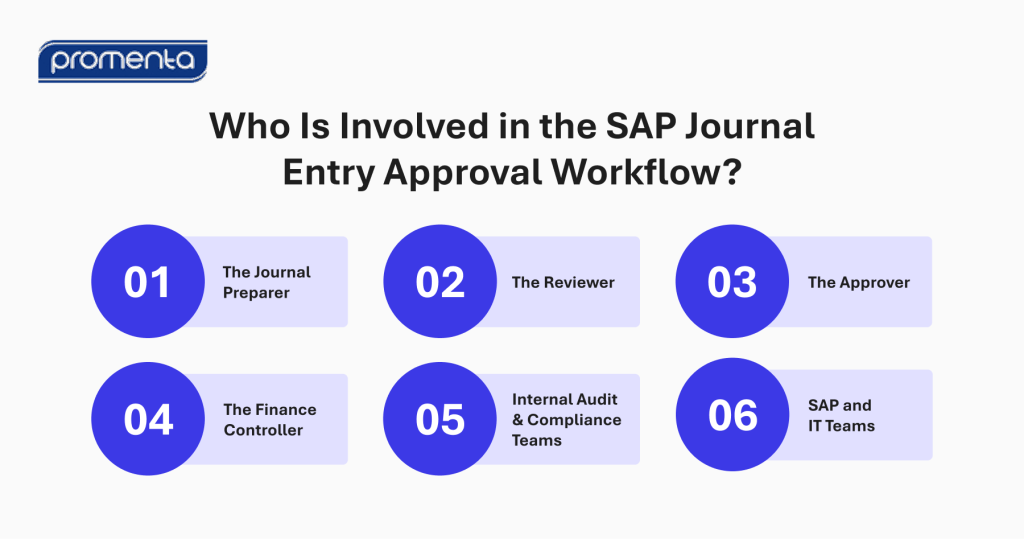
1. The Journal Preparer
The preparer is the finance user responsible for creating and submitting the journal.
Their responsibilities may include:
- Preparing the journal
- Providing accurate information
- Attaching supporting documentation
- Submitting the journal
- Responding to requests for changes
The preparer may use Excel or another familiar tool as part of the preparation process.
2. The Reviewer
The reviewer assesses the journal for accuracy, completeness, and business rationale.
Depending on the organisation’s control framework, the reviewer may be separate from the final approver.
The review process may focus on whether:
- The journal is complete
- The accounting treatment is appropriate
- The supporting evidence is sufficient
- The transaction has a clear business justification
3. The Approver
The approver authorises the journal in accordance with organisational policies and approval requirements.
The approver may be responsible for confirming that:
- The journal is appropriate
- The supporting evidence is sufficient
- The accounting treatment is correct
- Required controls have been followed
4. The Finance Controller
The Finance Controller may have oversight of the overall journal process.
Their responsibilities may include ensuring that the workflow aligns with:
- Financial governance requirements
- Internal control frameworks
- Approval policies
- Financial close procedures
5. Internal Audit and Compliance Teams
Internal audit and compliance teams may not approve individual journals as part of the normal workflow.
Instead, they may assess whether the controls surrounding the process are effective.
They may be interested in:
- Approval evidence
- Segregation of duties
- Audit trails
- Supporting documentation
- Policy compliance
6. SAP and IT Teams
SAP and IT teams may support the technical environment in which the workflow operates.
Their responsibilities may include:
- Workflow approval routing adjustments
- Security
- Integration
- User access
- System maintenance
A well-designed workflow should provide finance teams with appropriate flexibility to manage defined workflow requirements without requiring every change to become a technical IT project.
How Approval Routing Works
Not every journal requires the same approval path.
A robust workflow should therefore be configurable to reflect the organisation’s financial control framework.
Routing may be based on:
- Value thresholds
- Journal category
- Legal entity
- Cost centre
- General ledger account
- Department
- Location
- Risk level
For example, a low-value journal may not require any approval at all or a straightforward single approval, while a high-value or higher-risk journal may require additional levels of review.
Configurable routing helps ensure that:
- The right people receive the right approvals
- Approval processes are standardised
- Manual routing is reduced
- Governance requirements are embedded into the workflow
This also makes it easier for organisations to adapt the workflow as their structures, policies, and requirements change.
Limitations of Native SAP Journal Approval Workflows
While SAP provides extensive functionality for financial management, organisations may still encounter challenges when trying to manage the complete journal entry workflow.
The Excel disconnect
Finance users may be comfortable preparing journal entries in Excel. However, some native workflows may require users to leave this familiar preparation environment and move into rigid transaction codes or external processes to enter journal data and trigger approvals.
This can create friction in the user experience.
The issue is not Excel itself. The challenge is creating a seamless and secure integration between Excel journal preparation and SAP, including a controlled approval process.
Post-approval processing failures
If validation takes place late in the process, errors may only surface after a journal has completed multiple stages of approval.
This can lead to:
- Rejected postings
- Rework
- Approval process restarts
- Delays to the financial close
Early validation and posting simulation can help identify issues before the journal progresses through the complete approval cycle.
Complex configuration landscapes
Changes to routing rules, approval groups, or delegations may require significant technical involvement in some environments.
For finance teams, this can make it more difficult to adapt the workflow quickly when:
- Approval responsibilities change
- Organisational structures change
- Staff are absent
- Thresholds are updated
A more flexible approach can allow authorised users to manage relevant approval teams without requiring an IT ticket for every change.
The Role of Automation in SAP Journal Approval
Automation can strengthen the journal approval process in several ways.
Reduced approval delays
Automated routing ensures that journals are directed to the relevant people without relying on manual email coordination.
Improved visibility
Finance teams can see where journals are in the approval lifecycle and identify outstanding actions.
Stronger controls
Approval rules, validation requirements, and segregation-of-duties controls can be built into the workflow.
Better documentation
Supporting documents can remain connected to the journal throughout the process.
Improved auditability
The workflow creates a record of relevant actions, decisions, and approvals.
Reduced manual process interaction
Finance users spend less time manually tracking approvals and following up with stakeholders.
Some workflow solutions can also connect familiar preparation tools directly to the approval process. For example, an Excel Send-to-Workflow function can package the journal request, attachments, and justification and submit them into the controlled workflow.
Self-service configuration can also allow authorised users to manage approval groups, thresholds, and substitute approvers without requiring an IT ticket for every adjustment.
Why Keeping the Workflow Within SAP Matters
The location of the journal workflow is an important consideration for organisations managing sensitive financial information.
Moving critical financial data into disconnected external platforms can introduce:
- Additional data movement
- Integration complexity
- More systems to govern
- Security considerations
- Fragmented audit records
Keeping the workflow within the SAP environment can provide several advantages.
Reduced movement of sensitive data
Critical financial information can remain within the SAP environment rather than being transferred unnecessarily to an external platform.
Improved security
The workflow can operate within the organisation’s existing SAP environment and security framework.
Consistency with SAP authorisations
The process can align with existing SAP authorisation structures and financial controls.
Centralised control
Journal information, approvals, documentation, and workflow history can remain connected.
Reduced reliance on external systems
Organisations can strengthen journal approval processes without introducing a separate external cloud platform for critical financial workflows.
The key message is simple:
- Organisations can strengthen journal approval without moving critical financial data into an external cloud platform.
What Makes an Effective SAP Journal Entry Approval Workflow?
When evaluating an SAP journal entry approval workflow, organisations should consider whether the solution provides:
- Configurable approval hierarchies
- Clear role-based responsibilities
- Automated routing
- Validation controls
- Early posting simulation
- Supporting document and attachment functionality
- Real-time workflow visibility
- Clear rejection and resubmission processes
- Complete audit trails
- SAP integration
- Secure data handling
- Support for high-volume journal activity
- Flexible configuration of approval groups, thresholds, and substitutes
The most effective workflow is one that provides the appropriate balance between control and usability.
It should help finance teams work efficiently while ensuring that the organisation’s financial governance requirements are consistently applied.
Conclusion
An SAP journal entry approval workflow provides a structured framework for managing the journey from journal preparation to final posting.
The process can be summarised as:
Prepare → Validate → Submit → Route → Review → Approve → Post → Audit
Each stage contributes to the overall control and efficiency of the journal process.
A well-designed workflow can help organisations improve:
- Financial control
- Approval efficiency
- Data integrity
- Compliance
- Audit readiness
- Financial close performance
Importantly, automation does not need to replace familiar preparation tools. For finance teams that use Excel to prepare journal information, the goal is to bring greater structure, visibility, and control to the process that surrounds the spreadsheet.
For organisations evaluating their current journal entry processes, useful questions include:
- Have we eliminated all journal risk?
- Is there a risk we will fail our next audit?
- Where is each journal in the process?
- Who owns the next action?
- Has the correct approval been completed?
- Is supporting documentation available?
- Can the full audit trail be demonstrated?
See how a manual journal moves from Excel preparation to a posted SAP document with live validation, controlled approval, segregation of duties, and a continuous audit trail attached to the entry.
To learn more about how an SAP journal entry workflow can eliminate journal risk and audit findings, strengthen financial controls, improve audit readiness, automate the journal lifecycle for a faster financial close within SAP, explore Promenta’s SAP Journal Entry Workflow Solution.
Frequently Asked Questions
What is SAP journal entry workflow?
An SAP journal entry workflow is a structured process that manages a journal entry from preparation and submission through validation, approval, posting, and audit trail creation. It helps standardise the process and provide visibility into the status and ownership of each journal. It eliminates journal risk and audit findings, strengthens financial controls, improves audit readiness and automates the journal lifecycle for a faster financial close within SAP. Explore Promenta’s SAP Journal Entry Management Workflow Solution.
How does journal entry verification work in SAP S/4HANA?
Journal entry verification can involve checking that required information is complete, validating the entry against relevant financial rules, and confirming that the journal meets defined approval and control requirements. A workflow solution can also support posting simulation before the journal progresses through the approval process.
How do finance teams configure journal entry approval workflows in SAP?
Journal approval workflows can be configured according to the organisation’s control requirements. Routing may be based on factors such as company code, value, general ledger account, department, journal type, or other relevant fields.
What is the difference between manual and automated journal entry approval?
Manual journal entry approval often relies on email, spreadsheets, and individual follow-up to route and track journals. Automated approval uses a structured workflow to route journals, apply controls, record decisions, track status, and maintain an audit trail.
What are the different types of workflow steps in SAP?
Journal workflow steps may include preparation, submission, validation, approval routing, review, approval, rejection, amendment, resubmission, posting, and audit reporting. The exact workflow will depend on the organisation’s processes and control requirements.
How do you review a journal entry workflow?
Finance and control teams can review a journal entry workflow by assessing whether it provides appropriate approval controls, visibility, documentation, segregation of duties, validation, and auditability. They should also assess whether the process supports the organisation’s financial close requirements and SAP environment.