
SAP Journal Entry Management in S/4HANA Private Cloud: What Finance Teams Need to Know

Understand how SAP journal entry management in S/4HANA Private Cloud changes after migration from SAP ECC, including Universal Journal, workflow controls, security responsibilities, and audit considerations.

Finance teams moving from SAP ECC to S/4HANA Private Cloud often treat the transition as an infrastructure project. But SAP journal entry management in S/4HANA Private Cloud changes more than the technical layer.

The migration changes the finance data model, introduces new workflow options, and changes how responsibility is divided between SAP and the customer. SAP manages the underlying cloud platform, but decisions regarding finance users, application authorisations, segregation of duties, and journal controls remain with the organisation.

SAP journal entry management in S/4HANA Private Cloud requires finance teams to reassess how journals are prepared, validated, approved, posted, and evidenced. For organisations evaluating SAP journal entry management in S/4HANA Private Cloud, that review should cover both native SAP capabilities and the wider journal workflow.

SAP S/4HANA Cloud Private Edition is a single-tenant deployment operated by SAP on a hyperscaler and delivered through RISE with SAP. It retains classic ABAP extensibility and supports system conversion from SAP ECC, making it suitable for organisations with complex finance processes that require greater flexibility.

This article explains what SAP journal entry management in S/4HANA Private Cloud supports natively, how the Universal Journal changes journal processing, how responsibilities differ from SAP ECC, what security considerations apply, and what finance teams should resolve before migration.

What Is SAP Journal Entry Management in S/4HANA Private Cloud?

SAP journal entry management in S/4HANA Private Cloud is the end-to-end process of preparing, validating, approving, posting, and evidencing manual journal entries within a single-tenant SAP-operated S/4HANA environment. While SAP manages the technical platform under RISE with SAP, the customer retains full responsibility for application-level controls: user access, authorisations, segregation of duties, and approval governance.

SAP journal entry management in S/4HANA Private Cloud is the controlled process of preparing, validating, approving, posting, and evidencing manual journal entries within a single-tenant SAP-operated S/4HANA environment.

Although SAP operates the technical platform, the customer retains the application-level controls (including user identities, application authorisations, roles, and access permissions).

Essentially, the customer is responsible for determining who can prepare a journal, who can approve it, who can post it, and whether the organisation can demonstrate the complete history of the transaction.

A cloud operating model does not decide whether a journal followed the correct approval path or whether segregation of duties was enforced. So, migrating to Private Cloud does not automatically resolve journal-related compliance risks.

Effective SAP journal entry compliance and management depends on three connected areas:

● Preparation and validation: ensuring journal data is complete and checked against relevant SAP rules before submission.

● Approval and segregation of duties: ensuring the right individuals review and approve journal entries before posting. See how the SAP journal entry approval workflow operates natively in S/4HANA, consistent with segregation of duties requirements.

● Evidence and reporting: maintaining a clear record of actions, decisions, supporting documentation, and posting history.

How the Universal Journal in S/4HANA Changes Journal Entry Management

The SAP Universal Journal (table ACDOCA) is a single line-item structure in S/4HANA that consolidates financial and management accounting postings, replacing the separate tables used in SAP ECC such as BSEG, BKPF, and FAGLFLEXA.

One of the most significant changes when moving from SAP ECC to S/4HANA is the introduction of the SAP Universal Journal in S/4HANA. The Universal Journal provides a common line-item foundation for financial and management accounting.

In SAP ECC, financial and management accounting information was stored across separate tables, including general ledger, controlling, asset accounting, and material ledger structures. In S/4HANA, accounting-relevant postings are recorded in the Universal Journal, creating a single source of line-item data across financial and management accounting.

For finance teams, this simplifies reporting and reduces the need for reconciliation between financial accounting and controlling data. Reporting can access detailed line-item information directly rather than relying on separate aggregated views.

However, a manual journal still depends on human judgement. Someone must determine the accounting treatment, select the relevant accounts and cost objects, provide supporting justification, and ensure the entry is appropriate before posting.

Thus, while a unified data model improves visibility after posting, it does not determine whether the journal was correctly reviewed, approved, or supported before it reached the ledger.

One technical consideration remains important for high-volume journal activity. The applicable SAP document and posting-interface limits should be confirmed for the target S/4HANA release and posting scenario, because larger journal requests may require splitting before posting.

Therefore, it is important to assess how the organisation’s journal workflow handles large-volume entries while maintaining validation, approval controls, and audit visibility.

How Journal Entry Management in S/4HANA Private Cloud Differs from SAP ECC

See how Promenta keeps journal preparation, validation, approval and audit evidence inside SAP.

The differences between SAP ECC and S/4HANA Private Cloud are best understood across four areas:

Finance data model

The move from separate ECC tables to the Universal Journal changes how accounting information is stored and reported. Existing SAP journal entry upload templates, reports, and custom programmes may need review to ensure they align with the new data model.

The move from separate ECC tables to the Universal Journal changes how accounting information is stored and reported. Existing SAP journal entry upload templates, reports, and custom programmes may need review to ensure they align with the new data model.

Workflow capability

S/4HANA provides standard journal entry verification workflow capabilities that were not part of the classic SAP ECC finance baseline.

Many ECC organisations managed journal approvals through custom development, email-based processes, or third-party tools. During migration, finance teams must determine whether standard S/4HANA capability supports their requirements or additional controls are required.

Security and infrastructure ownership

In SAP ECC, organisations managed the full technical environment. In Private Cloud, SAP manages the infrastructure and platform, while the customer must clearly define:

●  Who can prepare journals

●  Who can approve journals

●  Who can post journals

●  How segregation of duties is enforced

●  How privileged access is controlled

Add-on lifecycle management

Any third-party solution supporting the journal process also requires careful planning.

Under the RISE with SAP model, customers and solution providers remain responsible for ensuring that add-ons are installed, supported, and maintained appropriately through future upgrades.

The key consideration is not only whether a solution works today, but whether the vendor has a clear approach for supporting the organisation’s S/4HANA Private Cloud lifecycle.

What Journal Entry Capabilities Does SAP S/4HANA Private Cloud Support Natively?

Before evaluating additional solutions, finance teams should first consider the capabilities already available within SAP journal entry management in S/4HANA Private Cloud.

SAP S/4HANA Private Cloud provides native applications for creating, uploading, reviewing, and verifying journal entries. It also includes standard workflow capabilities for journal verification, allowing submitted entries to be routed based on defined conditions before posting.

The standard journal approval workflow in S/4HANA supports core verification and approval requirements, with routing based on factors such as company code, document type, and amount thresholds.

However, the suitability of the native capability depends on the organisation’s process requirements.

For some finance teams, the standard SAP functionality for journal entry upload in S/4HANA may provide sufficient control. Others may require additional capabilities around:

●  Excel-based journal preparation connected to live SAP data

●  Organisation-specific approval structures

●  Additional supporting documentation requirements

●  Reporting across submitted, rejected, and amended journals

●  More complex journal lifecycle tracking

The evaluation should therefore begin with the organisation’s control requirements — rather than a tool list — before assessing the best automated journal entry software for the target environment. For finance teams, cloud-ready SAP journal management means validating the target release, architecture, security model, workflow, and upgrade path—not simply confirming that a tool can connect to S/4HANA.

What Data Security and Access Controls Apply to Journal Entries in S/4HANA Private Cloud?

Security considerations for journal processing extend beyond user permissions. Finance teams should also assess how journal data moves through the process, where approvals are executed, and how the workflow aligns with the organisation’s SAP security model.

For journal processes, key considerations include:

●  Whether journal preparation and approval remain connected to SAP authorisations

●  Whether sensitive financial data moves outside the SAP environment

●  Whether external platforms introduce additional integrations or audit requirements

●  Whether workflow activity remains visible within the SAP landscape

In S/4HANA Private Cloud, SAP is responsible for infrastructure, platform availability, and system operations. The customer remains responsible for: defining who can prepare, approve, and post journals; configuring and maintaining SAP user roles and authorisations; enforcing segregation of duties; and retaining audit evidence within the SAP environment. Migrating to Private Cloud does not transfer these responsibilities to SAP.

A journal process operating within SAP can continue using existing SAP security structures, financial configuration, and audit mechanisms. This is relevant when evaluating SAP S/4HANA private cloud finance tools because the location of journal data, approvals, and evidence affects the surrounding governance model. Processes involving external platforms may require additional controls around data movement, system access, integrations, and governance.

Which Journal Entry Tools Can Run in SAP S/4HANA Private Cloud?

SAP ECC mainstream support ends 2027. See how Promenta keeps journal control inside SAP through the transition.

Organisations evaluating an SAP S/4HANA PCE journal tool should look beyond basic journal upload. The relevant question is whether the solution supports the required journal lifecycle in the target Private Edition architecture.

S/4HANA Cloud Private Edition retains ABAP extensibility, allowing SAP-compatible partner solutions to operate within the SAP environment.

GLSU can support qualifying S/4HANA Private Cloud configurations, but technical support should be assessed against the organisation’s specific GLSU version, S/4HANA release, SAP-side components, and target architecture. Teams moving toward Fiori-led or browser-based finance operations should also review any remaining Excel, Windows desktop, or SAP GUI dependencies.

When assessing potential solutions, finance and SAP teams should consider:

●  Whether the solution is supported specifically for S/4HANA Cloud Private Edition

●  Whether the deployment approach aligns with the SAP-managed environment

●  Whether the solution supports the organisation’s journal approval, documentation, and reporting requirements

●  How the vendor supports future SAP upgrades

This is particularly important for organisations planning a RISE with SAP journal workflow, where long-term supportability matters as much as initial deployment. Buyers should confirm the specific S/4HANA release, solution version, SAP-side prerequisites, deployment architecture, and vendor support position before migration.

A tool that supports journal upload alone may address data movement. A complete journal process requires organisations to consider the wider lifecycle:

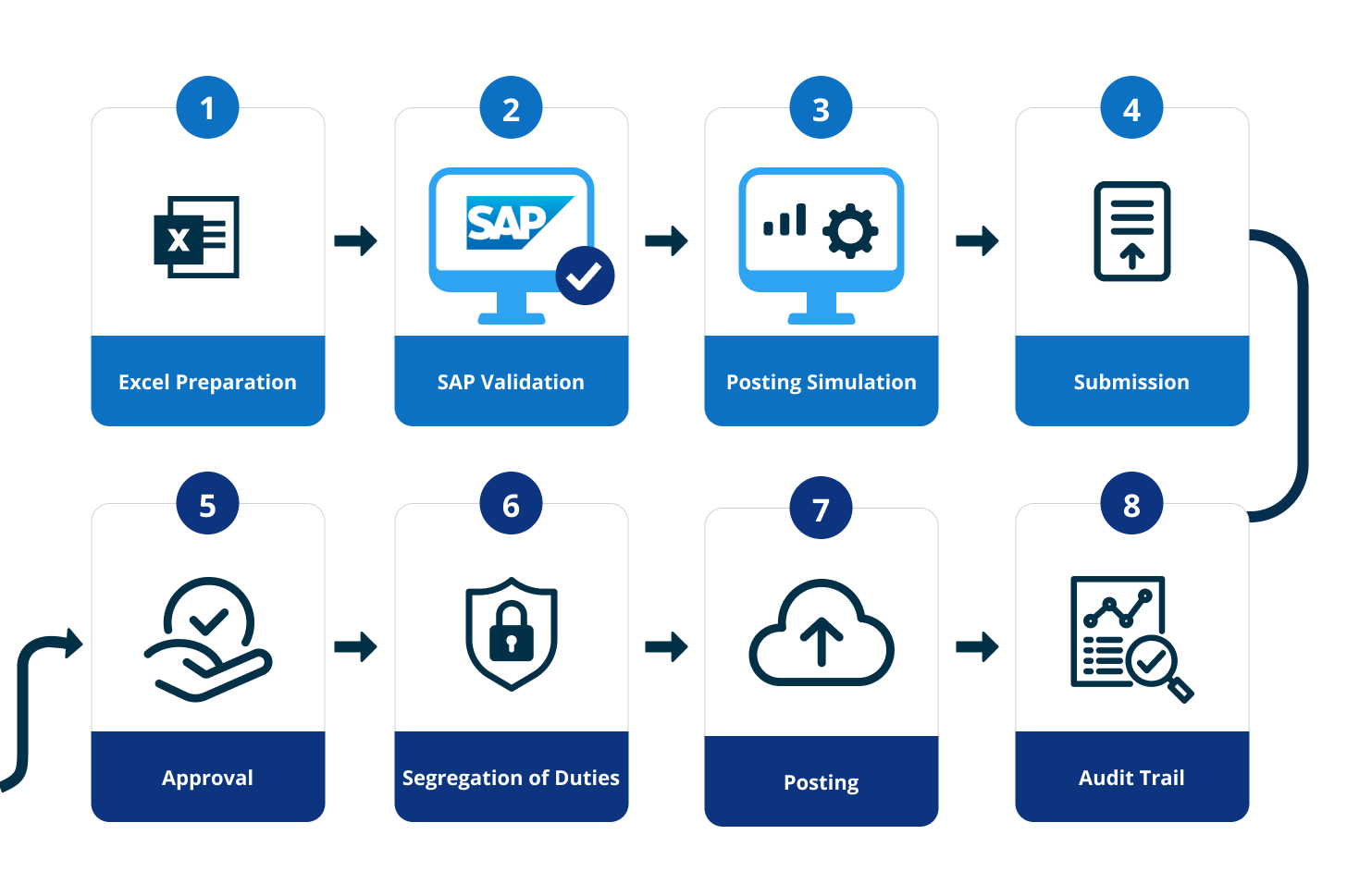
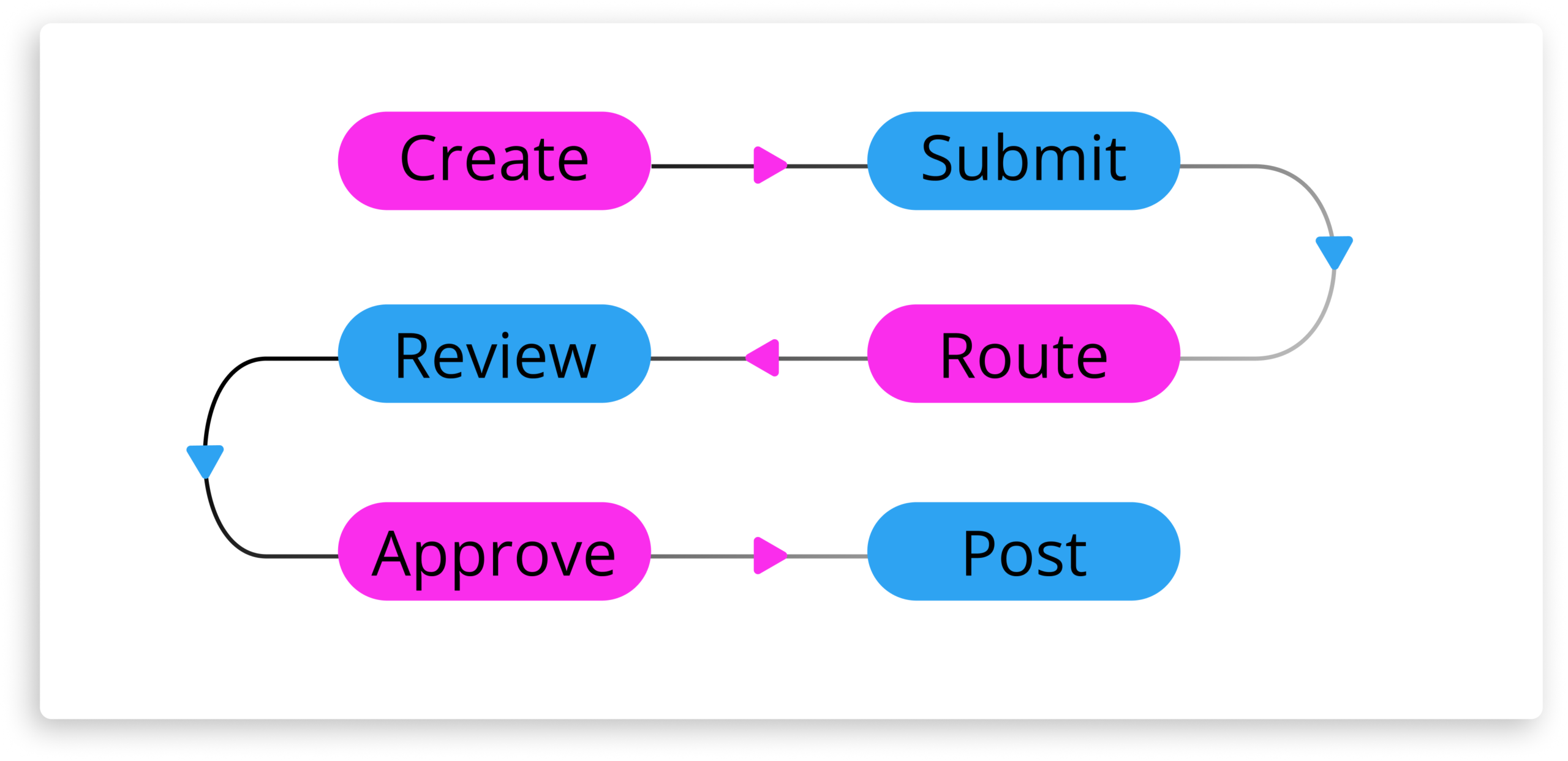
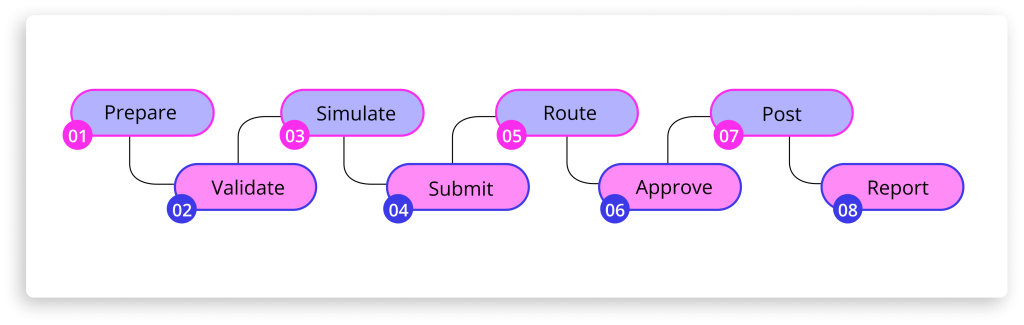
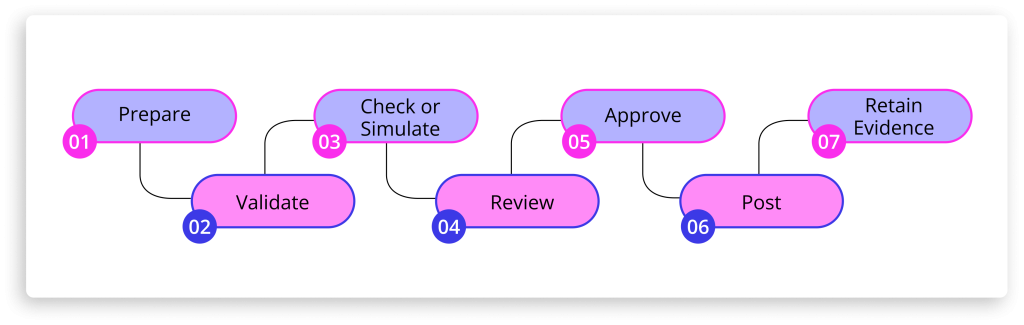
Prepare → Validate → Submit → Approve → Post → Audit

How Promenta Supports Journal Entry Management in S/4HANA Private Cloud

Promenta provides an SAP journal entry management solution that runs within SAP ECC and SAP S/4HANA environments, including supported RISE with SAP Private Edition deployments.

The approach allows finance teams to continue using familiar Excel-based journal preparation while connecting the process directly with SAP validation, approval controls, and posting. Promenta Journal Management can also work with the existing GLSU Excel sheet format, reducing unnecessary end-user disruption during migration.

Even in high-volume journal scenarios, Promenta Journal Management supports large journal requests that exceed applicable SAP document line limits. Where a journal exceeds the applicable limit, the solution can automatically split the entry across balancing accounts, allowing the resulting SAP documents to be posted through the controlled process.

Key capabilities include:

●  SAP-integrated Excel preparation with live SAP data validation

●  Posting simulation before the journal reaches final approval

●  Configurable approval routing based on business requirements

●  Separation between journal preparation and approval responsibilities

●  Supporting documentation connected to the journal request

●  Audit history maintained within the SAP environment

Because the process operates within SAP, organisations can continue using their existing SAP security model, authorisations, and financial configuration rather than introducing a separate external workflow environment for the core journal process.

For finance teams planning a financial close S/4HANA private cloud transformation, this provides continuity between the existing SAP operating model and the future-state finance process.

S/4HANA Private Cloud Journal Migration Checklist

Before moving journal processes from SAP ECC to S/4HANA Private Cloud, finance and SAP teams should review the following areas to ensure the future-state process is aligned with business requirements.

Area to reviewKey questions before migration
Current journal processWhich journal activities rely on SAP standard functionality, custom developments, spreadsheets, email approvals, or external tools?
Which processes require redesign before migration?
SAP standard capabilitiesDo the native SAP journal entry management capabilities in S/4HANA Private Cloud support current approval structures, documentation requirements, and reporting needs?
Workflow and controlsDoes the future-state process support the required approval routing, segregation of duties, and audit requirements?
Data and integrationsAre there external systems, interfaces, or manual steps involved in the current journal process that need to be reviewed before migration?
Security and authorisationsHave SAP roles, journal-related access, and posting responsibilities been reviewed for the S/4HANA environment?
Third-party solutionsAre existing or planned journal tools compatible with S/4HANA Cloud Private Edition? Has the upgrade and support approach been confirmed, including applicable licence and migration rights?
High-volume journalsCan the future-state process support large journal volumes, including scenarios requiring document splitting due to SAP line-item limits?

A structured review of these areas helps organisations identify where existing ECC journal processes can be retained, where changes are required, and where additional capabilities may be needed before migration.

Conclusion

An SAP ECC to S/4HANA Private Cloud migration is an opportunity to reassess how journal entry processes operate, rather than simply recreating existing ECC practices in a new environment.

Usually, the migration will expose decisions that may previously have been embedded in custom developments, spreadsheets, email approvals, or individual user practices. These decisions include where journals are prepared, how validation occurs, who owns approval responsibility, and how evidence is retained for audit.

The right future-state approach will depend on the organisation’s complexity, control requirements, and the level of flexibility needed after migration.

For organisations evaluating SAP journal entry management S/4HANA private cloud options, the focus should be on building a future-state process that supports both operational efficiency and long-term control. The appropriate journal entry tool for SAP S/4HANA Private Cloud will depend on the organisation’s process complexity, control requirements, deployment architecture, and long-term operating model.

Frequently Asked Questions

SAP S/4HANA Private Cloud supports journal creation, upload, review, and verification through standard applications. It also provides workflow capability for journal verification based on configured conditions such as company code, document type, and amount thresholds.

Organisations requiring additional preparation, approval, or reporting capabilities can evaluate SAP-compatible extensions.

The main differences are the Universal Journal data model, availability of standard journal verification workflow, SAP-managed infrastructure, and the continued customer responsibility for application security and authorisations.

The journal control process itself remains a finance governance decision. In practice, finance teams manage journals through preparation, SAP validation, verification or approval, posting controls, segregation of duties, and audit evidence.

Yes. SAP S/4HANA Private Cloud includes standard journal entry verification workflow capabilities that can route entries for review and approval based on configured rules.

The suitability of the workflow depends on the organisation’s approval structure and control requirements.

There is no single vendor-neutral list that answers this for every S/4HANA Private Cloud landscape. Buyers should verify the current certification or support status for the specific product and version, target S/4HANA release, deployment architecture, and upgrade requirements.

The relevant consideration is not only whether a tool can upload journals, but whether it supports the complete journal lifecycle.

The Universal Journal consolidates accounting-relevant postings into a single line-item structure, improving reporting and reducing reconciliation requirements between financial accounting and controlling.

It changes how journal data is stored, but does not replace approval, authorisation, or audit requirements.

SAP manages the technical platform, while customers remain responsible for application roles, user access, authorisations, and segregation-of-duties controls.

For journal processes, organisations must continue managing who can prepare, approve, and post entries.

No. In S/4HANA Private Cloud, SAP manages the infrastructure and platform under RISE with SAP. The customer remains responsible for application-level controls, including user access, authorisations, segregation of duties, approval governance, and audit evidence.

SAP S/4HANA Private Cloud includes a standard journal entry verification workflow, configurable through the Manage Workflows for Journal Entry Verification app in SAP Fiori. It routes journal entries to designated approvers based on conditions such as company code, document type, and amount. Organisations with more complex approval structures may require additional controls.

GLSU can support qualifying S/4HANA Private Cloud configurations, but compatibility depends on the specific GLSU version, S/4HANA release, and deployment architecture. Teams moving toward Fiori-based or browser-based operations should review GLSU’s dependencies on SAP GUI and Windows desktop environments before migration.


See how Promenta keeps journal preparation, validation, approval and audit evidence inside SAP.

SAP Journal Entry Automation Software: Five Options to Consider in 2026

Quick answer: SAP journal entry automation software ranges from spreadsheet-led posting tools (such as Process Runner GLSU) to SAP-native journal workflow solutions (such as Promenta) to broader financial-close platforms (such as BlackLine and HighRadius). The right choice depends on whether the requirement is efficient SAP data entry, a controlled journal lifecycle inside SAP, or multi-process close automation across several ERPs.

Every vendor promises faster journal processing, fewer errors and a better-controlled financial close. For finance teams evaluating SAP journal entry automation software, the useful comparison goes beyond whether a product can move journal data into SAP.

The key consideration is how the complete journal lifecycle is managed: where preparation takes place, when SAP validation occurs, how approvals are enforced, where supporting evidence is retained and how the final posting is controlled.

That does not mean every organisation needs the same type of product. A finance team looking primarily for faster Excel-to-SAP uploads has a different requirement from one seeking a controlled journal workflow, broader record-to-report automation or an enterprise financial-close platform.

This guide evaluates five SAP journal entry tools against a common set of criteria and identifies where each approach may be the strongest fit for teams comparing top SAP journal automation options in 2026.

This guide is written for SAP finance, IT, and project teams evaluating SAP journal entry automation software for the first time, switching from an existing tool, or preparing for an S/4HANA migration.

Why SAP Journal Automation Is Its Own Category

SAP journal automation is not simply a faster way to upload accounting entries.

A journal must comply with the organisation’s SAP master data, account structures, posting periods, authorisations, financial configuration and applicable validation rules.

The available products address these requirements through different architectures.

While some operate within the SAP landscape, some centre the user experience on Excel. Others manage journals through broader finance platforms connected to SAP.

The products differ in where the core journal process operates and how validation, workflow and evidence are managed.

This determines several practical considerations:

Seven Criteria for Evaluating SAP Journal Entry Automation Software

1. SAP Compatibility, Certification and Posting Integrity

Buyers should distinguish between SAP partnership status, product compatibility and a specific SAP product or integration certification. These terms are not interchangeable.

2. Where Validation Happens and When

A journal can pass spreadsheet-level checks and still fail against SAP-specific requirements.

So, buyers should assess if the solution can identify relevant SAP issues while the journal is being prepared or only when the final posting is attempted.

They should also examine which checks use live SAP master data or configuration, which rely on rules maintained within another platform, and whether a posting simulation or equivalent SAP check is available before approval.

Validation in the early stages can reduce rework, but the scope of that validation should be verified.

3. Segregation of Duties Enforced Through Workflow

A controlled process should be capable of separating journal preparation, approval and posting according to the organisation’s policy.

Finance teams should evaluate whether the solution can :

The architecture may differ by product. Some provide workflow within the journal tool itself, while others use custom in-house built workflows or a broader external finance platform.

The final SAP financial document is only one part of the journal history.

Finance and audit teams may also require preparation details, supporting evidence, validation results, approval decisions, rejection and resubmission history, timestamps and final posting information.

Buyers should establish which system holds this evidence and whether the complete journal lifecycle can be reconstructed without manually joining records from several locations. If the data remains scattered across spreadsheets, emails, and separate systems, reconstructing the full journal history becomes challenging during audit reviews.

5. High-Volume Journals and SAP Document Limits

For larger journals, buyers should test how each solution handles the “999-line rule” limits applicable to their own SAP environment, including document splitting, balancing, traceability between resulting SAP documents, error recovery and reprocessing.

6. S/4HANA Readiness and Upgrade Path

Organisations evaluating SAP S/4HANA journal entry software should consider how the solution fits into their longer-term SAP roadmap, including how it handles ECC-to-S/4HANA migration.

Key questions include :

A solution that aligns closely with the SAP environment may reduce the complexity of maintaining workflow, validation, and audit controls during future changes.

7. Total Cost of Ownership and Infrastructure

Licence price is only one part of total cost.

Finance and IT teams should also assess required servers or cloud services, SAP components, middleware, connectors, desktop software, security administration, integration support, upgrade testing and audit scope.

Two solutions may provide similar journal capabilities while creating very different operating models for IT and finance. See how manual journal entry risk factors into the total cost assessment.

This is very important and often overlooked.

Journal Upload Tool vs Journal Workflow vs Broader Finance Automation

See how Promenta keeps journal preparation, validation, approval and audit evidence inside SAP.

SAP journal entry automation software falls into three categories :

Before comparing SAP journal automation solutions, it is important to separate categories that are often conflated: journal upload tools, journal workflow, and broader finance automation solutions.

A journal upload tool primarily improves the movement of prepared data into SAP. It may also provide SAP-aware validation and other controls. These tools are often considered alongside SAP journal posting automation software when finance teams define the scope of automation they need.

A journal workflow solution adds structured submission, approval routing, segregation of duties, supporting documentation and lifecycle reporting around the journal.

Broader SAP financial close automation and record-to-report platforms can go further, automating journal creation alongside reconciliations, accruals, intercompany activity, close orchestration and other finance processes.

The right solution fit therefore depends on the problem the organisation is trying to solve.

How These SAP Journal Entry Automation Tools Were Selected and Compared

The five solutions listed below were selected because their current first-party documentation identifies SAP journal entry, Excel-to-SAP, journal workflow or broader record-to-report capabilities relevant to enterprise finance teams. This is not an exhaustive market list.

The product profiles and comparison table apply a consistent set of dimensions derived from the seven criteria above, providing a journal entry automation SAP comparison for finance teams assessing architecture, controls and operating model.

Five SAP Journal Entry Automation Software Options to Consider in 2026

1. Promenta

Primary use case: SAP-based controlled journal lifecycle

Promenta is an SAP partner and its Journal Entry Workflow is designed for SAP ECC and SAP S/4HANA.

It combines browser- or Excel-based preparation with SAP-integrated validation, workflow and posting controls.

Journal requests are validated against SAP finance rules, along with a full posting simulation before approval, configurable routing, supporting attachments, segregation-of-duties controls and process/audit reporting. Journals above 999 line items are automatically supported.

Promenta’s core journal workflow is deployed within the customer’s SAP landscape rather than operating as an external financial-close platform. This allows teams to use existing SAP users, authorisations, finance configuration and master data directly and provides IT with a very robust security and compliance posture.

Customers should confirm the precise implementation architecture, including Excel Add-In communications, document storage and any optional components relevant to their deployment.

2. Process Runner / GLSU (InsightSoftware)

Primary use case: spreadsheet-led SAP journal uploads

For teams researching GLSU alternatives in 2026 or Process Runner alternatives, the relevant comparison is whether the requirement is primarily spreadsheet-led SAP posting or a broader controlled journal lifecycle.

For organisations requiring approval workflow, insightsoftware documents integration with Easy Workflow (EWF). Its current Process Runner documentation describes Easy Workflow as a separately purchased add-on, while the GLSU documentation describes EWF as another insightsoftware solution with additional functionality available when the two are used together.

Thus, organisations should establish which Process Runner and workflow components are required for their intended control model. Licensing, required components, hosting arrangements and implementation scope should be confirmed directly with InsightSoftware.

3. Redwood Finance Automation [source]

Primary use case: broader record-to-report automation and orchestration

Redwood Finance Automation addresses journals as part of a wider record-to-report automation model.

Current Redwood documentation describes automating journal creation from data acquisition and calculation through validation, approval and SAP posting. It also describes process-level logging and audit controls, alongside automation for reconciliations, accruals, provisions, intercompany processing and other close activities.

Redwood describes Finance Automation as a cloud-based platform that integrates with SAP and other enterprise systems.

For buyers, the relevant comparison with Promenta is therefore one of scope and architecture: a broader cross-process orchestration platform versus a solution concentrated specifically on the SAP journal lifecycle.

4. Precisely Automate (formerly Winshuttle) [source]

Primary use case: general Excel-to-SAP process automation

Precisely Automate covers a broader range of SAP data and business processes, including journal entry management. For teams evaluating a Precisely SAP journal tool, the relevant questions include how its broader automation and workflow components can be configured for the organisation’s journal process.

Automate Studio allows business users to execute SAP processes from Excel and includes validation against SAP before data is posted. Precisely identifies journal vouchers among the transactional-data use cases supported by Studio.

Automate Evolve adds workflow, forms, role-based controls and audit-trail capabilities, and Precisely documents Excel workflow scenarios that route data and scripts through approval processes.

Precisely also publishes specific current SAP certification information for Studio and Evolve releases, including 2026 product versions.

For finance teams, the key evaluation is how the Studio and Evolve components can be configured for the organisation’s journal process, including approval, evidence, deployment and high-volume SAP posting requirements.

5. HighRadius [source]

Primary use case: broader financial-close platform

HighRadius offers dedicated journal-entry capabilities within its wider financial-close portfolio. For buyers comparing HighRadius journal SAP capabilities with other approaches, the key distinction is the role journal management plays within the broader financial-close platform.

The current journal product documentation describes journal preparation, pre-posting validation, rule-based approval hierarchies, direct ERP posting, recurring and batch journals, documented review history and audit trails.

HighRadius’ architectural model is ERP-agnostic and designed to integrate with multiple source and ERP systems.

SAP buyers should evaluate which journal validations use SAP-sourced information, where journal and supporting data reside during processing, how status is synchronised with SAP and which integration mechanisms are used for their environment.

SAP Journal Entry Automation Software: Side-by-Side Comparison by Criteria

SAP ECC mainstream support ends 2027. See how Promenta keeps journal control inside SAP through the transition.
SolutionPrimary use caseDeployment / operating modelSAP validationApproval workflowAudit evidenceHigh-volume handlingBuyer verification required
PromentaSAP journal workflow and controlCore workflow within customer SAP landscape; web interface with optional Excel Add-InSAP-integrated validation and posting simulation before approvalBuilt inWorkflow history, attachments and process reportingVendor documents >999-line supportCurrent SAP certification scope; precise implementation and optional-component architecture
Process Runner / GLSUExcel-led SAP financial posting
Excel-based GLSU interface connected to SAP; workflow available through Easy Workflow
Pre-validation against live SAP master dataEasy Workflow add-on; current vendor documentation states Process Runner Core is requiredConfirm required EWF evidence/reporting configurationVendor documents >1,000-line journalsLicences, EWF/components, hosting and complete workflow scope
Redwood Finance AutomationRecord-to-report execution and orchestrationCloud-based finance automation integrated with SAP and other systemsJournal validation and direct SAP posting documentedBuilt-in automated approvalsProcess logging and audit controlsHigh-volume journal use cases supported; confirm document-limit handlingExact SAP architecture, data movement, document splitting and commercial scope
Precisely AutomateGeneral Excel-to-SAP automation and workflow
Automate Studio plus optional/broader Evolve workflow components
SAP validation before posting documentedAvailable through Evolve workflowsWorkflow/audit capabilities documentedConfirm journal-specific line-limit handling
Exact SAP architecture, data movement, document splitting and commercial scope
Required components, deployment model and journal-specific configuration
HighRadiusEnterprise journal and financial-close automationERP-agnostic financial-close platform integrated with SAP/other ERPsPre-posting validation documented; confirm SAP-specific rule coverageBuilt inApproval history, timestamps and audit trailsRecurring and batch processing documented

Where Standard SAP Journal Processing Fits

Standard SAP journal entry capabilities remain the starting point for many organisations. Available functionality depends on the SAP product, edition and implementation.

Finance teams may also encounter SAP Fiori journal upload apps as part of their standard SAP journal-processing environment, or may use an SAP journal entry upload template as a starting point, while the Verify General Journal Entries process supports approval in relevant S/4HANA Cloud scenarios.

Here’s a side-by-side comparison of standard SAP journal processing vs. Promenta’s managed journal workflow :

CapabilityStandard SAP journal processingPromenta-managed journal workflow
PreparationSAP applications and supported upload templates, depending on editionBrowser or Excel Add-In connected to the journal workflow
ValidationSAP application/posting checks determined by the relevant processSAP-integrated validation plus posting simulation before workflow submission
ApprovalVerification workflows are available in relevant SAP scenarios; scope varies by product and configurationConfigurable journal-specific routing built into the Promenta process
EvidenceDepends on the SAP application and configured workflowJournal workflow history, attachments and process reporting maintained through the Promenta process
High-volume processingApplicable limits vary by posting interface and scenarioPromenta documents support for journals above 999 lines

How the Five Solutions Fit Different Requirements

There is no universal solution because these products solve different problems.

Promenta is designed for teams that need a controlled SAP journal lifecycle centred on SAP validation, approval, segregation of duties and connected audit evidence.

Process Runner GLSU fits organisations whose primary requirement is efficient spreadsheet-led SAP journal preparation, validation and high-volume posting.

Redwood fits organisations when journal automation is part of a wider record-to-report transformation covering multiple finance processes.

Precisely Automate fits organisations requiring broader Excel-to-SAP process automation and configurable workflows extending beyond journals.

HighRadius fits organisations when journal management needs to sit within a wider financial-close and reconciliation platform.

The final decision should come from testing each shortlisted architecture against the organisation’s actual SAP environment, journal volumes, approval policy, audit requirements and IT operating model.

Assess Your Current Journal Process

A useful starting point is to map one real journal from preparation through to posting and audit evidence.

Finance and SAP teams should establish where the journal is prepared, when it first encounters SAP validation, how approval is enforced, whether the preparer can bypass the workflow, where supporting evidence is stored and how the complete history would be produced for an auditor.

These solutions address different parts of the journal process. Promenta focuses on a controlled SAP journal lifecycle, including SAP-integrated validation, approval, posting and audit tracking. GLSU focuses on spreadsheet-led SAP financial posting, while Redwood and Precisely provide broader automation approaches. The relevant comparison depends on whether the requirement is journal lifecycle control, Excel-led SAP posting, broader record-to-report orchestration or wider SAP process automation.

Frequently Asked Questions

The required capabilities depend on the use case, but buyers should evaluate SAP compatibility, validation, approval workflow, segregation of duties, supporting evidence, audit reporting, high-volume processing, S/4HANA compatibility and the surrounding deployment architecture.

SAP certification is not the only factor determining whether a solution can support journal processing. A relevant SAP certification can provide evidence that a specific product or version has been tested within the scope of that certification. For organisations managing long-term SAP environments, certification may be an important consideration when assessing upgrade resilience and supportability.

A journal upload tool primarily helps transfer prepared journal information into SAP and may also provide SAP-aware validation. A journal workflow solution extends that process to submission, approval routing, segregation of duties, supporting documentation, posting control and lifecycle audit evidence. Broader record-to-report platforms may additionally automate journal creation and other close activities.

No. SAP line-item behaviour varies by product, posting scenario and interface. Current SAP S/4HANA documentation identifies a 999-line restriction for specific scenarios, including certain verification and reversal processes, while documenting different limits elsewhere. High-volume testing should therefore focus on the actual SAP landscape and posting process rather than treating 999 as one universal system limit.

Implementation timelines depend on factors such as number of company codes, approval complexity, SAP environment, integration requirements, and scope of journal processes being automated. A single implementation timeline cannot apply to every organisation. Finance and IT teams should evaluate effort based on their specific environment and control requirements.

A controlled SAP journal process should support segregation of duties, approval enforcement, supporting documentation, complete audit history, restricted posting access and reportable workflow activity. The objective is not simply to document that a review occurred, but to ensure that required controls operate consistently throughout the journal lifecycle.

SAP-native journal automation runs inside the customer’s own SAP ECC or S/4HANA system, using SAP’s existing master data, authorisations, validation rules, and finance configuration. No external servers, middleware, or separate security model is required. A third-party financial-close platform operates as a cloud application that connects to SAP via integration, which allows it to span multiple ERPs but means approvals, validation, and audit evidence are held outside SAP. The architectural choice affects total cost of ownership, upgrade exposure, and where audit evidence resides.

See how Promenta keeps journal preparation, validation, approval and audit evidence inside SAP.

GLSU and SAP S/4HANA: Compatibility, Architecture and Migration Considerations

GLSU supports SAP S/4HANA in qualifying on-premise and private-cloud environments, but support depends on the S/4HANA edition, GLSU version and target system architecture. Current published requirements state that SAP S/4HANA Cloud Public Edition is not supported.

For organisations moving from SAP ECC, the important question is therefore not only whether GLSU can continue to operate. Finance and SAP teams should also assess whether its SAP-side transport, Windows desktop, Excel and SAP GUI requirements align with their intended S/4HANA operating model.

This is particularly relevant for organisations moving towards Fiori-led access, tighter clean-core governance and browser-based financial workflows. This article examines GLSU SAP S/4HANA compatibility and compares its operating model with Promenta’s SAP-integrated journal-management architecture.

Key Takeaways

GLSU compatibility with SAP S/4HANA at a glance

Deployment editionPublished GLSU support positionPrincipal consideration
SAP ECCSupportedEstablished SAP-side transport, Excel add-in and desktop-client model
SAP S/4HANA On-PremiseSupported from release 1709 onwardsExisting customers using S/4HANA 1909 or later require at least GLSU 6.2c SAP/ABAP components
SAP S/4HANA Cloud Private EditionSupported in applicable configurationsConfirm the precise target landscape, product version and current certification scope
SAP S/4HANA Cloud Public EditionNot supported under current published requirementsThe existing SAP-side installation model is not supported in this edition

What does “S/4HANA compatible” actually mean?

See how Promenta keeps journal preparation, validation, approval and audit evidence inside SAP.

Process Runner GLSU—previously known as ZOption GLSU and now offered by insightsoftware—is an Excel-based tool used to prepare, validate and post financial transactions to SAP. For organisations researching ZOption GLSU and S/4HANA, the underlying operating model remains important: the product uses an Excel add-in together with SAP-side components installed by transport. 

Compatibility should be assessed at two levels.

The first is product support: does the installed GLSU version support the organisation’s target S/4HANA release and deployment edition?

The second is architectural fit: can the required transports, authorisations, desktop components and connection methods operate within the organisation’s target SAP landscape and governance model?

A product can be technically supported on S/4HANA while still requiring infrastructure or user access that an organisation intends to reduce after migration. This is why “supported” and “strategically aligned” are not necessarily the same conclusion.

What changes when GLSU moves from SAP ECC to S/4HANA?

For existing GLSU users, moving from ECC to S/4HANA does not automatically require the journal process to be rebuilt. However, a GLSU ECC vs S/4HANA assessment should account for the changes to the underlying finance environment, even where the familiar Excel preparation model and SAP-side installation continue in supported environments. 

However, an S/4HANA migration changes the underlying finance environment. The Universal Journal places ACDOCA at the centre of financial and controlling line-item data, while some ECC tables and behaviours are changed, replaced or made available through compatibility mechanisms.

Organisations should therefore revalidate the complete journal-posting path, including:

The current GLSU system requirements state that existing customers moving to S/4HANA 1909 or later require a minimum installation of GLSU 6.2c SAP/ABAP components. This GLSU SAP HANA version support requirement should be included in migration design and testing rather than treated as a post-go-live configuration task.

SAP GUI, Fiori and the end-user operating model

GLSU’s current requirements include supported versions of Microsoft Excel and SAP GUI on the user’s Windows environment. GLSU can also use RFC connectivity for direct Excel-to-SAP posting, so it would be inaccurate to describe the solution as relying exclusively on SAP GUI scripting.

Moving to S/4HANA does not itself remove SAP GUI. Many organisations continue to use classic SAP transactions alongside Fiori applications. The issue is instead whether the SAP GUI dependency for GLSU fits the organisation’s intended long-term access model. 

This becomes relevant where an organisation plans to :

GLSU provides some Fiori interoperability, including the ability to expose the ZGLSU transaction as a Fiori tile. However, insightsoftware’s documentation states that document drill-back does not work for customers using only SAP Fiori, and that some troubleshooting activities require SAP GUI access.

The practical question is therefore not “Does Fiori immediately break GLSU?” It does not. Organisations assessing a GLSU SAP Fiori alternative should instead consider whether maintaining the necessary SAP GUI and Windows desktop components remains consistent with their target user experience and endpoint strategy.

Transports, clean core and RISE with SAP

SAP S/4HANA Cloud Private Edition allows customers greater flexibility than the public-cloud edition, including the use of qualifying third-party solutions and extensions. GLSU on S/4HANA private cloud can therefore operate in supported configurations where the relevant product and landscape requirements are met. 

Clean core should not be interpreted as meaning that every extension must run on SAP BTP or that every on-stack extension is prohibited. SAP recognises both on-stack and side-by-side extensibility. The relevant governance question is whether an extension uses approved mechanisms, remains maintainable and can be managed through future upgrades.

GLSU is installed through an SAP transport and is not a BTP side-by-side extension. GLSU SAP BTP compatibility should therefore not be interpreted as GLSU operating as a BTP-native application. An organisation adopting clean-core principles should consequently determine :

Licensing considerations during migration

GLSU is available as a standalone product. Published documentation also distinguishes between Standard and Premium users, with different capabilities and support rights.

GLSU documentation states that the licence must be unlocked for each SAP system and client in which it is used. Publicly available documentation does not establish that every existing ECC commercial entitlement will transfer unchanged to a new S/4HANA or private-cloud landscape. GLSU licensing for S/4HANA should therefore be confirmed as part of the migration planning process. 

Customers should confirm directly with insightsoftware :

Comparing GLSU with Promenta’s journal-management architecture

SAP ECC mainstream support ends 2027. See how Promenta keeps journal control inside SAP through the transition.

For organisations reviewing journal tools as part of an S/4HANA migration, the decision should extend beyond basic compatibility and consider any GLSU limitations in S/4HANA that are relevant to the intended operating model. 

Promenta has worked with SAP customers for more than 20 years. Its journal-management solution runs within the customer’s SAP ECC or SAP S/4HANA environment, including supported on-premise and SAP S/4HANA Cloud Private Edition deployments.

Promenta’s workflow interface is web-based and served from the customer’s SAP environment. Core journal preparation, submission and approval do not require end users to operate through SAP GUI. SAP users, authorisations, workflow rules and audit records remain within the customer’s SAP environment, without a separate application server or external workflow platform in the journal-posting path.

Finance users can continue preparing journal data in Excel through the Promenta Excel add-in (which is also compatible with the GLSU excel sheet format), while applying live validation against SAP master data and SAP-configured financial controls, including applicable GGB0 validation rules.

The Promenta operating model provides :

The distinction is not that GLSU cannot run on S/4HANA. It is that the two products address journal processing through different end-user and control architectures.

Evaluation areaGLSUPromenta
Excel preparationYesYes
SAP-side componentsInstalled by transportInstalled within the customer’s SAP environment
Core end-user workflowExcel and external Microsoft server operating modelWeb-based workflow served from SAP
SAP GUIRequired within the supported client environment; some functions specifically depend on itNot required for core journal preparation and approval
ValidationSAP-connected validation and posting capabilitiesLive SAP validation, configured finance controls and pre-submission posting simulation
Approval and controlDepends on selected GLSU/Process Runner capabilities and configurationIntegrated multi-stage workflow, approval routing, supporting evidence and audit trail
External workflow infrastructureConfirm for the selected configurationNo separate application server or middleware in the journal-posting path

Organisations should validate both vendors’ current capabilities against their precise requirements and versions before relying on this summary.

Six checks before relying on GLSU after migration

For organisations asking “Will GLSU work after S/4HANA migration?”, these six checks help establish whether both the product support and operating model remain appropriate.

These checks are most valuable during migration design. An incompatibility found during testing can usually be addressed within the programme; the same problem discovered during period close becomes an operational risk.

Conclusion

GLSU and SAP S/4HANA are compatible in qualifying on-premise and private-cloud environments. Its documented requirements nevertheless make the target edition, GLSU version, SAP-side components, desktop environment and licensing important parts of migration planning. 

For organisations retaining Excel-led processing, SAP GUI and the existing GLSU architecture, continued use may be entirely workable. For organisations using S/4HANA migration to introduce browser-based workflows, stronger SAP embedded controls and fewer desktop dependencies, compatibility alone is not the deciding standard.

Compatibility answers whether a solution can run. Architecture, control and user experience help determine whether it remains the right fit.

Frequently Asked Questions

Yes, in qualifying environments. Whether GLSU will work after an S/4HANA migration depends on the target S/4HANA edition, GLSU version, SAP/ABAP components and system configuration. Existing customers moving to S/4HANA 1909 or later should also account for the minimum GLSU component requirements during migration planning and testing.

GLSU’s current system requirements include a supported SAP GUI installation. It can use RFC for direct posting, so not every interaction relies on GUI scripting. However, particular features and troubleshooting activities require SAP GUI, and insightsoftware states that document drill-back is unavailable in a Fiori-only environment. Organisations should therefore consider the SAP GUI dependency for GLSU when planning a browser-led access model.

GLSU RISE with SAP support applies to applicable SAP S/4HANA Cloud Private Edition configurations. Customers should verify their precise RISE landscape, GLSU version and current support or certification position directly with insightsoftware.

Public documentation does not establish that every ECC entitlement transfers unchanged. As part of GLSU licensing for S/4HANA, customers should confirm their user, system, client and migration rights directly with insightsoftware before moving.

Testing should cover the GLSU and SAP component versions, journal templates, field mappings, authorisations, authentication, connectivity, custom logic, validation, posting, error handling and drill-back against the target S/4HANA finance environment.

See how Promenta keeps journal preparation, validation, approval and audit evidence inside SAP.

How Much Does SAP Process Runner Cost? Licensing and TCO Explained

Process Runner and GLSU pricing is not publicly listed, so there is no reliable public figure for a typical licence or journal-workflow deployment. The final SAP Process Runner cost depends on the products, licence units, users, systems, workflow requirements and services included in the customer’s quotation. 

For finance teams, the key distinction is between purchasing Excel-to-SAP journal-posting capability and implementing a complete controlled journal process. GLSU addresses journal preparation and posting, while approval workflow may require Easy Workflow, which uses a SQL Server database and has its own licensing and administration considerations.

Promenta packages the requirement differently. Its SAP Journal Entry Management Workflow brings preparation, live SAP validation, approval routing, segregation of duties, posting and audit evidence together under an annual enterprise-wide subscription, with the workflow operating fully inside the customer’s SAP environment.

This article explains the publicly documented Process Runner SAP license model, the additional costs buyers should investigate and how to compare the two approaches over a three-to-five-year period.

Key takeaways

Is Process Runner pricing publicly available?

No. At the time of publication, InsightSoftware does not provide a public Process Runner or GLSU rate card. Prospective customers are directed to request pricing, while major software-review platforms also describe pricing as available on request or do not display a figure.

There is consequently no defensible public benchmark for :

Customer reviews may describe the software as inexpensive or expensive, but they do not reveal the products, users, systems, contract term, services or negotiated discounts included in a particular agreement. Process Runner G2 reviews and pricing discussions, for example, should not be used as evidence of what a specific organisation will pay. The same applies to any Process Runner Capterra cost references that do not disclose the underlying commercial scope.

The practical question is not simply, “How much does SAP Process Runner cost?” 

It is: Which products, users, systems, workflows, deployment rights and services are required for the intended journal process?

What needs to be licensed for a journal process?

See how Promenta keeps journal preparation, validation, approval and audit evidence inside SAP.

Process Runner is sold as a modular product family. The products relevant to a finance evaluation can include :

For an organisation requiring journal preparation and posting, GLSU is the directly relevant product. Where the intended process also includes controlled submission, approval routing and workflow governance, Easy Workflow may become part of the proposed configuration.

This is why GLSU pricing vs Process Runner pricing cannot be treated as a simple like-for-like comparison without first defining which modules and workflow capabilities are included. 

Buyers should therefore document the complete requirement before requesting or comparing quotations:

Excel preparation → SAP validation → submission → approval → posting → supporting evidence → audit reporting

An upload-and-posting requirement and an end-to-end controlled journal process are not the same commercial scope.

The principal Process Runner cost drivers

Insightsoftware does not publish a formula showing how a Process Runner quotation is calculated. The following areas should nevertheless be established during commercial evaluation.

1. Products and functional scope

Confirm which Process Runner products are included and which are separately chargeable. In particular, finance teams should establish whether the proposal covers only GLSU or also includes Easy Workflow and any other required modules.

2. Users and applicable licence units

Insightsoftware’s published terms describe a range of licensing models across its software portfolio. The structure applying specifically to Process Runner, GLSU and Easy Workflow must be confirmed in the customer’s order form.

For organisations comparing Process Runner per-user vs enterprise licence structures, ask the vendor to identify :

3. SAP landscape

A production environment may also involve development, test and quality systems and multiple SAP clients. The quotation should state which systems and clients are covered and how future landscape changes affect the commercial agreement.

4. Implementation and configuration

Journal workflows may need to reflect approval responsibilities, financial-control policies, SAP authorisations, workflow rules and audit requirements. Confirm whether configuration and deployment assistance are included, charged as professional services or expected to be completed internally.

The Process Runner implementation cost for SAP should therefore be assessed separately from the software licence itself.

5. Training, support and upgrades

Request a clear breakdown covering:

Where applicable, organisations should also clarify whether a Process Runner annual maintenance fee for SAP forms part of the proposal or renewal structure.

6. Expansion and renewal

Ask how pricing changes when the organisation adds users, workflows, sites, SAP systems or Process Runner products. Initial pricing should not be assumed to represent the cost of the eventual enterprise deployment.

Easy Workflow and SQL Server costs

Easy Workflow uses a SQL Server database. Insightsoftware’s documentation states that its licence is associated with the configured SQL Server instance and database and can define limits for users and workflows. See Request Easy Workflow License and About License Management.

Depending on the customer’s existing Microsoft licensing and infrastructure, a workflow-enabled configuration may therefore introduce costs for :

These costs should not be presented as unavoidable new expenditure for every customer. An organisation may already have suitable SQL Server capacity and licensing. The key consideration for SAP journal tool total cost of ownership is what incremental infrastructure and administrative cost the proposed Easy Workflow configuration creates in that customer’s environment.

How to calculate three-to-five-year TCO and ROI

A useful financial model begins with the current process rather than an assumed software price.

Measure the current annual cost

Calculate the internal time spent on:

Convert the hours into a fully loaded employment cost and add any existing infrastructure, administration and quantifiable error or rework costs.

Calculate the proposed annualised cost

Include:

The model can then use:

Estimated annual benefit = current annual operating cost − proposed annualised operating cost

Payback period = one-off implementation and transition cost ÷ estimated annual operating benefit

This provides a more useful basis for assessing SAP journal automation ROI than comparing licence quotations in isolation.

The platform supports SAP ECC and S/4HANA environments and operates as a broader finance automation platform integrated with SAP. Organisations considering Redwood are therefore making a wider automation decision than simply replacing an Excel upload tool.

Treat customer examples as directional evidence

Vendor-published case studies can show the types of processes that may generate savings, but they are not guaranteed ROI benchmarks. Differences in journal volumes, process design, staffing and implementation scope can materially change the outcome.

Finance teams should use case studies to identify measurable activities, then apply their own volumes, time savings and cost base.

Process Runner and Promenta: commercial and architectural comparison

SAP ECC mainstream support ends 2027. See how Promenta keeps journal control inside SAP through the transition.

The products cannot be compared reliably through public list prices because Process Runner does not publish a rate card and Promenta proposals depend on the customer’s scope. A more useful comparison considers what must be licensed, implemented and operated to deliver the intended journal process.

This is the practical way to evaluate what companies pay for the Process Runner SAP journal tool: not as a single public price, but as the combined cost of the required products, users, infrastructure, implementation and administration. 

Promenta uses an annual enterprise-wide subscription for its SAP Journal Entry Management Workflow rather than licensing individual journal preparers and approvers separately. The precise systems, entities and contractual scope are defined in the customer agreement.

The workflow runs within the customer’s SAP ECC or SAP S/4HANA environment. Core journal preparation, submission and approval are delivered through a web-based interface served from SAP, without requiring a separate external application or workflow server. SAP authorisations and security remain in place.

Evaluation areaProcess Runner GLSU / Easy WorkflowPromenta
Journal preparation and SAP postingGLSUIncluded – Promenta Journal Management
Approval workflowEasy Workflow is required for the compared workflow configurationIncluded – Promenta Journal Management
Commercial structureModular, quote-based configurationAnnual enterprise-wide journal-management subscription per SAP Landscape
Excel preparationIncluded with GLSUSAP-integrated Excel add-in part of Promenta Journal Management
SAP validationPre-verification and SAP-connected validation capabilitiesLive SAP master-data and configured finance validation
Pre-posting testingConfirm the scope of test and functions in the proposed configurationValidated virtual journal with SAP posting simulation before approval
Workflow infrastructureEasy Workflow uses a SQL Server databaseWorkflow operates within SAP without a separate workflow database
SAP GUIRequired for relevant GLSU client functionsNot required by Promenta Journal Management
Approval controlsDetermined by the selected Easy Workflow configurationSAP native routing and segregation-of-duties controls by Promenta Journal Management
Audit evidenceDetermined by the selected products and configurationSupporting evidence and audit trail within Promenta Journal Management
Published list priceNot publishedNot published
Quotation basis
Confirm products, users, systems, workflows and deployment rights
Confirm SAP Landscapes in scope and implementation services

Questions to ask before comparing quotations

Conclusion

There is no published Process Runner or GLSU price that finance teams can use as a reliable benchmark. What is publicly clear is that Process Runner is modular, GLSU is the finance-focused journal product, and Easy Workflow supplies additional workflow capability using a SQL Server database.

Thus, for teams asking how much SAP Process Runner costs, the answer depends on the specific configuration rather than a standard public price. 

Buyers should define the complete journal process before requesting a quote. The evaluation should cover products, users, SAP systems, workflow requirements, implementation, infrastructure, administration and future expansion across a three-to-five-year period.

So, if you are looking for an end-to-end controlled journal process, Promenta provides preparation, live SAP validation, approval routing, segregation of duties, posting and connected audit evidence through an annual enterprise-wide subscription. Its workflow operates within SAP without a separate external workflow database.

Frequently Asked Questions

No public Process Runner or GLSU rate card is currently available. Process Runner GLSU pricing is supplied by quotation and depends on the products, licensed units, deployment and services included.

GLSU provides finance-focused Excel-to-SAP preparation and posting capabilities. Easy Workflow is the additional Process Runner product used for the workflow configuration described in this comparison. Customers should confirm the precise product combination required for their process.

Easy Workflow uses a SQL Server database. The incremental cost depends on the customer’s existing Microsoft licensing, hosting capacity and administrative model.

A SAP journal tool total cost of ownership model should include the required products and licensed units, implementation, configuration, training, support, incremental infrastructure, database administration, expansion and upgrade-related testing.

Process Runner uses a modular, quote-based configuration. Promenta uses an annual enterprise-wide subscription per SAP Landscape for its journal-management workflow. The exact contractual scope and implementation services should be confirmed in each vendor’s proposal.

No public list price is used for this comparison. Promenta provides a quotation based on the SAP landscape scope, which is enterprise wide for unlimited users and transactions, avoiding separate per-preparer and per-approver licensing for journal management.

See how Promenta keeps journal preparation, validation, approval and audit evidence inside SAP.

Top Alternatives to SAP Process Runner for Journal Entry Automation

SAP finance teams have long used Process Runner and Process Runner GLSU to reduce the manual effort involved in moving journal data from Excel into SAP.

In 2026, many organisations are reviewing these tools as part of wider S/4HANA programmes, stronger segregation-of-duties requirements, tighter audit expectations and finance technology consolidation. The review often extends beyond spreadsheet upload to the full journal process, including preparation, validation, approval, posting and audit evidence.

Process Runner GLSU provides finance-specific Excel-to-SAP posting and pre-validation capabilities. Approval workflow is available through Easy Workflow, which InsightSoftware currently provides as a separately purchased add-on.

While this model works well for some organisations, others are evaluating whether journal upload, validation, approval and auditability should sit within a more SAP integrated process. This is why finance teams comparing alternatives to Process Runner SAP journal solutions increasingly look beyond upload functionality alone.

This article compares Process Runner alternatives available to SAP finance teams and explains where each approach may fit.

What Is SAP Process Runner and What Does It Do for Journal Entry Workflows?

Process Runner is InsightSoftware’s Excel-based SAP data automation portfolio. Within that portfolio, Process Runner GLSU — formerly Z Option GLSU — is the finance-specific product designed for SAP financial data entry and journal posting.

Finance teams can prepare journal data in Microsoft Excel, validate it, and post or park financial documents in SAP. GLSU supports pre-validation against SAP master data, with validation configured either against locally retrieved data or against SAP in real time.

The wider Process Runner portfolio currently includes:

Easy Workflow extends the upload capability with multi-step approvals, routing, notifications and other workflow controls. Organisations using GLSU without Easy Workflow may therefore have strong Excel-to-SAP posting and validation, while managing approvals through a separate process.

That separation is often one of the areas finance teams assess when comparing SAP journal automation tools like Process Runner.

Why Finance Teams Are Looking for Process Runner Alternatives in 2026

Several broader finance and SAP priorities are prompting organisations to review their current journal-entry tools and consider Process Runner competitors for SAP finance.

Approval workflow and segregation of duties

Finance teams may need formal approval routing, requester-and-approver separation and evidence that the required approvals were completed before posting, where journal workflow forms part of the core journal-management solution running inside SAP itself i.e., fully on-premises inside the SAP system of record.

An S/4HANA migration usually triggers a wider review of the surrounding finance technology landscape.

Process Runner GLSU supports SAP ECC and S/4HANA environments, so an S/4HANA move does not automatically require its replacement. The migration gives finance and SAP teams an opportunity to review whether existing SAP journal entry upload tools, workflow and control processes should continue unchanged.

Finance technology consolidation

Large finance functions often operate several products across journal upload, workflow, reconciliation, close management and reporting.

Where consolidation is a priority, organisations may look for solutions that cover more of the journal lifecycle within one operating model.

The right level of consolidation varies. A broad record-to-report automation platform solves a different problem from a dedicated SAP journal workflow product, and this distinction matters when evaluating the best Process Runner replacement for SAP.

Audit and SOX evidence requirements

Finance and audit teams may need to demonstrate the complete history of a journal, including who prepared it, what validation occurred, who approved it, whether segregation of duties was maintained, and what evidence supported the entry.

When this information sits across several different application stacks on both SAP and external non-SAP infrastructure, finance teams may need to manually pull all the information together during an audit. Solutions that keep more of the journal lifecycle connected in one place can reduce that administrative effort and risk point.

What to Evaluate in a Process Runner Alternative for SAP

See how Promenta keeps journal preparation, validation, approval and audit evidence inside SAP.

A useful comparison of Process Runner SAP replacement tools for finance teams should apply the same criteria to each solution.

1. Deployment architecture

Assess where preparation, workflow approvals and control information operate.

Some products run within the SAP environment. Others use desktop, server or cloud infrastructure and connect back to SAP. This can affect integration, security, support requirements and audit scope.

2. Workflow and approval capability

Confirm whether approval routing is included within the journal solution or requires another module.

Finance teams should also assess whether approval requirements and segregation of duties can be enforced before a journal reaches posting.

3. Validation timing and depth

Several products, including Process Runner GLSU, provide pre-posting validation.

The comparison should look at how that validation works.

Finding an error during preparation generally creates less rework than finding it after approval.

4. SAP version coverage

Confirm support for the organisation’s current and planned SAP environment, including ECC, S/4HANA On-Premise and S/4HANA Private Cloud where relevant.

Public Cloud support should be checked separately for each product.

5. Line-item and volume handling

Month-end and year-end journal activity may include large documents, multiple journals and high processing volumes.

Finance teams should assess how each solution manages these scenarios and whether the same controls continue to apply during peak close activity.

6. Total cost of ownership

Licence cost provides only part of the picture.

Additional external non-SAP workflow modules, servers, databases, middleware, user management, implementation work, IT compliance and risk mitigation, upgrade testing and ongoing administration can all affect the solution’s overall cost.

Top Alternatives to Process Runner for SAP Journal Entries

For organisations asking what are the best alternatives to SAP Process Runner, the main options differ significantly in scope, architecture, and workflow design.

1. Promenta SAP Journal Entry Management Workflow

Promenta delivers an enterprise grade end-to-end journal entry management capability which enables SAP finance teams to mitigate and control journal risk, maintain continuous audit readiness and close the period faster.

Promenta journal upload and journal-management process runs inside S/4HANA or SAP ECC and combines the familiarity of Excel-based journal preparation with deep and dynamic SAP integration. Approvers can interact with an intuitive web-based interface to review fully validated Promenta virtual journals that have all followed a posting simulation at the request stage of the process. Configurable approval routing, segregation-of-duties controls, supporting evidence, and audit reporting add to the feature list, all natively inside SAP. 

Promenta Journal Entry Management does not require any external servers or user management, instead leveraging existing SAP users and security model. 

Finance users can continue preparing journals in Excel with a secure and real-time web based SAP integration at all times (i.e. “Fiori friendly” – SAP GUI is not required for Promenta user logon). This also gives organisations an alternative form of SAP Excel journal posting software where Excel preparation remains part of a controlled SAP-native process. 

Critically, Promenta’s approval workflow and reportable audit trail resides within SAP and all sensitive financial data stays within SAP and your network.

Promenta supports SAP ECC and S/4HANA environments, including S/4HANA Private Cloud.

Promenta has partnered with SAP for over 20 years and has been an SAP-certified partner since 2004.

2. Redwood Finance Automation

Redwood Finance Automation for SAP covers a broader part of the journal process. 

Its finance automation platform can support journal creation from data acquisition and calculation through validation, approval and SAP posting. Journals can be posted into SAP or passed into the organisation’s environment for further processing.

This broader scope may suit finance teams where significant manual work occurs before the journal is ready for posting. Data may need to be collected from several sources, calculations performed, and recurring accruals or provisions prepared before SAP becomes involved.

Redwood can automate more of this upstream record-to-report activity.

The platform supports SAP ECC and S/4HANA environments and operates as a broader finance automation platform integrated with SAP. Organisations considering Redwood are therefore making a wider automation decision than simply replacing an Excel upload tool.

3. Precisely Automate

Precisely Automate is structurally closer to Process Runner because both support business-user SAP automation through spreadsheet-based interfaces.

With Automate Studio, teams can map spreadsheet data to SAP transactions, post Precisely SAP journal entries, and validate data against SAP before the posting run. SAP validation is also supported for relevant finance transactions. 

Automate Evolve extends workflow capabilities. It can route Excel-based data through configurable workflows, manage approval and rejection tasks, control when SAP scripts run, and retain workflow history.

Finance teams evaluating Precisely should therefore consider the combined Studio and Evolve environment rather than looking only at the spreadsheet upload capability.

Precisely supports SAP ECC and multiple S/4HANA environments and may suit organisations looking for a broader SAP data-automation platform across finance, master data and other business processes.

4. Native SAP S/4HANA Tools

SAP S/4HANA provides the Upload General Journal Entries app for uploading journal entries from spreadsheet or CSV templates. SAP also provides Verify General Journal Entries, which can introduce configurable verification and approval before selected journals are posted.

For organisations already operating S/4HANA, the assessment should focus on whether the standard functionality provides the preparation experience, workflow flexibility, validation, supporting-document management, reporting and volume handling required by the finance function.

Some organisations may find the native capability sufficient. Others may require deeper Excel integration or more specialised journal workflow and control functionality.

Process Runner vs. Alternatives at a Glance

SolutionDeployment locationWorkflow and approvalValidation timingSAP version support
Process Runner GLSUExcel client with SAP-side GLSU components; Easy Workflow uses additional non-SAP infrastructureAvailable through separately purchased Easy WorkflowPre-posting validation; live SAP or locally retrieved validation data depending on configurationECC 6.0 EHP0+; S/4HANA 
On-Premise 1709+; Private Cloud 
supported in most cases
PromentaRuns inside the customer’s SAP environmentIncluded within the Journal Entry Management solutionLive SAP validation and full posting simulation before approvalSAP ECC and S/4HANA, 
including Private Cloud
Redwood Finance AutomationCloud-based automation platform integrated with SAPIncluded within the wider finance automation platformValidation before SAP postingSAP ECC and S/4HANA
Precisely AutomatePrecisely environment integrated with SAP; deployment depends on the Automate products selectedAvailable through Automate EvolveSAP validation before posting; available for relevant transactionsSAP ECC and S/4HANA; 
Private cloud and selected Public Cloud 
scenarios supported
Native SAP S/4HANAInside SAP S/4HANACustom workflow build availableSAP checks occur during the upload and verification process before final postingSAP S/4HANA; 
capabilities vary by release

The best fit depends on the scope of the process the organisation wants to change. The same principle applies when comparing Process Runner competitors for SAP finance: the closest feature match is not always the closest architectural match.

Migrating Away from Process Runner: What to Expect

SAP ECC mainstream support ends 2027. See how Promenta keeps journal control inside SAP through the transition.

The first step is to understand how Process Runner is currently being used.

The environment may include GLSU templates, SAP validation settings, custom validations, Process Runner scripts, Easy Workflow routing, supporting documents, and separate approval or reporting records.

Financial documents that have already posted into SAP remain part of the SAP accounting record. 

A replacement project may need to cover:

Migration effort will vary considerably.

An organisation using a small number of GLSU templates will face a different project from one using extensive custom validation and Easy Workflow across multiple entities.

Conclusion

Process Runner GLSU remains a capable Excel-based SAP financial data-entry product with pre-posting validation and support for journal processing.

Finance teams reviewing alternatives to Process Runner SAP journal solutions are usually looking at a wider set of requirements: commercial considerations, approval workflow, segregation of duties, SAP architecture, audit evidence, validation, and the number of systems involved in the process. 

Finance and SAP teams can narrow the options by asking :

These questions are also useful for organisations deciding which tools replace Process Runner for SAP journal entries without changing more of the finance architecture than necessary. 

The most appropriate alternative depends on which of these requirements is driving the review.

Frequently Asked Questions

Process Runner is InsightSoftware’s Excel-based SAP automation portfolio. Process Runner GLSU is its finance-specific product for preparing, validating, and posting SAP financial data from Excel.

Approval workflow is available through Easy Workflow, which is licensed separately from GLSU.

Potential reasons include, total cost of ownership reviews relative to alternatives in the market, stronger SAP side approval and segregation-of-duties requirements, S/4HANA programmes, finance technology consolidation.

These factors do not mean Process Runner is unsuitable for SAP. They are common reasons for reviewing whether the current operating model still meets the organisation’s requirements and whether other SAP journal automation tools like Process Runner provide a closer fit.

Process Runner GLSU focuses on Excel-based SAP financial data entry and validation, with workflow available outside of SAP infrastructure through Easy Workflow.

The Promenta journal upload process governs the full journal lifecycle, combining SAP integrated Excel-based journal preparation with SAP native approval workflow, including posting simulation, approvals, segregation of duties, audit readiness and reporting.

Redwood Finance Automation for SAP can support the same journal process, but its scope is broader. 

The platform covers activities such as data acquisition, calculations, journal creation, validation, approval and SAP posting. It may therefore suit organisations looking to automate a broader record-to-report scope.

Finance teams should compare GLSU Process Runner total cost of ownership relative to alternatives in the market, deployment architecture, workflow and approval capability, validation, SAP-version support and high-volume processing. 

It is also useful to review where supporting documentation and approval evidence are retained, whether SAP ArchiveLink external document storage is supported by GLSU Process Runner and alternatives, how segregation of duties is enforced, and whether the solution reduces end-user SAP GUI dependencies. 

These factors provide a more useful comparison than relying only on G2 Process Runner alternatives or user-review rankings.

This heavily correlates with the new SAP Journal tool’s total cost of ownership relative to GLSU Process Runner. It also depends on whether the new tool has a simplified or more complex deployment architecture, workflow and approval capability, validation, SAP-version support and high-volume processing capability. 

Finance teams should also consider whether the new solution creates a light-touch or heavy change-management impact. In other words, on day one, will operational activities be harder or measurably similar? 

Proof-of-concept side-by-side evaluations in SAP non-production are critical to inform the right choice when assessing Process Runner SAP replacement tools for finance teams.

See how Promenta keeps journal preparation, validation, approval and audit evidence inside SAP.

Cloud-Ready SAP Journal Entry Management: What Finance Teams Need for S/4HANA Private Cloud

A move to SAP S/4HANA Cloud Private Edition changes the operating environment beneath the journal process, even where the finance process itself stays largely the same. Cloud-ready SAP journal entry management – meaning the tools, controls, and approval workflows that govern manual postings – must be assessed specifically for the Private Cloud operating model, not assumed to carry through unchanged from ECC or on-premises S/4HANA. Validation, approval routing, authorisations and audit evidence still need to work, but the underlying SAP infrastructure is now operated as a managed cloud service.

This makes SAP journal entry management an important consideration for finance and SAP teams planning an S/4HANA migration.

For many SAP ECC customers, the timing also matters. SAP provides mainstream maintenance for core SAP Business Suite 7 applications until the end of 2027, followed by optional extended maintenance until the end of 2030. Assessing journal tooling only once migration is under way can leave limited time to resolve compatibility, support or control-design issues before the first financial close in the new environment.

This article explains what S/4HANA Cloud Private Edition means for journal-entry tooling, how finance teams can assess cloud-ready SAP journal management, and which controls should be tested before cutover.

Why timing matters: SAP mainstream maintenance for SAP Business Suite 7 ends in 2027, with optional extended maintenance to 2030. Finance and SAP teams that assess journal tooling only during cutover planning have limited time to resolve compatibility, licensing, or control-design issues before the first financial close in the new environment.

What is cloud-ready SAP journal entry management? An SAP journal entry management solution is cloud-ready for S/4HANA Private Cloud when it is supported on the target S/4HANA release, fits the deployment architecture, maintains full journal controls through migration, and can be kept current through future upgrades without disrupting finance operations.

What Is SAP S/4HANA Cloud Private Edition and What Does It Mean for Your Cloud-Ready SAP Journal Entry Management?

SAP S/4HANA Cloud Private Edition is a dedicated private-cloud deployment of S/4HANA. SAP manages much of the infrastructure and technical operation, while the customer remains responsible for areas such as business configuration, application design, testing and the governance of extensions and partner solutions.

Private Edition is commonly delivered through RISE with SAP. RISE is the commercial and service model; S/4HANA Cloud Private Edition is the ERP deployment.

The main SAP deployment models differ in ways that directly affect finance tooling:

Deployment modelOperating modelImplication for journal tools
SAP S/4HANA on-premises
Customer manages the infrastructure and technical environment
Broad flexibility for SAP add-ons, custom code, and extensions
SAP S/4HANA Cloud Private EditionSAP manages the technical cloud environment; the customer retains extensive configuration and extensibility optionsExisting qualifying SAP and partner add-ons continue to form part of the landscape, subject to release compatibility and vendor support
SAP S/4HANA Cloud Public EditionStandardised SaaS environment with SAP-managed updatesExtensibility follows SAP’s cloud extensibility model rather than traditional classic add-on approaches

Is Process Runner pricing publicly available?

Moving to Private Edition does not automatically require journal processes or existing SAP extensions to be rebuilt from the ground up. Private Edition is specifically designed to preserve more of an organisation’s existing SAP configuration and partner-solution investment than Public Edition.

However, deployability is only the first test. An organisation still needs to confirm that the journal solution supports the target S/4HANA release, fits the intended architecture, and remains supported through future upgrades.

These are important considerations when evaluating SAP S/4HANA Cloud Private Edition finance tools.

What Does Cloud-Ready Actually Mean for SAP Journal Entry Management?

See how Promenta keeps journal preparation, validation, approval and audit evidence inside SAP.

An SAP journal entry tool is cloud-ready for S/4HANA Private Cloud when it is supported on the target release, fits the organisation’s deployment model, and remains maintainable through future upgrades without breaking journal controls or audit evidence.

For journal management, a more useful test is whether the solution is supported in the organisation’s S/4HANA Private Edition environment and whether its infrastructure, integration, security and upgrade requirements fit the target operating model.

Two broad architectural approaches are common.

SAP-native solutions run within the organisation’s S/4 HANA environment. They can use SAP users, authorisations, master data and finance configuration directly, without introducing a separate external application platform into the core journal process.

Side-by-side or connected solutions operate partly outside the S/4HANA core. This may include a vendor-hosted application, customer-managed infrastructure or an extension running through SAP Business Technology Platform (SAP BTP). SAP BTP is SAP’s cloud extension and integration platform, enabling side-by-side applications and connections to the S/4HANA core. Data and process steps are exchanged with S/4HANA through supported interfaces and integration services.

Both can be valid architectures in Private Edition.

The difference lies in what each model adds to the operating environment. A connected architecture may introduce another platform, integration layer, security boundary or audit-evidence location that needs to be governed. An SAP-native architecture can reduce those additional dependencies by keeping the core workflow inside the system in which the financial transaction is ultimately recorded.

For cloud-native SAP finance automation, finance and SAP teams should therefore ask:

Cloud-readiness is not established by the product label. It is established by how the complete architecture operates in the organisation’s target environment.

How S/4HANA Private Cloud Differs from On-Premises for Partner Journal Tools

For organisations moving through RISE with SAP, journal entry tooling becomes part of the upgrade planning responsibility from day one. In an on-premises S/4HANA environment, the customer is responsible for implementing the technical upgrade and determining its upgrade plan.

Private Edition changes that division of responsibility.

S/4HANA Cloud Private Edition follows the same base-release cycle as S/4HANA on-premises. From the 2023 release onwards, SAP moved to a two-year base-release cycle, with seven years of mainstream maintenance for each release.

Under RISE with SAP, customers can request a technical upgrade from SAP, while planning, preparation, functional testing and other non-technical activities remain the responsibility of the customer or its implementation partner.

For a RISE with SAP journal workflow, this makes vendor compatibility part of the upgrade plan.

Approval routing, journal validation, posting behaviour, authorisations and audit reporting should all be regression-tested against the target release. A partner solution that runs inside SAP still requires this testing; native architecture does not remove the need to validate the add-on itself.

The architectural difference is the number of components involved.

Where the journal process runs within SAP, testing centres on the S/4HANA environment and the installed solution. Where an external workflow platform or integration layer is involved, that connection and the external application also form part of the test scope.

For an S/4HANA private cloud journal tool, upgrade planning should therefore cover both technical compatibility and the complete journal-control process.

Which Journal Entry Tools Are Compatible with S/4HANA Cloud Private Edition?

There is no single list confirming which journal entry tool works in RISE with SAP Private Cloud deployments. Compatibility depends on the product version, the target S/4HANA release, and the deployment architecture.

Before including a journal tool in the migration design, finance and SAP teams should verify three areas.

1. Product and release support

The vendor should confirm that the product and installed version support the target S/4HANA release and Private Edition environment. General S/4HANA compatibility should not automatically be treated as confirmation for every Private Edition landscape.

2. Deployment and maintenance model

Teams should understand what must be installed inside SAP, what operates externally and how those components are maintained when S/4HANA is patched or upgraded.

3. Licensing and commercial terms

Licensing agreed for an ECC or on-premises environment may not necessarily describe the commercial position after migration. System, client, user and deployment entitlements should be checked before cutover planning is finalised.

SAP Business Technology Platform is also relevant here. BTP supports side-by-side extensions and integration around S/4HANA and can therefore form part of a SAP BTP journal entry integration architecture.

Where the solution uses SAP BTP journal entry integration, teams should also assess the governance, licensing, and integration-maintenance requirements that the external platform adds to the journal path. That is a supported SAP extension pattern. However, the design still needs to establish where workflow state, approval evidence, attachments and financial data are stored and how those components are governed alongside S/4HANA.

Can Finance Teams Continue Using Excel-Based Journal Uploads in S/4HANA Private Cloud?

SAP ECC mainstream support ends 2027. See how Promenta keeps journal control inside SAP through the transition.

Yes. Spreadsheet-based journal preparation remains viable in S/4HANA Cloud Private Edition. Finance teams can continue using an SAP journal entry upload process, provided the surrounding validation, approval, and control layer meets their compliance requirements. provided the surrounding validation, approval, and control layer meets their compliance requirements.

SAP itself provides applications for creating and uploading general journal entries from a spreadsheet template. SAP’s General Journal Entry Verification capabilities can also route selected journal entries through configurable in-house built verification workflows before posting.

Depending on the S/4HANA release and configuration, workflow conditions can be based on financial attributes such as threshold amounts, account groups, company codes, cost centres and journal-entry types, with workflow status and associated comments or attachments retained in the process.

For finance teams evaluating S/4HANA private cloud Excel upload, an important consideration is whether the available process meets the organisation’s complete journal-control requirements.

Where SAP’s standard scope meets those requirements, it may be sufficient. Where additional preparation, workflow, validation or control capabilities are required, a partner cloud SAP journal approval workflow can deliver the necessary additional capabilities.

What Compliance Controls Must Carry Through an S/4HANA Private Cloud Migration?

SAP journal entry compliance in S/4HANA does not reset at cutover – the same segregation of duties, approval enforcement, and audit evidence requirements that applied in ECC continue to apply, and must be tested in the target environment. A cloud migration changes the technology environment, but it does not remove the organisation’s responsibility to operate and evidence its journal controls. Cloud-ready SAP journal entry management means those controls – approval routing, segregation of duties, supporting evidence – work correctly in the target environment from the first financial close.

PCAOB AS 2401 requires auditors to consider controls over journal entries – who can initiate them and what approvals are required – and to test entries for potential misstatement due to fraud, making SAP journal entry compliance a critical design item before any cutover. before any cutover.

For organisations subject to SOX or similar financial-control requirements, migration becomes an important testing point.

Four areas deserve particular attention.

Useful migration questions include:

The architecture matters because every additional system involved in the journal process can create another control and evidence boundary that needs to be understood.

How Promenta Delivers Cloud-Ready SAP Journal Entry Management in S/4HANA Private Cloud

Promenta has worked with enterprise SAP environments for over 25 years. Its SAP Journal Entry Workflow is an SAP Certified Partner Product that runs within SAP ECC and S/4HANA, including supported RISE with SAP Private Edition deployments.

The core journal workflow operates within the customer’s SAP environment rather than requiring a separate external workflow platform in the journal-posting path.

Finance users can prepare journals using their familiar Excel interface – including real-time SAP pick lists and in-sheet validation against live SAP master data – via a dedicated SAP journal entry upload template.

Before a journal can be submitted for approval, Promenta supports a full SAP posting simulation. This allows issues that SAP would raise during posting to be identified while the journal is at the request stage prior to approval and posting.

The same controlled process then manages:

posting occurs through the controlled SAP journal entry workflow rather than through direct transaction access. than through direct transaction access.

Because the workflow, validation and audit reporting operate within SAP, the organisation continues to use its existing SAP security model, authorisations and finance configuration.

This is the central architectural advantage for organisations asking how to manage journal entries in SAP cloud without adding a separate external workflow platform to the core journal path.

SAP S/4HANA Private Cloud Migration: Journal Management Evaluation Checklist

Migration checkWhat finance and SAP teams should confirm
Private Edition supportIs the journal solution supported on the specific S/4HANA release and Private Edition deployment being implemented?
Deployment dependenciesWhich components run inside SAP, and which require external infrastructure, middleware or other platforms?
Upgrade responsibilityWhat needs to be tested when S/4HANA is upgraded, and which party owns each part of that testing?
Role and authorisation migrationWill requester, approver and posting permissions continue to enforce the intended segregation of duties after cutover?
Workflow continuityWill existing approval routes, thresholds, substitutions and escalation rules transfer to the target environment or require redesign?
Audit evidence continuityHow will finance and auditors retrieve journal evidence from both the pre-migration and post-migration periods?
Cutover testingHave preparation, validation, rejection, resubmission, approval and posting been tested end to end before the first close?
Licensing continuityConfirm whether the journal tool’s existing ECC or on-premises licence extends to the S/4HANA Private Cloud deployment, or whether commercial renegotiation is required before cutover planning is finalised.

Conclusion

An S/4HANA Private Cloud migration is an opportunity to reassess whether the journal tool, control model and supporting architecture still fit the organisation’s target SAP environment.

The finance control framework needs to remain intact through the move to S/4HANA Private Cloud, with validation, approvals, segregation of duties, supporting evidence and auditability continuing to operate effectively after cutover.

So, organisations asking “how to manage journal entries in an SAP cloud environment?” the process remains straightforward:

The controlled SAP journal entry process in S/4HANA Private Cloud follows this sequence: Prepare → Validate → Submit → Route → Review → Approve → Post → Audit

Frequently Asked Questions

The tool should be supported on the target S/4HANA Private Edition release, fit the organisation’s deployment model and remain maintainable through future upgrades. Finance teams should also understand any external infrastructure or integration dependencies the solution introduces.

Process Runner GLSU supports SAP Private Cloud in supported configurations – though teams evaluating a GLSU alternative for S/4HANA may find a natively deployed option reduces long-term upgrade complexity. Compatibility should still be confirmed against the organisation’s specific S/4HANA release, product version and deployment requirements before migration.

Promenta runs within the customer’s S/4HANA Private Edition environment as an SAP add-on. Journal validation, workflow, approval and posting remain within SAP rather than moving through a separate external workflow platform.

Evaluation should happen early enough to influence the target finance and security design. Teams should confirm release support, deployment requirements, licensing, upgrade responsibilities and end-to-end control testing before cutover.

SAP BTP can support side-by-side journal workflow extensions and integrations with S/4HANA. Organisations should assess where workflow data and evidence are retained, how access is governed and what additional integration needs to be maintained.

Yes. S/4HANA Private Edition supports spreadsheet-based journal processing. The main consideration is whether the surrounding validation, approval and control process meets the organisation’s requirements.

Key controls include segregation of duties, enforced approval, restricted posting access, supporting documentation and a complete audit history. These controls should remain effective from the first close after migration.

An SAP-native journal entry tool runs within the customer’s S/4HANA environment and uses SAP’s own users, authorisations, and security model. A BTP-based tool runs partly on SAP Business Technology Platform, introducing an additional platform, integration layer, and governance boundary outside the core SAP environment. Both can be valid architectures, but the design choices – where workflow evidence is stored, who maintains the integration, and what needs to be tested at each upgrade – differ significantly between the two.

See how Promenta keeps journal preparation, validation, approval and audit evidence inside SAP.

GLSU Not Working in SAP? Common Causes and What Finance Teams Should Do Next

GLSU not working usually means the failure sits in one of five places: SAP connectivity, SSO or SNC authentication, master-data validation, Excel formatting, or SAP-side configuration after a system change.

GLSU gives finance teams a familiar Excel-based way to prepare, validate and post financial data into SAP, so when it stops working during a month-end or year-end close, the disruption can extend beyond the individual journal. Posting may be delayed, preparers may need to repeat checks, and SAP or Basis teams may need to determine whether the issue sits with the spreadsheet, the desktop configuration, SAP itself or the GLSU installation.

A GLSU error does not necessarily mean that GLSU is unreliable.

Nor does it automatically mean that the journal data is incorrect.

The first step is to identify where in the process the failure is occurring.

Common GLSU issues tend to arise around a small number of areas: SAP connectivity and authentication, validation and master data, Excel formatting, SAP-side configuration, and changes to the underlying SAP environment.

Understanding these different scenarios can help finance and SAP teams investigate the issue more systematically before escalating it to support.

Quick answer: GLSU stops working for one of five reasons: a connection or launch failure, an SSO or SNC authentication issue, a master-data validation rejection, an Excel date or formatting error, or an SAP-side configuration gap after an upgrade. Identify which stage failed before changing the journal data.

Key Takeaways

What Is GLSU and Where Does It Sit in the SAP Journal Process?

GLSU, now offered as Process Runner GLSU. is an Excel-based solution for preparing, validating, and posting financial data into SAP.

The solution includes both PC and SAP components.

Finance users work from Excel, while SAP-side components support functions such as validation, posting, and configuration. Transaction ZGLSU supports GLSU administration and configuration in SAP.

This distinction matters when GLSU is not working, since the visible symptom does not always identify the underlying cause.

A problem experienced from Excel may originate from the local Add-In, the connection to SAP, SAP authorisations, validation configuration, or the SAP-side GLSU components.

Current GLSU documentation is maintained by InsightSoftware under Process Runner GLSU, although organisations may still encounter legacy ZOption terminology in installations, documentation and configuration.

Issues relating to the GLSU Excel Add-In or its installation should be directed to the relevant GLSU vendor support channel.

SAP ECC mainstream support ends 2027. See how Promenta keeps journal control inside SAP through the transition.

Why Is GLSU Not Working? 5 Common Causes to Check

GLSU depends on several components working together across Excel, the user’s desktop environment, and SAP.

A problem can therefore appear in GLSU even when the underlying cause sits elsewhere in the process.

The main failure points usually fall into a small number of areas :

A journal that fails validation requires a different response from one that cannot connect to SAP. Similarly, an authentication problem should not be investigated in the same way as a date-format issue in Excel.

Identifying the stage at which the process failed is therefore the most useful starting point for GLSU SAP troubleshooting.

The following sections look at each failure point separately, what it may indicate, and what finance, SAP, or IT teams should check first.

1. Connection and Launch Issues

A blank screen error should first be separated from a problem with the journal itself.

This is particularly important where GLSU is connected to an additional workflow process.

For example, in a GLSU Process Runner workflow scenario there may be a need for a browser session to start in an external system outside of SAP. If the SAP server returns an error during that handoff, or a security or authentication issue prevents the browser from starting correctly, the user may see a security message in Excel instead.

The journal itself may not be the cause.

In this situation, useful checks include :

This last point is particularly important.

If the GLSU Add-In itself does not load in Excel, the issue is different from a browser failing to open during a workflow handoff. Add-In installation and local GLSU issues should be investigated separately through the GLSU support route.

Troubleshooting should therefore begin with the stage that failed, not simply the message that appeared on screen.

2. SSO and SNC Configuration Errors

Where SNC is correctly installed and configured, GLSU can use the organisation’s existing SAP authentication without requiring a separate GLSU authentication mechanism.

This also means that a change to the surrounding authentication environment can affect GLSU connectivity.

For example, an issue may appear after:

From a finance user’s perspective, the result may look like a GLSU problem.

The underlying issue may instead sit with the SAP authentication path.

If a GLSU SSO error or browser security message begins immediately after one of these changes, the internal SAP Basis or IT team should confirm that SNC is operating correctly before the journal itself is reworked or resubmitted.

Authentication determines whether GLSU can communicate with SAP. It does not determine whether the accounting entry is valid.

3. GLSU Validation Errors for G/L Accounts, Company Codes and Master Data

GLSU validation errors can have different causes, so it is important to identify what is being validated and how.

GLSU can be configured to validate selected SAP master data, such as  vendor, customer and,  material master records.

Depending on the configuration, that validation may use master data downloaded from SAP to the user’s PC or real-time validation against SAP.

A rejected  G/L account company code,  cost centre  or other master-data value may indicate that :

The first question is therefore not simply whether the spreadsheet looks correct.

It is whether the value is valid in the SAP environment against which the journal will be posted.

Where an organisation uses downloaded GLSU validation data, finance teams should also consider whether that data is current.

Where real-time validation is enabled, the journal can be checked directly against current SAP information.

A spreadsheet can be structurally correct while still containing accounting data that SAP will not accept.

4. Excel Date and Format Errors

Excel is a widely used tool for journal preparation because finance teams can use a familiar environment – they work with already-known formulas, calculations and templates.

So, Excel in itself is not the problem.

It is ensuring that the data Excel passes into the SAP process is interpreted consistently.

Dates are a common example.

GLSU can interpret dates entered as text according to SAP or user settings. This can become problematic where the same workbook moves between users with different regional formats.

For example, a value that appears clear to one user may be interpreted differently when the workbook is opened or processed in another locale.

A safer approach, covered in more detail in Promenta’s guide to  common SAP journal entry upload template mistakes, is to store journal dates as actual Excel date cells instead of text values.

When a GLSU date format error occurs, finance teams should therefore check :

Standardising the template can reduce this source of variability.

It also avoids spending time investigating SAP master data when the underlying problem is simply how Excel has stored the value.

What Changes After an SAP Upgrade

GLSU is not only an Excel file running independently of SAP.

The solution includes SAP-side components, transport objects and authorisation requirements.

That becomes particularly relevant when a problem appears immediately after an SAP support change, system migration or S/4HANA upgrade.

Current GLSU requirements include specific SAP components and supported versions. GLSU also relies on relevant SAP authorisations, including access to ZGLSU and the functions required for the posting method being used.

A post-change problem should therefore prompt SAP and Basis teams to review :

Instead of simply assuming the upgrade has broken GLSU, teams should focus on discovering what exactly changed.

This provides a much clearer starting point for the Basis team and, where required, GLSU support.

GLSU Troubleshooting Map: Symptom, Cause and Owner by Area

AreaTypical symptomWhat to check firstLikely owner
Excel Add-In or installationGLSU tab missing, Add-In will not load

GLSU tab missing, Add-In will not load
Local GLSU installation and Excel Add-In status

GLSU vendor support / desktop IT
Browser or workflow handoffBrowser does not start, security popup during workflow submissionSAP response, browser handoff and workflow configurationBasis / IT / relevant workflow support
SSO and SNCAuthentication error, certificate or login issueDesktop SNC and SAP authentication configurationSAP Basis / IT
Master-data validationG/L account, company code or cost object rejectedSAP master data and whether GLSU validation data is currentSAP FICO / master-data team
Excel date or formatDate rejected or interpreted incorrectlyExcel cell type and regional settingsJournal preparer / template owner
Post-upgrade or SAP changeGLSU stops working after system changeVersion compatibility, transports, SAP components and authorisationsSAP Basis, followed by GLSU support

What Finance Teams Should Check Before Raising a GLSU Support Ticket

A small amount of structured triage can make a support request much easier to investigate.

Before raising a ticket, capture :

This does not replace vendor or internal SAP support.

It gives those teams a clearer starting point.

When Repeated GLSU Issues Point to a Wider Journal-Control Question

GLSU and similar Excel-to-SAP tools solve an important operational problem.

They allow finance teams to prepare financial data in Excel and transfer it into SAP, avoiding the risk of manual journal entries that comes with re-keying every line by hand.

For many organisations, this is a valuable benefit.

However, when preparing an Excel spreadsheet, finance teams must consider the same journal entry compliance questions around validation, workflow and audit evidence :

Answering these questions helps teams effectively compare GLSU with a complete journal-management process.

Process Runner GLSU provides finance-specific Excel-to-SAP functionality and pre-validation. Organisations that require approval workflow can also use additional workflow functionality, including InsightSoftware’s Easy Workflow.

That may be entirely appropriate for some SAP environments.

Other organisations may prefer to keep validation, workflow, authorisations, posting and audit evidence within the SAP landscape itself.

The most appropriate approach depends on the organisation’s existing architecture, finance-control requirements and operating model.

Where an SAP-Native Journal Workflow Differs

For organisations evaluating the best automated journal entry software for SAP and reviewing the wider process (not just an individual GLSU error), the workflow’s location becomes an important evaluation point.

A journal-management process may need to cover:

Excel preparation → SAP validation → posting simulation → submission → approval → segregation of duties → posting → audit trail

The individual capabilities matter, and so does where they operate.

Promenta’s Journal Management solution is designed to manage this process natively within SAP S/4HANA and ECC. Promenta has partnered with SAP for over 20 years and has been an SAP-certified partner since 2004.

Finance teams can continue using Excel as the preparation environment through the Promenta Excel Add-In (even with the GLSU excel format), while the wider control process remains connected to SAP. This includes :

Capability Typical Excel-to-SAP upload tools (e.g. GLSU) Promenta SAP-native journal workflow
Where it runs Outside SAP, often via an external server or middleware in the journal path Natively inside SAP S/4HANA and ECC, with no external server or middleware in the journal path
Validation Depends on configuration; may use downloaded master data or real-time SAP validation Validation against current SAP data and finance rules, with full posting simulation (GGB0) before submission
Approval and segregation of duties Not a built-in feature of the upload step itself Configurable approval routing, with requester and approver separation and segregation-of-duties controls
Audit evidence Depends on the surrounding process and where supporting documentation is stored Supporting documentation and a continuous, reportable audit trail retained within SAP
Governance footprint May add an additional system and environment to govern One system to govern for preparation, validation, approval, posting and audit evidence

The architectural difference is that the core journal workflow operates inside SAP without requiring an external server or middleware in the journal path.

For organisations with strict finance-control, data-security or audit requirements, this can reduce the number of environments across which journal data, approval evidence and authorisations need to be governed.

While it does not mean that every GLSU user needs to replace GLSU, it means finance and SAP teams should separate three questions that may have different answers:

Is the current upload tool meeting the organisation’s preparation and posting needs?

Is the wider journal process providing the required validation, approval, segregation of duties and audit control?

Are the journal management functional requirements being met in the most commercially competitive way with the most efficient total cost of ownership?

Finance and SAP teams weighing that first question against a native alternative can review how Promenta’s free SAP journal upload tool compares as a Process Runner GLSU alternative.

See Promenta's SAP Journal Workflow in Action

Built natively on SAP. No external servers, no duplicate financial data.

Conclusion

Most cases of GLSU not working can be investigated more effectively once finance and SAP teams identify which part of the process has failed.

A validation message should be treated differently from an SNC authentication problem.

A browser security issue should be separated from an Excel Add-In problem.

A failure that begins immediately after an SAP upgrade should prompt a review of SAP-side components, compatibility and authorisations before the journal data itself is changed.

The same principle applies to the wider journal process.

The objective is to ensure journal preparation, validation, approval, posting and audit evidence work together as a controlled process.

For finance leaders reviewing the current approach, useful considerations include:

Recurring GLSU problems may simply require a technical fix.

Thus, beyond exposing wider gaps in validation, workflow or auditability, these issues may also provide a useful opportunity to review how the complete journal life cycle is controlled.

See how Excel-based journal preparation can remain familiar while SAP validation, posting simulation, approval, segregation of duties, and audit evidence stay connected throughout the journal lifecycle.

Frequently Asked Questions

The cause depends on the stage at which the problem occurs.

If the GLSU Excel Add-In itself does not load, the local installation should be checked through desktop IT or GLSU vendor support.

Where the issue occurs during a browser-based workflow handoff, a browser or SAP security error can prevent the session from starting. In that situation, SAP connectivity, authentication and SSO configuration should be checked before the journal data is changed.

GLSU can validate SAP master-data values such as G/L accounts and other finance fields.

Depending on the organisation’s configuration, validation may use SAP data downloaded to the user’s PC or real-time SAP validation.

Therefore, a rejection may mean the value is not valid in SAP, and that the relevant master data has changed, or locally held validation data needs to be refreshed.

Finance teams should confirm the value in the relevant SAP system and client before repeatedly changing the spreadsheet.

GLSU supports SAP single sign-on through SNC.

If SNC is correctly installed and configured on the desktop, no separate GLSU SSO configuration should normally be required. When an authentication problem begins after a new machine, certificate change, or SAP security update, the internal SAP Basis or IT team should confirm the SNC configuration first.

Authentication problems should be resolved separately from journal validation issues.

GLSU includes SAP-side components, transports and authorisation requirements, so an SAP environment change can affect the conditions under which GLSU operates.

If a problem begins immediately after an SAP or S/4HANA change, Basis teams should confirm that the installed GLSU version remains compatible, that the required SAP components and transports are present, and that relevant authorisations and connectivity remain correctly configured.

The timing of the failure is an important diagnostic clue, but it does not by itself prove that the SAP upgrade is the cause.

There is no single verified public definition that can be applied to every occurrence of GLSU error 1005.

Many reports of the error associate it with GLSU-to-SAP connectivity or the logon stage, but the exact cause can depend on the environment and configuration.

Finance teams should capture the complete error message, note the step where it occurred, and confirm whether authentication or connectivity has recently changed. They can then provide the full information to the GLSU vendor support rather than applying a generic fix based only on the error number.

Yes.

Dates stored as text can be interpreted according to SAP or user date settings, which becomes particularly relevant when the same workbook moves between users in different regions.

Using actual Excel date cells provides a more consistent approach.

If a date-related GLSU error affects only one user or begins after a workbook moves between locations, the Excel cell type and regional settings should be checked before the journal is resubmitted.

Journal Entry Approval Workflow in SAP S/4HANA: How It Works, How to Set It Up, and Where It Falls Short

The journal entry approval workflow in SAP S/4HANA is managed through General Journal Entry Verification, a native SAP Fiori capability that routes general ledger entries to designated approvers before posting. Finance users submit the journal; the system evaluates configured conditions and assigns a processor; the approver reviews and either approves or rejects the entry. Once all required verification steps are complete, the journal progresses to posting.

Approving journal entries before they post is a vital financial control.

A journal entry approval workflow in SAP S/4HANA ensures that selected entries are reviewed and authorised before they are posted – using a native mechanism called General Journal Entry Verification, which allows journal entries to be submitted for review and routed to the appropriate approver.

For finance teams, however, approval is only one part of the journal process.

The wider control question is whether the journal has been prepared correctly, validated against SAP standards, supported with the required evidence, routed according to the organisation’s policy and retained with an end-to-end audit trail.

This article explains how the journal entry approval workflow in SAP S/4HANA operates, how the standard verification process is configured and where organisations may need additional journal management controls.

While this article focuses on SAP S/4HANA, the same approval principles and limitations apply to SAP ECC environments, where Promenta also operates natively.

What Is the Journal Entry Approval Workflow in SAP S/4HANA?

SAP S/4HANA uses General Journal Entry Verification – its native general ledger approval mechanism – to manage which journal entries require review before posting.

A finance user creates the journal and submits it for verification. An active workflow evaluates the conditions defined by the organisation and determines whether verification is required and who should receive the journal.

The designated person can then review the accounting information and take the appropriate action.

Where multiple verification steps are required, the journal progresses through the configured sequence before it can complete the process.

This is crucial, because the journal entry approval workflow in SAP S/4HANA is not simply the act of passing a journal from one person to another.

Its value as a financial control comes from ensuring that the required review takes place against a planned approval process, before the journal is allowed to progress through to posting.

It is also useful to distinguish journal upload from journal verification.

SAP provides standard functionality for uploading general journal entries from spreadsheet files. General Journal Entry Verification is the workflow capability used to control review and approval.

Though these are related activities, they are not the same process.

In SAP S/4HANA, General Journal Entry Verification is supported by three Fiori apps: the Verify General Journal Entries app for requesters (F2547), and two processor apps – the Inbox (F2728) and Outbox (F2729). The process is driven by standard Workflow Scenario WS02800046, which organisations configure and extend through the Manage Workflows for General Journal Entry Verification Fiori app.

SAP ECC mainstream support ends 2027. See how Promenta keeps journal control inside SAP through the transition.

Journal Entry Approval Workflow in SAP S/4HANA: Step by Step

The exact applications and options available can vary depending on the S/4HANA deployment and release, but the standard approval process broadly follows these stages.

1. Create the journal entry

Step 1: Create the Journal Entry. The requester prepares the journal, including relevant accounts, amounts, company code, and any required supporting information.

The journal contains the accounting information required for posting, including the relevant accounts, amounts, company code and other financial dimensions.

Supporting information may also need to be provided depending on the organisation’s control requirements.

2. Submit the journal for verification

Step 2: Submit for Verification. Once the entry is ready, the requester submits it into the verification process, creating a formal control point before approval or posting.

This creates a formal control point between journal preparation and the subsequent approval or posting activity.

The journal’s status also becomes visible within the workflow rather than relying on separate emails or manual follow-up.

3. SAP determines the approval route

Step 3: SAP Determines the Approval Route. The active workflow evaluates configured conditions and determines which verification process and approver should apply

Approval routing can reflect criteria relevant to the organisation’s financial-control model, such as:

So, different journals can follow different approval paths.

A routine lower-value entry may require a relatively simple process or no approval, while a higher-value or higher-risk journal usually requires additional verification.

4. The approver reviews the journal

Step 4: The Approver Reviews the Journal. The designated approver reviews the journal and the available information to make an informed decision.

The approver needs sufficient information to determine whether the journal is appropriate and the required financial controls have been followed.

Depending on the configured process, the approver may approve, reject, or suspend the journal.

5. The journal progresses towards posting

Step 5: The Journal Progresses Towards Posting. Once all required verification steps are complete, the journal continues through the configured process towards posting.

This connects approval to the journal lifecycle.

Where additional approval levels have been configured, each required step must be completed according to the workflow design.

6. Workflow status remains traceable

Step 6: Workflow Status Remains Traceable. The workflow provides full visibility into the journal’s progress status and the actions taken during verification.

Requesters and finance teams can see whether an entry is awaiting action, approved or rejected. They do not need to maintain a separate approval tracker.

This creates the basic SAP journal approval path:

The next consideration is how that routing is configured around the organisation’s own policies.

How to Configure Journal Entry Approval in SAP S/4HANA: General Journal Entry Verification

SAP journal entry workflow configuration for General Journal Entry Verification is managed through standard SAP workflow-management functionality.

At a high level, organisations define:

Thus, while SAP provides the framework for journal verification, the organisation still needs to translate its financial-control requirements into that framework i.e. design and build the workflow.

Approval thresholds, responsibilities, organisational structures and exceptions all need to reflect the way the finance function operates.

That becomes particularly relevant as entities, approval responsibilities or control policies change.

What Are the Limitations of SAP S/4HANA Journal Entry Approval?

General Journal Entry Verification provides an important approval control.

But approval is not the complete journal lifecycle.

Finance teams must also consider what happens before the approval starts and what evidence remains after the journal posts.

Excel preparation and SAP upload remain separate considerations

Excel remains widely used for journal preparation because it is practical for calculations, analysis, and complex financial data – a dynamic explored further in our guide to automated vs manual journal entries.

However, the manual entry process is not the biggest challenge here; it is how the spreadsheet connects to SAP.

SAP’s standard functionality for uploading general journal entriesallows journal information to be transferred from a spreadsheet into S/4HANA. This can remove some direct screen entry, but a file-based upload is different from having SAP functionality available inside Excel during preparation.

A deeper Excel-to-SAP process can provide controls while the journal is still being prepared, including:

The distinction is not simply whether SAP can receive an Excel file.

It is the degree of SAP control available before that file reaches the posting stage.

Approval does not replace early validation

Approval establishes whether the journal has been authorised.

Validation establishes whether the journal data itself is acceptable for posting.

A journal can be properly approved and still contain an account, cost object, period or other value that causes a posting problem later.

Therefore, the timing of validation matters.

If a material SAP error is discovered only after a journal has completed several approval stages, the entry may need to be corrected, resubmitted and approved again.

This creates unnecessary work during the close period, when finance teams are already under time pressure.

A better journal entry process offers more control and moves validation closer to preparation.

See Promenta's SAP Journal Workflow in Action

Built natively on SAP. No external servers, no duplicate financial data.

The aim is to identify avoidable posting problems before approvers spend time reviewing the journal.

Approval and validation serve different purposes.

A controlled process needs both.

Workflow administration can become a practical issue

Approval requirements rarely remain static.

People change roles. Organisations restructure. Approval thresholds are revised. Substitute approvers are needed during leave or close periods.

SAP provides configurable workflow capabilities, but organisations still need to consider how teams can easily maintain day-to-day approval structure.

If every routine change requires technical intervention, workflow administration can become another source of delay.

Finance teams therefore need to assess not only whether a workflow can be configured, but also how easily authorised users can maintain approval teams, thresholds, hierarchies and substitutes as operating requirements change.

High-volume journals need additional handling

Control requirements do not disappear when journal volumes increase.

Month-end and year-end can involve large journals, multiple requests and significant volumes of accounting adjustments moving through a limited close window.

Relevant standard SAP journal upload and verification scenarios can also encounter line-item constraints around large journal documents.

For finance teams processing entries beyond those limits, the process may need to divide the journal into multiple balanced SAP documents while maintaining the required validation and approval controls.

The same issue applies when several journals are prepared together.

Efficiency at close depends on being able to process volume without creating a separate manual control process for each journal.

Approval evidence needs to form part of the wider audit trail

Recording an approval action is useful.

However, for audit purposes, organisations may need to demonstrate substantially more than the final approval – a challenge explored in detail in our guide to SAP journal entry compliance.

That can include :

Thus, finance teams should also oversee whether the complete journal lifecycle can be reconstructed and reported from a connected control record.

How to Extend SAP Journal Entry Approval Beyond the Native Workflow

For organisations that require more than journal verification alone, Promenta brings Excel preparation, SAP validation, approval, posting and audit evidence into one controlled journal process.

It operates natively within S/4HANA (and ECC) instead of introducing a separate external platform into the core journal path.

SAP-integrated Excel preparation

Finance teams can continue working in Excel using the Promenta Excel Add-In , which connects directly to SAP during journal preparation.

Instead of preparing a disconnected spreadsheet and uploading it at the end, users can access SAP-connected functionality while the journal is being created.

This includes capabilities such as dynamic SAP picklists, add or remove journal fields, validation of all journal data prior to posting, as well as direct workflow submission from Excel ensuring strong compliance control.

Promenta also provides a Template Manager which supports multiple Excel journal templates e.g. GL, AP, AR, Recurring, Intercompany etc.

Even if Excel remains the preparation environment, the controls around it improve and journal risk is diminished.

Validation before approval

Promenta creates a fully validated virtual journal document and runs a full simulated SAP posting at the request stage.

This means the journal is tested against the SAP environment before it moves through approval.

Errors can be returned to the requester while the entry is still being prepared rather than after a multi-stage approval process.

That changes where rework occurs.

An issue corrected before submission creates far less disruption than the same issue discovered immediately before posting.

This capability is possible because Promenta runs natively inside S/4HANA, the system of record, unlike alternative external or cloud based solutions.

Journal-specific configurable workflow

Promenta provides an enterprise journal workflow designed specifically around  documented financial approval rules and compliance requirements.

Routing can reflect any combination of fields available in the journal e.g. governed by company code, value, GL etc. and incorporates:

The workflow is highly configurable without requiring every routine business change to become a coding exercise.

This allows the approval model to remain aligned with the organization as responsibilities and control requirements change.

Controlled posting and connected audit evidence

A journal does not progress simply because its spreadsheet has been uploaded.

Validation, approval and other required controls form part of the path towards posting.

The resulting journal history retains the preparation, supporting documentation, validation, approvals, rejections, amendments and posting activity as part of a reportable audit record.

This makes audit evidence a product of the process — finance teams do not need to reconstruct it after the close.

SAP-native architecture

Where the workflow operates is also a governance consideration.

Promenta runs within S/4HANA and SAP ECC, allowing the journal process to remain aligned with the organisation’s SAP users, authorisations, master data, finance configuration and security environment.

Sensitive journal information need not be moved to a separate external platform for the core workflow.

For organisations running SAP ECC as well as S/4HANA, the same journal entry approval principles and process limitations apply – Promenta’s solution addresses both environments natively.

This reduces the additional infrastructure, integrations and governance boundaries associated with managing the process across multiple non-SAP systems and environments.

Promenta has partnered with SAP for over 20 years and has been an SAP-certified partner since 2004, developing its Journal Management capabilities specifically for SAP finance environments.

SAP S/4HANA Native Journal Approval vs Promenta Journal Management: Feature Comparison

The table below shows how standard SAP S/4HANA journal approval compares with Promenta Journal Management across the wider journal process.

Area Standard SAP S/4HANA Promenta Journal Management
Journal upload Standard spreadsheet-based upload capability SAP-integrated Excel Add-In capable of deep SAP finance validation in the Excel context, add/remove journal fields, template manager, park, post, send-to-workflow
Excel preparation Spreadsheet prepared for subsequent upload Excel connected directly to SAP functionality during preparation
Templates Standard upload structure Template Manager supporting multiple journal templates
SAP validation from Excel File-based upload process Real-time SAP integration, deep transactional validation and dynamic picklists
Approval General Journal Entry Verification configured for organisational requirements Pre-built and proven journal-specific configurable workflow software
Pre-approval validation Depends on the standard process and configuration used Fully validated virtual journal with simulated posting before approval
Segregation of duties Depends on workflow and SAP authorisation configuration Journal-specific SoD controls and self-approval prevention
Workflow administration Configured within the standard SAP workflow framework Highly configurable journal workflow with no-code administration
High-volume processing Standard upload and document constraints apply Supports larger and multiple journals through the controlled process
Audit evidence SAP journal and workflow records Continuous, reportable preparation-to-posting journal audit trail and external support documentation storage against the SAP finance document

The standard SAP process may be suitable for organisations requiring a relatively straightforward journal verification model.

A broader journal management solution becomes more relevant when finance teams also need deeper Excel integration, earlier SAP validation, flexible journal-specific routing, high-volume processing and connected audit reporting.

Conclusion

For organisations evaluating a journal entry approval workflow in SAP S/4HANA, the native General Journal Entry Verification mechanism provides an important starting point.

As the journal volumes, entities and approval requirements increase in complexity, finance teams need to consider whether enhanced SAP partner tooling like Promenta is more appropriate to meet their process needs.

The process also needs to address how journals are prepared, when they are validated, how segregation of duties is enforced, how easily approval structures can adapt, and whether supporting evidence remains connected throughout the journal lifecycle.

Promenta extends the process beyond simple upload by connecting Excel preparation, live SAP validation, simulated posting, configurable workflow, controlled posting and audit evidence within SAP.

The result is a journal process designed to identify issues earlier, enforce the required controls before posting and maintain an end-to-end audit trail, supporting SAP finance teams to mitigate journal risk and pass audits.

If those questions are difficult to answer, the issue may lie less with journal preparation itself and more with the process surrounding it.

Frequently Asked Questions

In SAP S/4HANA, a journal entry that requires verification is created and submitted into the General Journal Entry Verification process.

The configured workflow determines which approver or processor should receive the entry. The approver reviews the journal and can take the appropriate action, such as approving or rejecting it.

Once all required verification steps have been completed, the journal can progress through the configured process towards posting.

General Journal Entry Verification is SAP S/4HANA functionality for controlling the review of general journal entries before they progress to the posting stage.

Organisations can configure workflow conditions, verification steps and responsibility according to their financial-control requirements.

Its purpose is to make journal review part of a structured SAP process.

Yes.

SAP S/4HANA provides General Journal Entry Verification functionality that can be configured to route relevant journal entries for approval.

However, journal approval is only one part of journal management.

Organisations may also need to consider Excel preparation, early SAP validation, segregation of duties, supporting documentation, high-volume processing and audit reporting when evaluating the wider process.

Journal entry upload moves prepared journal data into SAP.

Journal entry verification controls whether a journal requires review and approval before it moves to posting.

A complete journal management process goes further by connecting preparation, SAP validation, supporting evidence, approval, posting and audit reporting throughout the journal lifecycle.

Yes.

Finance teams can continue using Excel as the preparation environment while applying a controlled approval process around the journal.

The level of integration depends on the solution used.

With Promenta’s SAP-integrated Excel Add-In, finance users can prepare journals in Excel while accessing SAP-connected picklists and validation, perform a simulated posting and submit the journal into the approval workflow without separating Excel preparation from the wider SAP control process.

General Journal Entry Verification is the native SAP S/4HANA Fiori capability for controlling the review of general ledger journal entries before they are posted. It was introduced with SAP S/4HANA 1709 and is configured through the Manage Workflows for General Journal Entry Verification Fiori app. Organisations can define which entries require review, who should approve them, and how exceptions are handled. Its purpose is to make journal approval part of a structured, traceable SAP process.

For a broader view of how this capability fits into the wider journal management process, see our guide to the SAP journal entry approval workflow.

Yes. Journal entry approval workflow capabilities are available in both SAP S/4HANA and SAP ECC. In the SAP ECC environment, organisations can configure journal entry approval through workflow-based controls similar in principle to S/4HANA General Journal Entry Verification. Promenta’s journal management solution operates natively inside both SAP ECC and S/4HANA, providing the same pre-approval validation, configurable routing, segregation of duties, and audit trail capabilities across both environments.

Journal Entry Solution for SAP: What Finance Teams Should Evaluate

A journal entry solution for SAP is a structured process and technology layer that governs how manual general ledger entries are prepared, validated, approved, posted and evidenced within SAP ECC or S/4HANA. Unlike simple upload tools, a governed solution connects preparation, approval controls, segregation of duties, and audit trail into one continuous process inside SAP.

Posting is often where weaknesses earlier in the journal process become visible.

A journal may fail validation late in the close. An entry may be prepared for the wrong period. Approval evidence may sit in a mailbox rather than alongside the finance document. Or finance teams and auditors may need to reconstruct who reviewed an entry several months after it was posted.

The issue is not necessarily how the journal was prepared.

Excel remains a familiar and effective tool for calculations, analysis and complex journal preparation. The greater control question is what happens around that preparation: how the journal is validated, who approves it, how segregation of duties is enforced, when it reaches SAP and where the supporting evidence is retained.

In many organisations, these activities have developed separately over time. Excel supports preparation, email supports approval, spreadsheets track progress and SAP is used for the final posting.

Each component may work.

The weakness appears in the handoffs between them.

This matters as the wider compliance environment becomes more complex.

The 2025 KPMG SOX survey of roughly 150 SOX professionals found the average number of in-scope systems increased from 17 to 40 in two years, while automated controls fell from 21% to 17% of the control population.[1]

More systems inside audit scope, proportionally fewer controls running by rule. This means finance teams are managing more systems with proportionally fewer automated controls – exactly the environment where a structured journal entry solution for SAP becomes a compliance necessity, not a convenience.

A better journal entry management solution for SAP must address more than posting.

It should strengthen the process from preparation and validation through approval, evidence, posting and reporting.

What Most SAP Journal Workflows Actually Look Like

SAP journal entry management in most organisations has developed incrementally rather than from a single end-to-end design.

That does not mean the underlying practices are inherently wrong.

The risk arises when preparation, approval, validation, posting and evidence operate as separate activities with weak connections between them.

Validation Happens Too Late

In a fragmented process, SAP-specific issues may only become apparent when the journal reaches the posting stage.

Posting-period restrictions, incomplete fields, incorrect master data or other validation issues can therefore surface when the close timetable has the least flexibility.

An error identified during preparation is relatively straightforward to correct. The same error discovered after approval may require the journal to be amended, reviewed and approved again.

This close delay risk is largely created by the sequence, not by the people involved.

Approval Routing Depends on Individual Knowledge

Approval structures can also become dependent on precedent.

A preparer may know who normally reviews a particular type of journal because the same person approved it the previous month.

However, this does not necessarily demonstrate that the approver is appropriate for the company code, journal value, account or business area involved.

Often, it becomes difficult to demonstrate if segregation of duties has been applied consistently.

Evidence Is Fragmented

The calculation may remain in Excel.

The approval may sit in email.

The final finance document sits in SAP.

When these elements are separated, finance and internal audit teams may need to reconstruct the history of a journal from several sources.

The journal itself may be correct, but teams may struggle to show the evidence around it.

Posting Authorisations Become a Practical Workaround

Where the approval process operates outside SAP, finance users may continue to retain powerful posting transaction codes because somebody needs the ability to complete the process.

While it does not automatically create a control failure, the broader standing access can increase the importance of compensating controls and create additional segregation-of-duties considerations.

SAP ECC mainstream support ends 2027. See how Promenta keeps journal control inside SAP through the transition.

How to Tell Whether the Journal Process Is Still Heavily Manual

A useful starting point is to look at what happens during period close.

●  Are approvals regularly followed up through email or chat?

●  Are SAP validation errors commonly discovered after a journal has already been reviewed?

●  Is a spreadsheet used to establish which journals are awaiting approval, approved or posted?

●  Can finance teams produce, from one place, the preparer, approver, supporting documentation and status of a particular journal?

●  Do journal preparers continue to hold powerful SAP posting authorisations because the process depends on manual posting?

One of these characteristics on its own may not indicate a significant weakness.

If several of these are true, teams must closely examine their journal workflow.

What a Journal Entry Solution for SAP Should Include

A better journal entry solution for SAP is not simply a longer list of automation features.

The sequence matters.

Ideally, the journal should be validated against SAP rules before submission, routed according to defined approval logic, supported by appropriate documentation and recorded as it progresses through the workflow.

These capabilities are strongest when they operate as one governed process.

There is also an architectural decision to consider.

An organisation can build journal workflow functionality through bespoke SAP development, use a separate platform that interfaces with SAP or implement a configured SAP-native workflow solution.

According to the organisation’s requirements, each model can provide useful capabilities.

The key questions to consider are –

● Where the journal data resides,

● Where validation takes place,

● How approval rules are maintained,

● How evidence is connected to the finance document, and

● What additional systems need to be governed.

These distinctions affect control, compliance and operational efficiency.

See Promenta's SAP Journal Workflow in Action

Built natively on SAP. No external servers, no duplicate financial data.

How a Journal Entry Solution for SAP Strengthens Control

Control does not mean adding approval steps for their own sake. Rather, it ensures the required path and standards are applied consistently.

Route Journals According to Defined Rules

Approval requirements can vary considerably.

A low-value journal may autopost, or require a relatively simple approval path. A high value journal involving a particular company code or G/L account may require additional reviewers, teams or approval levels.

A structured workflow can use information in the journal request itself to determine the appropriate route.

Promenta supports configurable routing using any field in the journal request, such as company code, journal value and G/L account, from simple one-step approval through to multi-team and multi-level processes.

So, the advantage is not simply automation; it is more about following a planned, documented and controlled process, consistently.

Enforce Segregation of Duties Within the Process

A documented segregation-of-duties policy is useful. However, a strong control is one that makes the workflow enforce it.

For example, a requester should not normally be able to approve the same journal unless the organisation has explicitly defined an exception within its approval rules.

Promenta supports this form of requester-versus-approver control and can restrict journal requests according to authorised SAP users and areas of responsibility.

This reduces reliance on individuals remembering which control applies to each transaction.

Validate Before the Journal Enters Approval

Validation is most valuable when it happens before an approver spends time reviewing the entry.

With an SAP-integrated preparation process, journal data can be checked against SAP master data and finance rules as part of preparation. A simulated posting can then identify SAP-specific posting issues before the journal is submitted for approval.

Promenta’s SAP Journal Entry Workflow supports Excel-based submission with SAP pick lists and a full posting simulation before the request can be submitted.

This changes the role of approval.

The approver is reviewing a journal that has already passed key system checks rather than one that may still fail when it reaches SAP.

Compliant and Audit-Ready Journal Posting

A robust SAP journal entry workflow solution is not measured solely by whether an approval happened.

It is also about whether the organisation can demonstrate what happened, who was involved and what evidence supported the decision – covering SOX evidence, audit trails, and segregation of duties

Capture the Audit Trail as the Journal Moves

A workflow can record the request, approval, rejection and subsequent processing of the journal as those events occur.

This is stronger than reconstructing the sequence later from email and separate trackers.

Promenta provides real-time process reporting and an audit trail of users who approved or rejected a journal request, with the information available from within SAP.

The evidence exists because the process created it.

Keep Supporting Documentation Connected

Manual journals often rely on supporting material such as calculations, schedules, or explanations.

Those documents are part of the control environment.

Where supporting evidence travels with the journal request and remains connected to the finance document, reviewers can assess the journal and its basis together. It also becomes easier for finance and audit teams to retrieve the same evidence later.

Promenta supports multiple evidence attachments that can be saved in SAP against the finance document.

Reduce Dependence on Powerful Posting Access

A governed workflow may also allow organisations to reconsider which users genuinely require direct posting access.

Promenta provides the option to remove powerful SAP Finance transaction codes from end users where the organisation’s process and control model allow it.

This is an important distinction.

Approval controls and access controls should reinforce one another.

Journal Testing Still Matters

A controlled workflow does not remove audit scrutiny of journals.

PCAOB AS 2401 requires auditors to design procedures to test the appropriateness of journal entries and other adjustments as part of the response to the risk of management override. The standard also notes that testing ordinarily focuses on entries around the end of a reporting period, while considering whether testing across the wider period is also necessary.

A better workflow therefore does not eliminate journal risk – but it does improve the manual journal entry controls in SAP that auditors test when they review the close.

It improves the quality, consistency and accessibility of the evidence available when those journals are reviewed.

Can a Journal Entry Solution for SAP Be Both Fast and Controlled?

Speed and control are sometimes treated as opposing objectives. But they don’t need to be.

Much of the avoidable delay in journal processing comes from rework, incomplete information and waiting for approvals.

Reduce Posting Rework

When a journal has been validated and subjected to posting simulation before approval, SAP-specific errors can be identified earlier.

That can reduce the likelihood of a journal reaching the end of the process only to require correction, resubmission, and another approval cycle.

The goal must be to get the journal right earlier in the process while accelerating posting.

Reduce Manual Approval Chasing

Email-based approval can become difficult when approvers are unavailable, or responsibility is unclear.

Workflow notifications, team inboxes, substitute approvers, and forwarding can help keep requests moving without bypassing the defined approval structure.

Promenta provides these workflow capabilities within its journal solution.

Teams benefit from less manual coordination, not less governance.

Manage Higher Journal Volumes Without Weakening the Process

Period close can involve large journals, recurring entries, and multiple journals that need to be processed within a limited timeframe.

SAP documentation identifies a 999-line-item constraint in a number of standard FI posting scenarios, although the technical treatment can vary by S/4HANA configuration and posting process. Promenta supports journals with more than 999 line items as well as multiple journals within a single request.

Process reporting gives controllers the visibility of what has been approved, posted, and remains outstanding.

This is where control and efficiency reinforce one another.

See a Journal Move From Excel to Posted Inside SAP

A journal entry solution for SAP processes a manual journal through eight connected stages: Prepare, Validate, Simulate, Submit, Route, Approve, Post, and Report. Each stage must be connected to the next for the control to hold. A useful evaluation is to follow one journal through the complete process:

Instead of fixating on the number of individual features within the process, teams must focus on keeping each stage connected to the next.

Consistency helps enforce the right controls at the right stage.

See Promenta’s SAP Journal Entry Workflow solution

Native SAP Journal Workflow vs External Solutions: Key Differences

When evaluating a journal entry solution for SAP, organisations typically choose between three models: native SAP-configured workflow, bespoke custom development, or an external close platform that interfaces with SAP. The right SAP journal entry management software should fit the organisation’s deployment model, control requirements and upgrade path. The table below compares a configured SAP-native journal workflow with bespoke or external workflow approaches across key governance dimensions.

Some organisations develop functionality inside SAP. Others use external close or workflow platforms. Others prefer a configured SAP-native solution.

The most appropriate approach depends on the organisation’s SAP landscape, wider finance architecture, control requirements and existing technology investments.

Dimension SAP-Native Journal Entry Solution Bespoke or external workflow
Approval rules Can be maintained through configured workflow logic, depending on the solution May be maintained through custom development or on a separate platform
Validation point Can validate directly against SAP finance rules before submission Depends on the design and integration; some SAP-specific validation may rely on interfaces or occur later
Finance data during approval Remains within the SAP environment May be processed or stored on an additional platform
Evidence and attachments Remains connected to the SAP workflow and finance document May reside across the workflow platform, SAP and other repositories
Governance scope Keeps workflow and evidence within the existing SAP control environment Introduces additional applications, interfaces or connectors for IT and control teams to consider
Ownership Product configuration and maintenance can remain vendor-supported Bespoke developments require internal ownership or ongoing implementation support
Upgrade considerations SAP-certified products can reduce some compatibility concerns, although appropriate testing is still required Custom code and integrations may require additional regression testing or remediation during upgrades

This architectural distinction matters because journal governance depends not only on the approval steps.

It also depends on where sensitive finance data is stored, where validation takes place, how access is controlled, and where audit evidence is retained. For a step-by-step breakdown of how approval routing works in practice, see the SAP Journal Entry Approval Workflow guide.

How Promenta’s Journal Entry Solution for SAP Works

Once the process and control requirements are clear, the technology decision becomes easier to assess.

Promenta’s SAP Journal Entry Management Workflow deploys and runs inside SAP ECC or S/4HANA and integrates with the organisation’s existing SAP finance rules, transactional validation and security model. The solution is SAP certified for ECC and S/4HANA.

Preparers can work through the browser or use the Promenta Excel Add-in.

So, Excel can remain part of journal preparation without operating outside the controlled process.

Journal requests can include supporting documentation, undergo posting simulation before submission, and follow configurable approval routing based on finance-relevant fields. Browser and SAP Fiori mobile approvals are supported, while process and audit reporting remain available from within SAP.

Promenta has specialised in SAP data process automation since 2002 and is certified by SAP as a provider of SAP solutions.

What Should Change at the Next Close?

A better journal entry solution for SAP should not require finance teams to choose between control and efficiency.

The objective is to improve both.

Early validation can reduce rework, and rule-based approval can improve consistency.

Connected evidence can strengthen audit readiness.

Better process visibility can help controllers identify outstanding journals before they become a close issue.

And Excel can continue to support journal preparation where it remains the most practical tool.

The end goal should be to support manual journals with a better control process.

Before the next period end, finance leaders may want to consider three questions.

● Can controllers see which journals are prepared, awaiting approval, approved and posted without reconciling several trackers?

● Can finance or internal audit demonstrate who prepared and approved a specific journal and retrieve its supporting evidence from a connected process?

● And if the SAP landscape changes, can the journal workflow move with it without creating an unnecessary governance and maintenance burden?

If those questions are difficult to answer, the issue may lie less with journal preparation itself and more with the process surrounding it.

Frequently Asked Questions

A journal entry solution for SAP should be evaluated on where validation takes place, how approval rules reflect the organisation’s governance model, how segregation of duties is enforced, where supporting evidence is retained, and how the workflow survives SAP upgrades.

Finance teams should consider where validation takes place, whether approval rules can reflect the organisation’s governance model, how segregation of duties is enforced, where supporting evidence is retained and how the workflow is maintained through SAP changes.

Architecture should also form part of the evaluation.

A solution that requires journal data, approval records and evidence to move across several systems and outside of your network creates a different control model from one that operates natively within SAP.

Yes.

Faster posting does not necessarily require fewer controls.

Delays often occur because errors are identified late, journals need to be resubmitted or approvers need to be chased manually.

Earlier validation and structured routing can address those delays while preserving the required review and approval process.

A native workflow operates within the SAP environment and can use the existing SAP finance rules, validation logic, security and authorisation model.

A non-native workflow operates through an additional platform, potentially outside your network and interfaces with SAP.

That does not make an external platform inherently unsuitable. Many organisations use them successfully, particularly across mixed ERP environments.

The distinction is architectural.

Finance and SAP teams should understand where journal data and approval evidence reside, where SAP-specific validation takes place, what integrations are required and which systems form part of the governance and audit environment.

Yes.

Excel remains useful for calculations, analysis and complex journal preparation.

If the preparation process has a real-time integration with SAP master data and validation, submits the completed journal into a governed approval workflow and preserves the required supporting evidence, Excel can remain the preparation layer while the control framework continues to operate in SAP. Finance teams can also use Promenta’s free SAP journal posting Excel upload tool as an entry point to that governed process.

A structured journal workflow can reduce risks created by fragmented evidence, inconsistent approvals, late validation, and poorly controlled access.

It does not remove the need for audit testing or professional judgement.

PCAOB requirements continue to require journal-entry testing as part of the auditor’s response to management-override risk.

What a controlled workflow can change is the quality of the evidence available: identifiable preparers and approvers, demonstrable separation of duties, connected supporting documentation and a consistent population from which journals can be reviewed.

SAP Journal Entry Upload Template: How to Use It and Common Mistakes to Avoid

When journal volumes increase during period close, entering every line directly into SAP is not practical. Finance teams typically prepare journals in Excel and use an SAP journal entry upload template to move the data into the system more efficiently.

Accruals, provisions, reclassifications, intercompany entries and other adjustments frequently require finance judgement, calculations and supporting analysis before they can be posted.

Excel remains a practical environment for much of that preparation.

For many SAP finance teams, SAP Excel journal upload through a structured template is the starting point – though the controls around that upload matter as much as the template itself.

An SAP journal entry upload template helps structure the journal data into fields SAP can process, reducing the need to enter each line individually.

The template has an important role.

But a well-structured upload file is not the same as a well-controlled journal process.

The more important question is what happens between preparation and posting: whether values are checked against current SAP data, approval requirements are enforced consistently, supporting evidence remains connected to the journal, and whether the resulting audit trail is complete.

Depending on the SAP version, deployment model and posting process, SAP can perform checks when journal data is uploaded and can also provide verification workflows. However, the spreadsheet template itself does not necessarily have a live view of SAP master data, posting periods, validation rules or approval requirements while the journal is being prepared.

This distinction matters.

The question is not whether finance teams should stop using Excel. It is whether the SAP journal posting controls around validation, approval, supporting evidence and segregation of duties remain effective as the journal moves from preparation to posting.

A 2025 survey of 100 finance professionals found that 94% used Excel during the month-end close, while 50% identified managing the close in Excel as the key reason preventing a faster close. This broadly illustrates some of the challenges of relying on spreadsheets to bridge fragmented systems and processes, specifically Excel processes that are not integrated closely enough with SAP.

It is also why tools such as Promenta’s free SAP Excel journal upload tool exist to connect Excel preparation to controlled SAP posting, with live validation and an approval workflow running natively inside SAP.

This article explains how an SAP journal entry upload template fits into that process, the mistakes finance teams should consider, and where additional controls – including those required for SAP journal entry compliance – may be required.

SAP ECC mainstream support ends 2027. See how Promenta keeps journal control inside SAP through the transition.

What Is an SAP Journal Entry Upload Template?

An SAP journal entry upload template is a structured Excel or CSV file that organises journal header data (company code, document type, posting date, currency) and line items (G/L accounts, amounts, cost centres, profit centres) into a format that SAP can process. It improves preparation efficiency during period close but does not itself validate entries against live SAP data, enforce approval, or create an audit trail.

The template normally contains journal header information such as :

It also contains the individual journal line items, which may include G/L accounts, amounts, debit and credit values, cost centres, profit centres, assignments and explanatory text.

SAP S/4HANA, for example, provides standard functionality for uploading multiple general journal entries from a spreadsheet template. SAP performs checks before posting the uploaded journal data.

Essentially, the template performs a specific job: it structures the data.

While a structured file can improve consistency, it does not demonstrate if the complete journal process is controlled.

Approval routing, segregation of duties, supporting evidence, live master-data validation, posting simulation and audit reporting may sit elsewhere in the process depending on how the organisation has configured SAP and any surrounding systems.

Why a Single Generic SAP Journal Entry Upload Template Creates Control Risks

Often, recurring upload mistakes are attributed to preparer error. Most are structural, and the structure in question is a single generic template asked to serve every journal type a finance team posts.

The thing is – not every journal requires the same information or level of review.

A reversal, for example, may require a reversal date and evidence supporting the calculation.

An intercompany journal may require trading-partner information and additional checks around the corresponding entity.

Payroll-related journals may require more restricted access to supporting information.

The exact requirements vary by organisation.

Finance teams must consider that different journal types can have varying :

This does not necessarily mean that every journal type needs a separate spreadsheet; it means the process must be able to recognise and enforce the requirements that apply to the journal being submitted.

A generic format can become a control weakness when those distinctions exist only in procedure documents or in the preparer’s memory.

Instead of simply standardising the file, teams should aim to standardise the control applied to the journal.

How to Use an SAP Journal Entry Upload Template Correctly

When used correctly, an SAP journal entry upload template can be an effective preparation tool within a controlled journal process.

How to Upload Journal Entries in SAP Correctly: A Step-by-Step Process

A standard process should include the following stages :

1. Start with the requirements for the journal

Establish the journal’s requirements before entering any figures.

Before entering figures, finance teams should establish what the journal requires.

This may include mandatory fields, supporting evidence, reversal treatment, cost objects, references and the appropriate approval route.

Where several journal types use the same template, those requirements still need to be enforced consistently across the process.

2. Prepare using current SAP master data

Prepare using current SAP master data, not values copied from a previous period.

G/L accounts, cost centres, profit centres and other master-data values can change between accounting periods.

Using values copied from a previous journal therefore introduces avoidable risk.

A cost centre may have been closed.

A G/L account may have been blocked.

An organisational assignment may have changed.

Where possible, journal preparation should use current SAP values rather than relying on historical spreadsheets.

3. Validate as early as possible

Validate the journal as early in the process as possible.

The timing of validation matters.

Errors identified while the preparer is still working on the journal are generally easier to correct than errors discovered after submission or during posting.

SAP itself performs validation during journal processing, and connected preparation tools may bring some of those checks closer to the point of entry.

Teams should focus on validation at the point where it is most useful.

4. Check or simulate the posting before approval

Check or simulate the posting before submitting the journal for approval.

A journal may appear complete in Excel and still fail SAP posting rules.

Posting periods, account assignments and configuration rules are maintained within SAP. Posting periods, for example, must be open for journal entries to be posted.

A posting check or simulation can therefore identify problems before the journal progresses too far through the approval process.

SAP’s journal-entry APIs also distinguish simulation as a test-mode process that performs business-related checks against the document being prepared.

5. Apply approval rules consistently

Apply approval rules consistently and enforce them through the workflow, not through individual memory.

Journal approval should reflect the organisation’s control policy.

Depending on the organisation, routing may be influenced by company code, journal value, G/L account, journal type or other risk-relevant criteria.

Consistency is an important issue.

Approval should not depend on the preparer remembering which person to email – a structured SAP journal entry approval workflow enforces routing by rule, not by memory.

Where segregation of duties requires independent review, that separation should also be enforced through system access and workflow rather than relying only on procedure.

6. Keep supporting evidence connected to the journal

Keep all supporting evidence connected to the journal record inside SAP.

A complete journal record extends beyond the debit and credit lines.

Supporting calculations, explanations and approval evidence may all be relevant when the journal is reviewed later.

Where documentation is stored separately from the journal, retrieval becomes an additional reconciliation exercise.

Supporting documentation belongs against the SAP finance document, not in a shared folder, and the requester, approvers and timestamps should be reportable from the same system that holds the posting.

Common SAP Journal Entry Upload Template Mistakes and How to Avoid Them

Most SAP journal entry upload template problems are not caused by the spreadsheet format alone.

They occur when a control is missing, inconsistent, or applied too late in the process.

Using an old journal as the starting point

Previous journals are convenient reference points.

They can also carry forward outdated master data, obsolete account assignments and values that were correct for a different accounting period.

Although previous files can be useful for calculations and recurring structures, they should not automatically be treated as the source of current SAP master data.

Assuming a structured template has validated the journal

A file may contain every required column and still contain an invalid value.

This is an important distinction.

Formatting checks structure. SAP validation checks whether the data is acceptable to the system.

The two should not be confused.

Using a generic template without journal-specific requirements

A generic upload format may be perfectly adequate where the organisation applies journal-specific requirements elsewhere.

The risk arises when nothing in the process distinguishes an accrual from an intercompany journal, payroll entry, provision or reclassification.

In that situation, mandatory evidence and approval requirements can become dependent on individual knowledge rather than process design.

Validating only when the journal reaches posting

Late validation increases rework.

A journal that fails after review may need to be corrected, returned and reviewed again.

Bringing appropriate validation closer to preparation can reduce that cycle while still leaving finance judgement with the preparer and approver.

See Promenta's SAP Journal Workflow in Action

Built natively on SAP. No external servers, no duplicate financial data.

Balancing the spreadsheet rather than the SAP documents

A complete worksheet may net to zero while individual documents within it do not satisfy the relevant balancing requirements.

Where several journal entries are included in one upload, validation needs to operate at the appropriate document level rather than relying only on a workbook total.

Handling high-volume journals manually

Large journals require particular care.

SAP’s line-item treatment is more nuanced than a simple universal 999-line rule.

In SAP ECC, the 999-line limit is associated with the three-digit BSEG line-item field. In S/4HANA, SAP uses a six-digit line-item counter in ACDOCA, although BSEG and particular posting interfaces or applications can still make the 999-line threshold relevant.

For example, SAP’s standard Upload General Journal Entries documentation states that, by default, each uploaded general journal entry can contain a maximum of 999 line items.

So, a journal with 999+ line items must be split across different documents.

The problem is not the split; it is who makes it.

When a preparer chooses the break points, builds the balancing entries by hand, and submits the files separately, the business event ends up in several unlinked documents with no single approval covering it.

Keeping approval evidence in email

Email may be convenient for communication.

It is less effective as the primary audit record for journal approval.

When approval history, supporting documents and the final posting are held in separate locations, finance and internal audit teams may need to reconstruct the complete record later.

The issue is not simply email.

It is the fragmented evidence chain.

Common issue Potential consequence Where the control should sit
Outdated copied master data Posting failure or incorrect account assignment Validation against current SAP data
Generic format without journal-specific requirements Missing fields, evidence or approval Preparation rules and workflow
Closed posting period Journal rejected at posting Pre-submission check or posting simulation
Document-level imbalance Failed or incomplete posting Document-level validation
Manual high-volume splitting Additional reconciliation and approval risk Controlled system processing
Approval held separately in email Fragmented audit evidence Workflow and connected audit trail

When to Move Beyond an SAP Journal Entry Upload Template

A pattern runs through these examples.

The spreadsheet is rarely the entire problem.

Challenges usually begin when the processes around it are not adequately controlled or governed.

SAP S/4HANA already provides baseline journal upload and verification capabilities, and these may be appropriate for organisations whose requirements are relatively simplistic.

However, many organisations may require additional control around Excel-based preparation, multiple journal-specific templates, deep SAP integrated validation, workflow routing, high-volume processing, supporting evidence or process reporting.

This is where the architecture becomes important.

For organisations looking to retain Excel for journal preparation while applying proper controls, Promenta’s SAP journal entry upload solution provides an SAP-native journal management workflow with live validation, enforced approval, and a complete audit trail inside SAP.

The inbuilt Promenta Excel Add-in allows preparers to work in Excel while using SAP-connected pick lists and deep SAP transactional level validation and submitting journal requests into workflow from the spreadsheet. Promenta also creates a fully validated virtual journal document and performs a posting simulation before a request can progress to SAP park or workflow  approval.

Approval workflows can be configured using any field in the journal request such as company code, G/L account and journal value, with support for multiple approval levels, substitutes and team inboxes.

Promenta also supports auto-posting and controls that prevent a requester from approving their own journal. Where the organisation’s access model permits, a controlled workflow can also help reduce the need for end users to retain powerful direct finance posting transactions.

For high-volume journals, Promenta can automatically divide journals across multiple SAP documents using configurable line thresholds and balancing accounts while retaining them within the same workflow request. It also supports multiple independent journal documents within a single request.

Supporting documentation can be saved against the SAP finance document, while workflow history and process reporting remain available from within SAP.

Promenta Journal Entry Management Workflow runs natively in SAP ECC and S/4HANA without any external server requirement keeping all sensitive finance data inside SAP the system of record, maintaining a strong compliance posture.

This architectural distinction can be relevant to finance, IT and internal audit teams.

Keeping the workflow close to SAP can allow SAP finance rules, security and transaction validation to remain central to the process while reducing the number of additional systems across which sensitive journal data and audit evidence need to be governed.

The objective is not automation for its own sake.

It is to implement an SAP journal entry process that improves efficiency without weakening control.

Conclusion

Finance teams should rightly prepare journals in a tool they know – Excel.

Flat non-SAP integrated journal Excel files have significant limitations.

For organisations that want to retain Excel preparation while applying real-time SAP-integrated validation and posting controls, Promenta offers an enterprise grade SAP journal management tool covering preparation, validation, workflow, audit, supporting documentation and auto-posting, all reportable and natively inside SAP, your system of record.

See a Controlled SAP Journal Process in Practice

See how Promenta moves journal preparation, validation, approval, and audit into a single controlled process inside SAP ECC or S/4HANA.

Frequently Asked Questions

An SAP journal entry upload template allows finance teams to structure multiple journal lines or journal documents in a format that can be uploaded into SAP rather than entering each line manually.

It is particularly useful for higher-volume manual journal activity during period close.

The template supports preparation efficiency. The controls around validation, approval, evidence and posting depend on the SAP process and any workflow configured around it.

The spreadsheet template itself should not be confused with SAP validation.

Standard SAP journal upload functionality cannot perform checks on journal data before upload, and custom workflows are possible.

Where Excel based journal functionality offered by Promenta is connected directly to SAP through an add-in or workflow solution, validation can be moved closer to the point of preparation.

The key consideration is where the check occurs and whether the preparer can correct the issue before it creates unnecessary rework at later stages.

Journal uploads can fail for several reasons, including invalid or inactive master data, closed posting periods, incomplete account assignments, document-balancing issues, or other SAP configuration and validation rules.

Some of these conditions can change between accounting periods.

This is why finance teams should avoid assuming that values copied from a previous journal remain valid for the current posting.

Not by itself.

The file records the journal data contained within it.

A complete journal audit trail normally also needs to capture who prepared or submitted the journal, who reviewed and approved it, when those actions occurred, what supporting evidence was provided, and when the journal was finally posted.

That evidence may be provided through SAP or a journal workflow created around the template.

The control objective is to keep the record complete, connected and easy to retrieve.

An SAP journal entry upload template structures journal data for upload into SAP. A controlled journal process adds live SAP validation, enforced approval, segregation of duties, and a continuous audit trail around that upload.

The template handles the data format. The process controls what happens to that data before and after it is submitted to SAP.