
How to Upload Journal Entries in SAP S/4HANA: Step-by-Step Guide and Best Practices

Knowing how to upload journal entries in SAP S/4HANA correctly is more than a technical task – it is a significant point of control exposure in the financial close.

Accruals, provisions, recurring month-end postings and correction entries often arrive in volume and under time pressure. A single upload may move dozens or hundreds of line items into the general ledger in a single action.

The upload itself is only one part of the process. The more important questions concern what happens before and after it: how the journal is prepared, when it is validated, who approves it, and whether SAP journal entry controls – including segregation of duties and evidence retention – are enforced as a unified process rather than disconnected steps.

This distinction is important.

While Excel and other structured templates remain practical tools for journal preparation, the control weakness does not necessarily sit in the spreadsheet.

It develops when preparation, validation, approval, posting, and evidence are handled through disconnected steps that are difficult to govern as a unified process.

What is a controlled SAP journal entry upload?

A controlled SAP journal entry upload is a five-stage process – preparation, validation, approval, posting, and evidence retention – executed as a single governed sequence inside SAP.

It ensures only validated, independently approved journals reach the general ledger, with a complete and reportable audit trail attached to each document.

The SAP financial close journal entry process already operates within a limited window.

Journal preparation and posting are among the high-volume activities consuming that time. Where an upload must be reversed and reposted, the finance team spends time that the close window may not have.

This guide explains how to upload journal entries in SAP S/4HANA as a controlled process rather than simply a data-entry task. It covers the main upload approaches, the recommended sequence, the control questions that remain around the standard upload path, and the practices that help keep journals validated, approved, and audit-ready before they reach the ledger.

Why journal entry uploads require control at financial close

A journal entry upload can appear mechanical: populate a template, load the file, and progress to the close. The exposure lies in what the step commits to the ledger.

Manual journals often receive particular audit attention because they depend on judgement and may not originate from the same automated source controls as subledger transactions.

At period-end, volumes increase while the time available for review decreases. Accruals and provisions may depend on estimates.

Recurring entries repeat a familiar structure but require current-period values. Correction postings can surface late, after related balances have already changed.

Where an error reaches the ledger, the operational consequences may include :

Two considerations decide whether an upload is good to go :

The second is audit readiness: whether the record of preparation, review, approval, posting and supporting evidence is created as part of the process or assembled later from emails, files and system logs.

See Promenta's SAP Journal Workflow in Action

Built natively on SAP. No external servers, no duplicate financial data.

Two Common Ways to Upload Journal Entries in SAP S/4HANA

Generally, many finance teams handle journal entry creation in SAP S/4HANA in two ways.

Manual entry in SAP

Users can enter journals directly through the relevant SAP finance applications or transactions. This can be appropriate for a small number of straightforward entries.

However, it becomes less practical as volumes grow because line-by-line entry takes time and creates more opportunity for keying errors.

Manual entry is not inherently uncontrolled. The relevant question is whether authorisations, approval requirements and supporting documentation are applied consistently.

If the same person can prepare and post journals without an effective review step, the process may still create a segregation-of-duties risk.

Bulk upload from a structured template

In many scenarios, finance teams prepare accruals, provisions, and recurring month-end entries in a spreadsheet and perform a bulk upload of journal entries to SAP. SAP S/4HANA provides standard upload capability, and some organisations also use a free SAP journal posting Excel upload tool, free SAP journal posting Excel upload tool or specialist journal workflow solutions.

Though the spreadsheet remains useful for calculations, analysis and complex preparation, a static file does not by itself demonstrate that master data was valid when the journal was prepared, if the journal was independently approved, or if the supporting evidence remained connected throughout the process.

How to Upload Journal Entries in SAP S/4HANA: A Five-Step Controlled Sequence
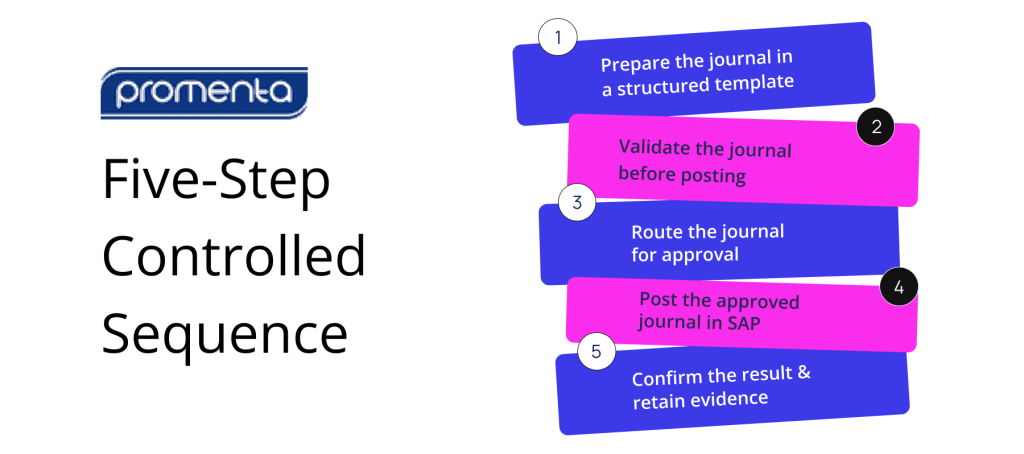
1. Prepare the journal in a structured template

Complete the required header information, such as company code, posting date, document currency, and header text. Then populate the line items, including debit and credit values, G/L accounts, cost objects, etc.

Standardised templates can reduce avoidable rework, particularly for journal types that recur each period. The template should reflect the information needed for that journal rather than forcing every entry through a generic structure.

2. Validate the journal before posting

Ensure the journal is balanced and that accounts, cost objects, posting periods, and other SAP finance requirements are valid.

The timing of validation matters.

Errors identified during preparation are usually easier to correct than errors discovered when the journal is being posted under close pressure.

Depending on the standard SAP capability or solution in use, validation may occur after the file is uploaded into SAP, through a check or posting simulation, or earlier when the journal is still being prepared.

Finance teams should understand exactly which controls run at each stage.

3. Route the journal for approval

Segregation of duties in SAP journal entry processing requires the preparer and approver to remain structurally separated – not just by policy, but through system-enforced controls that prevent the same user from preparing, approving, and posting without an independent review step.

The approval path may depend on company code, journal value, G/L account, business area, or another relevant risk factor.

SAP S/4HANA supports a journal entry approval workflow journal entry approval workflow in applicable editions and releases when correctly configured – but coverage and approval conditions vary by system edition, release, and journal type. The control question is whether the workflow used covers the journal population in scope, applies the required approval conditions, and prevents unauthorized self-approval.

4. Post the approved journal in SAP

Only journals that have passed the required checks and approvals should enter the ledger. Posting creates the SAP accounting document and document number that confirm the transaction has been recorded.

5. Confirm the result and retain evidence

The final record – your SAP journal entry audit trail – should connect each journal to its preparer, reviewer, posting result, and supporting documentation, and be reportable across the complete journal population rather than reconstructed from separate files during an audit.

Together, these five steps form the control chain around the upload.

Where Does the Standard SAP Journal Entry Upload Path Leave Control Gaps?

SAP S/4HANA provides standard functions for uploading general journal entries, checking uploaded data and, in relevant configurations, routing journal entries for verification. It would therefore be wrong to describe the standard environment as having no validation or workflow capability.

The more useful assessment is whether the organisation’s configured process provides continuous control from preparation through posting and evidence.

Validation may remain disconnected from preparation

The standard upload can check journal data after it has been brought into SAP. However, where preparation takes place in a static spreadsheet, the preparer may not have live SAP-dependent validation or current pick lists during journal preparation.

This creates a timing issue. The journal can still be corrected before final posting, but errors may surface later in the close process, after preparation and review effort has already been spent.

Verification workflow may require separate configuration

Journal entry verification capability is available in SAP S/4HANA for supported scenarios, but it must be configured around the organisation’s requirements. Coverage can vary depending on the system edition, release, journal type and process design.

Finance and SAP teams should therefore confirm:

The existence of workflow capability is not the same as a fully governed process – the configured outcome matters.

Preparation evidence can sit outside SAP governance

A generic spreadsheet may contain the journal data but not the complete control history. Review comments, approval emails and supporting files can remain in separate locations.

The posted document is visible in SAP, while the reasoning and evidence that preceded it may be fragmented.

This creates an auditability issue. The finance team may be able to prove that a journal was posted, but still need to assemble how it was prepared, reviewed, and approved.

Architecture can introduce an additional governance boundary

Some custom tools and external platforms process or stage journal data outside SAP before sending it back for posting. Depending on the architecture, this may introduce additional infrastructure, interfaces, security controls and data retention arrangements for IT, finance and internal audit to govern.

Although external architecture may be needed in certain scenarios, buyers should understand where financial data is held, which authorisation model applies at each step and how audit evidence remains connected across systems.

See how Promenta closes these control gaps inside SAP

Review how Promenta’s SAP-native workflow connects preparation, validation, approval, and audit evidence — with no external server required.

What Does a Governed SAP Journal Entry Upload Process Look Like?

A governed journal upload connects preparation, validation, approval, posting and evidence rather than treating the upload as an isolated event.

Promenta’s SAP Journal Entry Workflow does exactly that.

Preparation takes place in Excel through the Promenta Excel Add-in, which connects the spreadsheet to SAP in real time. This allows finance teams to continue using a familiar preparation environment while drawing on dynamic pick lists and SAP-dependent validation.

Duplication checks and SAP finance validations can be applied before submission, and a simulated posting can identify errors while the journal remains a request rather than a posted document.

Approval routing within the journal entry approval workflow SAP journal entry workflow is configured around relevant request data, such as company code, journal value, or G/L account. Segregation-of-duties rules can prevent a requester from approving their own journal, subject to the organisation’s agreed policy and any explicitly configured thresholds.

Because users submit journals through the controlled workflow, organisations may also be able to restrict direct access to powerful posting transactions for the relevant user population. This can help align system access with the intended approval process rather than relying on policy alone.

Posting takes place inside SAP.

Requests, approvals, posting results, and supporting evidence remain connected and reportable against the journal process. Attachments can be retained in SAP against the finance document, reducing the need to reconstruct the audit history from separate files and emails.

The architectural distinction supports the control model. Promenta runs natively inside SAP ECC or S/4HANA and is designed without an external server or replicated financial dataset in the journal path.

This may reduce the number of interfaces and infrastructure components that the organisation must govern.

Promenta has operated as an SAP partner product since 2002, supporting both on-premises and private cloud deployment options.

One architecture cannot apply to every organisation – each has unique needs. The relevant question is whether the solution fits the organisation’s SAP landscape, control requirements, security model and audit expectations.

Standard SAP capability and what a governed journal workflow adds

Area Standard SAP S/4HANA capability Promenta SAP Journal Entry Workflow
Templates A single generic Excel upload template. A template manager supporting multiple Excel templates, configured to the entry types a team actually posts.
Excel preparation No SAP functionality inside the spreadsheet; the template is a static file until it is loaded. An in-sheet Excel Add-in with real-time SAP integration: SAP validation, dynamic pick lists, duplication prevention, and journal risk mitigation during preparation.
Workflow & controls No standard workflow; approval, segregation of duties, and the audit trail have to be designed and built by the customer. Enterprise journal workflow with segregation of duties, compliance controls, and a reportable audit trail, highly configurable with no coding and native inside S/4HANA.
Audit Trail May be stored separately Commonly retained outside the journal record
Where data is held during the process Inside SAP May move through a custom or external tool
Audit trail Audit trail relies on the SAP document record; supporting evidence and approval context are typically held in separate files, emails, or systems outside SAP. Requests, approvals, posting results, and document attachments remain connected and reportable inside SAP against each journal document, without reconstruction.

Best practices for journal entry uploads in SAP S/4HANA

The decision to upload journal entries in SAP S/4HANA through a governed sequence – rather than as an isolated file transfer – depends on process design as much as technology.

The following practices apply whichever upload method an organisation uses.

Validate early

Run account, cost object, balance and SAP finance checks before final posting. Earlier validation reduces the likelihood that avoidable errors reach the final stages of the close.

Enforce segregation of duties through access and workflow

Approval should not depend only on an informal expectation that a colleague will review the journal.

Segregation of duties in SAP journal entry processing must be enforced through system access and workflow controls, not policy alone – ensuring the required separation between preparation, approval, and posting is structurally embedded in the process.

Keep evidence connected to the journal

Supporting calculations, explanations and approval history should remain easy to retrieve against the journal. Audit readiness is stronger when evidence is produced by the process rather than assembled afterwards.

Standardise recurring templates

Recurring journals often use the same structure each month even when the values change. Standardised templates can reduce preparation effort and inconsistency without removing the need for current-period validation and approval.

Review the complete configured process

Finance teams should assess the upload app, verification workflow, authorisations, supporting documentation and reporting together. A control may exist in SAP but still leave a gap if it is not configured for the relevant journal population.

Plan for S/4HANA transformation requirements

Where an organisation is moving from SAP ECC to S/4HANA, SAP journal entry workflow design – including templates, approval routing, and controls – should be part of the transformation plan, not retrofitted after go-live.

The objective should be to align governed journal processes with the standard S/4HANA environment rather than create unnecessary competition between them.

Preserve human judgement as automation develops

AI may support journal preparation by proposing recurring entries or suggesting accruals from prior patterns. That does not remove the need for professional finance judgement, current-period evidence and appropriate approval.

More automation does not automatically mean better control.

Conclusion

Uploading journal entries in SAP S/4HANA is only as controlled as the process around the upload. Standard SAP capabilities can support upload, checking and journal entry verification.

Organisations should focus heavily on whether the configured process connects preparation, validation, approval, posting and evidence for the journal population that matters.

A governed process should make it possible to answer the following questions clearly :

Where the answers demonstrate connected control, the organisation is better placed to support an efficient close and audit-ready evidence.

Where the process depends on disconnected files, emails and late checks, finance teams continue to absorb the control and administrative work each period.

See a governed journal upload inside SAP

Review how preparation-side validation, approval, segregation of duties and continuous audit evidence can remain attached to the journal without introducing an external server into the process.

Frequently Asked Questions

The key best practices for a controlled SAP journal entry upload are:

1. Validate journals against SAP rules before final posting.

2. Enforce segregation of duties through system access and workflow, not policy alone.

3. Retain supporting documents and approval history connected to the journal inside SAP.

4. Standardise recurring templates to reduce preparation inconsistency each period.

5. Assess the entire configured process – upload app, verification workflow, authorisations, and reporting – together as a control chain rather than in isolation.

The control principles are similar, but the standard tooling differs. SAP ECC environments commonly rely on manual entry, custom upload programs, or specialist tools for high-volume journal uploads.

SAP S/4HANA provides standard applications for uploading general journal entries and, in supported scenarios, journal entry verification workflows. The exact functions available depend on the edition, release, and configuration.

A governed workflow can provide a consistent control model across both environments by applying the relevant SAP rules and authorisations within each system.

Recurring accruals and allocations are strong candidates for standardised templates and repeatable preparation. Scheduling can reduce manual effort, but it does not remove the need to validate current-period figures and apply the required approval.

The structure may repeat; the evidence and judgement still belong to the current period.

A spreadsheet can be an appropriate preparation tool, but it does not offer complete control over the process by itself.

A spreadsheet-based upload alone is not sufficient for SOX or audit purposes without a governed process around it. SOX and audit requirements depend on the organisation’s control design, but finance teams will generally need to demonstrate validation, appropriate approval, segregation of duties, controlled changes, and retrievable evidence. A spreadsheet-based upload can support those requirements when it operates within a governed process that connects the file to the system of record and its approval history.

Not necessarily. Promenta is intended to add connected preparation, validation, approval, segregation of duties, and audit evidence around journal processing.

Some teams may continue to use standard SAP upload capability for suitable scenarios while applying a governed workflow where additional preparation-side control, routing, or evidence is required.


SAP Journal Entry Upload: Controlled Validation, Approval, and Audit Trail Inside SAP

Manual journal entries are an essential part of financial reporting. They allow finance teams to record accruals, corrections, reclassifications, provisions and other transactions that may not originate from a standard source document.

However, this flexibility also makes manual journals a critical area of financial control.

Unlike a payment supported by an invoice or a goods receipt connected to a purchase order, a manual journal may begin with a finance user deciding the amount, account, cost object, posting period and accounting treatment.

This does not mean that every manual journal is inherently high risk. Nor does it mean that organisations should simply try to eliminate manual journals.

Rather, the focus lies in what happens around the journal.

How is the information validated? Who reviews and approves it? Can the preparer also post the entry? Is supporting documentation retained alongside the journal? Can the organisation demonstrate the complete history of the transaction during an audit?

The risk of manual journal entries in SAP therefore depends less on the number of journals being processed and more on where the controls are applied.

If controls operate only after a journal has posted, the organisation may be able to detect a problem. If the controls operate during preparation and approval, the organisation has a better opportunity to prevent the problem from reaching the ledger.

Why the Risk of Manual Journal Entries in SAP Requires Preventive Controls

Manual journals are a critical part of the financial close. They allow finance teams to record accruals, reclassifications, provisions, intercompany entries, corrections and other adjustments that require professional judgement.

The challenge is not the journal itself. It is the SAP journal entry upload process – how the journal moves from Excel preparation into the SAP general ledger, and what controls, validation, and approval exist along that path.

While many organisations use their own Excel upload process to post journals, in many SAP environments, finance teams still rely on one of two methods :

The problem is that neither of these methods necessarily provides a controlled process around preparation, validation, approval, supporting evidence, and auditability.

Promenta SAP Journal Entry Upload is designed to replace these approaches with a controlled, SAP-native process Finance users can continue preparing journals in Excel, while live SAP validation, posting simulation, approval routing, segregation of duties and audit evidence remain connected to the entry throughout its lifecycle.

Beyond enabling finance teams to upload journals more quickly, Promenta ensures each journal is validated, authorised and fully documented before it becomes a posted SAP financial document.

What Is SAP Journal Entry Upload?

SAP journal entry upload is the process of moving a manually prepared journal entry from Excel into the SAP general ledger. A controlled SAP Journal Posting, Excel Upload Tool includes live SAP validation, posting simulation, enforced approval, segregation of duties, and a continuous audit trail – all operating inside SAP ECC or S/4HANA without external servers or replicated financial data.

Why SAP Journal Entry Upload Requires Stronger Controls Than Manual Posting

The scale of manual journal posting in SAP remains significant across enterprise finance functions.

Research published in 2026 across finance shared-service teams found that only approximately 2% of organisations described their close as fully automated. This means manual journal preparation and posting are widely practised across enterprise finance functions.

Manual journal entries are also a specific area of auditor attention. Per PCAOB auditing standards, auditors are required to test journal entries and other adjustments because inappropriate or unauthorised journals are a proven pathway for misstated financial statements.

Finance teams may need to demonstrate:

Promenta Journal Posting, Excel Upload Tool is designed to create this controlled path from Excel preparation through to posting and audit.

What a Controlled SAP Journal Entry Upload Replaces

Before evaluating a controlled upload process, it is important to understand the two methods it is intended to replace.

1. Manual Entry into Standard SAP Finance Screens

In SAP ECC, users may enter journals through standard posting or parking transactions such as FB50, FB01, or FV50.

In SAP S/4HANA, finance teams may use standard journal entry applications that post into the Universal Journal.

SAP validates the entry when it is submitted for posting. However, direct screen entry does not necessarily provide:

The user entering the journal may also hold standing access to post it.

This creates an important segregation-of-duties issue. A user may be able to prepare and post the same journal without independent approval being enforced through the system.

An approval may still take place through email or another informal process. However, if the journal can be posted regardless of whether that approval occurred, the approval is not operating as a preventive control.

2. Custom or Generic Excel Upload Tools

Basic Excel upload tools make journal preparation easier by allowing finance users to structure entries in a spreadsheet and transfer them into SAP.

While these tools may confirm that the file is structurally complete, they do not confirm if the journal complies with the live finance rules SAP will apply when the document is posted.

Custom or generic tools may not provide:

Where approval exists, it may still be managed through email and retained separately from the journal.

The spreadsheet may improve preparation efficiency, but the controls surrounding the journal largely remain manual.

SAP ECC mainstream support ends 2027. See how Promenta keeps journal control inside SAP through the transition.

What Is the Difference Between a Format Check and Live SAP Validation?

Validation is one of the most important distinctions between a basic Excel upload and Promenta SAP Journal Entry Upload.

File and Format Validation

A format check determines whether the spreadsheet is structurally suitable for upload.

It may confirm that :

Though these checks are useful, a format check says nothing about whether the entry will actually post.

Even a correctly formatted journal may contain an invalid general ledger account, an incorrect cost object, an unavailable posting period, or another issue that causes it to fail when it reaches the SAP environment.

Validation Against Live SAP Rules

SAP journal entry validation examines the entry against the live SAP environment, including the master data, finance configuration, and posting rules that will govern the actual posting.

Depending on the organisation’s configuration, this may include:

This is fundamentally different from merely validating the spreadsheet structure.

The journal is tested against the same live data and financial rules that will govern the eventual posting.

Why the Timing of Validation Matters

The challenge with manual entry into SAP and basic Excel upload tools is that in both, errors surface too late, usually close to posting.

By that stage:

Promenta moves this validation earlier.

Promenta SAP Journal Entry Upload uses a fully validated virtual journal document and runs a full simulated posting at the request stage. So, the requester can see the errors SAP would raise before the journal is submitted for approval.

This allows structural, master-data and field-level issues to be corrected while the journal is still being prepared.

Thus, it allows finance teams to prevent avoidable errors from progressing to approval rather than discovering them at the final posting stage.

How an SAP-Integrated Excel Add-In Improves Journal Upload Control

Excel remains a practical and familiar preparation tool for finance teams.

It supports calculations, analysis, large datasets, and the preparation of complex journals. Replacing Excel is not always the most viable option.

An Excel journal upload to SAP is practical and familiar. The question is not whether to use Excel, but what connects it to SAP and whether that connection includes live validation, approval routing, and audit control. Organisations looking to move beyond manual screen entry can start with Promenta’s free SAP Excel upload tool as an entry point before adopting full workflow controls.

Promenta provides an SAP-integrated Excel Add-In that allows finance users to prepare journals using a familiar interface while accessing SAP-aware controls.

The Add-In supports:

The Add-In turns Excel into the controlled preparation point for an SAP journal request.

This connects the approval policy to the underlying SAP authorisation structure.

See Promenta's SAP Journal Workflow in Action

Built natively on SAP. No external servers, no duplicate financial data.

How SAP Journal Entry Upload Enforces Approval and Segregation of Duties

Validation establishes whether the journal data is acceptable; it does not establish whether the journal has been independently authorised.

That requires an approval workflow and segregation of duties.

With direct entry, the user preparing the journal may also have the standing SAP access required to post it.

With a basic Excel upload, the journal may be approved through email, but the approval remains detached from the SAP posting process.

Promenta moves the approval into the controlled SAP journal path.

The SAP journal entry approval workflow routes requests using meaningful financial fields, including :

The workflow can support :

A requester cannot approve their own journal.

Because the document posts only after the required approvals are complete, the organisation can also remove access to sensitive finance posting transactions from everyday users.

Segregation of duties becomes an enforced property of the workflow rather than a procedure dependent on individual behaviour.

Why SAP Journal Entry Upload Should Run Inside SAP

The location of the upload determines whether journal data, validation, approvals and audit evidence remain within SAP or must be managed across additional systems.

When preparation, validation, approval and posting remain connected to SAP, the process can use the organisation’s existing:

Sensitive financial information does not need to be replicated into an external platform for the core process.

By contrast, an external application may introduce:

Promenta operates inside SAP ECC and SAP S/4HANA without external servers, middleware or replicated financial data for the core journal process. Deployment can remain on-premises or within the organisation’s private-cloud SAP environment.

The journal is validated against the same finance rules and posted into the same ledger to which it belongs.

This helps preserve one connected control environment throughout the upload process.

How Promenta Replaces Both Existing Methods

A controlled SAP journal entry upload combines the familiar elements of Excel preparation and SAP posting within one governed process, keeping validation, approval, and audit evidence connected throughout.

A finance user continues to prepare the journal in Excel.

The difference is what happens around that preparation:

Promenta effectively replaces direct screen entry or custom Excel upload tools by providing an integrated Excel Add-In with live SAP validation, workflow and audit controls rather than relying on a file-format check.

A Comparative Mapping of the Three Approaches

Area Direct Entry into SAP Screens Custom or Generic Excel Upload Promenta SAP Journal Entry Upload
Where the journal is prepared Entered directly into the SAP posting screen Prepared in a spreadsheet without a fully SAP-aware Add-In Prepared in Excel through the SAP-integrated Promenta Add-In
When SAP validation occurs At the point of posting Usually limited to file and format checks before SAP posting Against live SAP rules during preparation, with simulated posting before submission
Approval and segregation of duties May rely on standing posting access and informal review Approval commonly retained in email or another external process Approval routed and enforced inside SAP
Supporting documentation May be stored separately Commonly retained outside the journal record Attached to the controlled journal request
Where data is held during the process Inside SAP May move through a custom or external tool Remains inside the SAP environment
Audit trail May be divided between the ledger, emails and other evidence May be divided between spreadsheets, emails and SAP Continuous and reportable inside SAP
When errors are identified At posting Commonly at posting Before submission and approval
SAP GUI dependency Required for standard transactions Depends on the tool Promenta does not require SAP GUI
Primary objective Enter and post the journal Make spreadsheet upload more efficient Control preparation, validation, approval, posting and audit

How SAP Journal Entry Upload Handles High-Volume and Month-End Activity

Control should not weaken when journal volumes increase.

Month-end and year-end close may involve large journals, recurring activity, and multiple journal requests that need to move through the process within a limited period.

The solution also supports complex, high-volume journal activity through the same controlled path used for individual entries.

Where a journal contains more than SAP’s standard 999 line-item limit, Promenta can automatically divide the entry into multiple balanced SAP documents. For example, a journal containing 3,000 line items can be split across the required balancing accounts and then posted through the same controlled process.

Finance teams can also prepare multiple journals within a single Excel sheet. Promenta identifies and processes each journal as a separate SAP document, allowing several journals to be validated, approved and posted together without requiring a separate upload process for each one.

How a Controlled SAP Journal Entry Upload Speeds Up the Financial Close

A faster financial close goes way beyond simply accelerating the spreadsheet upload.

It is the result of reducing the errors, rework, and uncertainties surrounding journal processing.

When journals are validated before submission:

When approvals are managed through one controlled workflow:

When the audit history is complete

The close becomes faster because there is less to correct, reconcile, and explain after the event.

What Audit Trail Does a Controlled SAP Journal Entry Upload Create?

The final difference is the SAP journal entry audit trail – the complete, continuous record of what was prepared, validated, approved, and posted, held inside SAP from start to finish.

Promenta SAP Journal Posting, Excel Upload Tool creates a continuous record inside SAP showing :

An auditor can review the lifecycle from one controlled record rather than reconciling a spreadsheet, an email chain, and the final SAP document. This is a direct outcome of running approvals inside the SAP journal entry workflow rather than outside it.

The Role of AI in Journal Preparation

AI has the potential to assist finance teams with journal preparation, classification and anomaly detection.

However, AI does not replace the controls required around a manual journal.

The data entered into the journal and the authority to approve it remain human responsibilities.

Validation, segregation of duties, approval evidence and accountability must therefore continue to operate through the organisation’s financial-control framework.

An SAP-native model keeps these responsibilities connected to the same authorisation and governance structure used by the wider finance function.

The bottom line – finance leaders evaluating their current process should consider:

If these controls sit outside SAP or operate only after posting, the journal upload is not yet managing the full risk.

See Promenta SAP Journal Entry Upload Inside SAP

See how a manual journal moves from Excel preparation to a posted SAP document with live validation, controlled approval, segregation of duties, and a continuous audit trail attached to the entry.

Frequently Asked Questions

Promenta SAP Journal Entry Upload is an SAP-native controlled process for moving manually prepared journal entries from Excel into the SAP general ledger, with live validation, enforced approval, segregation of duties, and a complete audit trail inside SAP ECC or S/4HANA.

Finance users prepare the journal through the Promenta Excel Add-In. The entry is then validated against live SAP data and finance rules, simulated before submission, routed for approval, and posted only after the required controls have been completed.

The complete preparation, approval, posting, and audit history remains inside SAP.

It is designed to replace:

●      Manual journal data entry directly into standard SAP finance screens or SAP S/4HANA Universal Journal applications

●      Custom or generic Excel upload tools that do not provide an SAP-integrated Excel Add-In, live SAP validation, enforced approvals, segregation of duties, and complete audit evidence

Promenta SAP Journal Entry Solution aims to retain the usability of Excel while creating a more controlled route into the SAP ledger.

Yes. Excel is a preferred choice as the preparation tool for many finance teams.

With the Promenta Excel Add-In, finance users can access SAP picklists, validate the journal against live SAP rules, and submit it into the approval workflow directly from Excel.

This preserves the familiar preparation interface without separating validation, approval, or audit evidence from SAP.

It depends on what the tool validates and where the controls operate.

Many custom or generic tools confirm that a spreadsheet is correctly formatted but do not validate the journal against live SAP finance rules before submission.

Approval may also remain in email or another process outside SAP.

Key compliance and audit considerations include verifying whether:

●      SAP validation occurs before posting

●      Approval is enforced

●      Segregation of duties is applied

●      Supporting evidence is mandatory

●      The complete audit record remains inside SAP

A format check confirms that the spreadsheet structure is correct and required fields are populated.

Live SAP validation checks the journal against the organisation’s current SAP master data, finance configuration, substitutions, posting rules and validations.

A file can pass a format check and still fail when it reaches SAP.

Promenta performs live SAP validation and simulated posting before the journal is submitted for approval, which means errors surface during preparation rather than at the point of posting.

No. Promenta SAP Journal Entry Upload does not require SAP GUI for the end-user preparation and workflow process.

Finance users can prepare and submit journals through Excel while maintaining secure integration with SAP.

Keeping the process inside SAP allows the journal to remain connected to the organisation’s existing users, authorisations, master data, finance rules, security controls and audit environment.

It also avoids introducing an external server, replicated financial data, separate middleware or another application environment for the core journal process.

[/et_pb_text][/et_pb_column]
[/et_pb_row]
[/et_pb_section]

How to Reduce the Risk of Manual Journal Entries in SAP

Manual journal entries are an essential part of financial reporting. They allow finance teams to record accruals, corrections, reclassifications, provisions and other transactions that may not originate from a standard source document.

However, this flexibility also makes manual journals a critical area of financial control.

Unlike a payment supported by an invoice or a goods receipt connected to a purchase order, a manual journal may begin with a finance user deciding the amount, account, cost object, posting period and accounting treatment.

This does not mean that every manual journal is inherently high risk. Nor does it mean that organisations should simply try to eliminate manual journals.

Rather, the focus lies in what happens around the journal.

How is the information validated? Who reviews and approves it? Can the preparer also post the entry? Is supporting documentation retained alongside the journal? Can the organisation demonstrate the complete history of the transaction during an audit?

The risk of manual journal entries in SAP therefore depends less on the number of journals being processed and more on where the controls are applied.

If controls operate only after a journal has posted, the organisation may be able to detect a problem. If the controls operate during preparation and approval, the organisation has a better opportunity to prevent the problem from reaching the ledger.

Why the Risk of Manual Journal Entries in SAP Requires Preventive Controls

Most transactions recorded in the general ledger originate from another business process.

A payment is normally supported by an invoice. A goods receipt is connected to a purchase order. A customer receipt may have a remittance or transaction record.

A manual journal may have no equivalent source transaction.

Instead, the journal may be prepared in a spreadsheet, reviewed by another finance user, approved through email, and subsequently entered into SAP. Supporting documentation may then be retained in a shared folder or separate system.

Each step may appear reasonable. However, the wider process can become fragmented.

APQC identifies manual journal entries as a persistent source of errors and expense. For organisations operating SAP, the risks generally fall into five connected categories.

1. Data Integrity and Posting-Error Risk

SAP journal posting errors typically arise when journal information does not comply with live master data, account determinations, cost objects, tolerances, or finance validation rules and the most common cause is validation happening too late in the process.

When preparation happens in a standalone spreadsheet, some of these checks may not occur until the journal is entered or posted into SAP.

Potential issues can include:

The later an error is identified, the more work may be required to correct it.

A journal may already have completed several approval stages before failing at posting. Alternatively, an incorrect entry may be posted and only become visible during reconciliation or subsequent review.

2. Compliance and Segregation-of-Duties Risk

A journal approval is only effective when it is connected to the process that allows the journal to post.

Where approval occurs via email or another informal process, the approval may provide evidence that a review occurred. However, it does not necessarily prevent the journal from being posted without that approval.

This creates a distinction between a documented procedure and an enforced control.

Segregation of duties may also be weakened where one individual has sufficient access to prepare, approve and post a journal.

A controlled journal process should be able to demonstrate that:

These requirements become particularly important when users retain powerful SAP finance posting transaction codes that allow journals to be posted outside the intended workflow.

3. Audit and Evidence Risk

Auditors need to see more than the final document posted into the ledger.

They may need evidence of :

When this information is spread across SAP, email inboxes, spreadsheets, shared folders and external approval systems, the organisation may need to reconstruct the journal history.

Reconstruction creates both administrative effort and the possibility of gaps.

The audit trail may therefore show the posting without providing a complete record of the decisions and controls that preceded it.

4. Financial Close Delay Risk

Manual journal activity frequently increases during month-end and year-end close.

At the same time, finance teams may have less capacity to manage errors, delayed approvals, and incomplete documentation.

A process that depends on manual coordination can require employees to :

Each activity may appear small. Across a large journal population, the accumulated effort can create material delays.

The core objective is not simply processing journals more quickly; it is to reduce avoidable administration while maintaining the controls required for an accurate and auditable financial close.

5. Data Security and Infrastructure Risk

The location of the journal workflow is another important consideration.

A journal may be prepared, staged or approved outside SAP before being transferred back into the ERP for posting.

This can introduce :

Automating a manual process on an external platform does not necessarily remove these considerations.

It may improve certain administrative activities while introducing a separate environment that must be governed, integrated, secured, and audited.

See a Controlled SAP Journal Process in Practice

See how Promenta moves journal preparation, validation, approval, and audit into a single controlled process inside SAP ECC or S/4HANA.

SAP Journal Entry Controls: Detective Versus Preventive Approaches

Two broad types of control can operate around a journal entry.

A detective control identifies a problem after it has occurred. Examples may include reconciliations, exception reports, and reviews performed after the journal has posted.

A preventive control is designed to stop an incorrect or non-compliant journal from posting in the first place.

The distinction matters.

A reconciliation may identify that an incorrect value has entered the ledger. It does not prevent the value from being posted.

An exception report may reduce the time required to identify unusual activity. It does not necessarily stop the activity from occurring.

Reducing the risk of manual journal entries in SAP means moving validation, approval, and evidence capture earlier in the process, before a journal reaches the ledger, not after.

This means :

1. Validate Journal Data Before It Posts

Early validation is one of the most important controls in a manual journal process.

In a standalone spreadsheet, a finance user may be able to check calculations and review the structure of a journal. However, the spreadsheet may not have access to the live SAP data and finance rules that will ultimately determine whether the journal can be posted.

The first complete validation may therefore occur when the journal reaches SAP.

This can result in errors being identified after the journal has already been reviewed or approved.

SAP-integrated Excel preparation can move validation earlier, Promenta’s free SAP journal posting Excel upload tool is one way finance teams start this process without a full workflow investment.

Relevant checks can be performed against live SAP data while the journal is still being prepared. These may include :

Promenta uses a fully validated virtual journal document and supports a full simulated posting before the journal is submitted.

This allows potential errors to surface to the requester during preparation rather than at the final posting stage.

The timing of validation matters because an error identified before submission can be corrected before it creates additional review, approval, and close activity.

Why the Validation Environment Matters

Validation should take place against the financial environment where the journal will ultimately be posted.

Where an external platform uses a separate rule set, certain SAP-specific issues may only become visible when the journal is transferred back into SAP.

Validation inside the SAP landscape uses the same environment and rules that govern the live posting.

This reduces the risk of a journal appearing valid in one system but failing when it enters the ledger.

2. Route Approval Through the Posting Path

Approval should be more than an administrative sign-off.

A journal may be approved via email, but if the user can still post it regardless of whether approval has been received, the approval is not being enforced by the system.

A controlled SAP workflow can make approval a condition of posting, for a detailed walkthrough of how this works, see how the SAP journal entry approval workflow operates step by step.

Routing may be configured according to criteria such as:

Different journals can therefore follow different approval paths based on the organisation’s financial-control requirements.

The workflow can also prevent the requester from approving their own journal and require the appropriate level of independent review before posting.

Connecting Approval with SAP Access

Segregation of duties is weakened when users retain standing access that allows them to bypass the controlled workflow.

Where appropriate, organisations can remove powerful posting transaction codes from everyday users and allow journals to post only through the approved process.

This connects the approval policy to the underlying SAP authorisation structure.

It also reduces the need for finance teams to chase approvals manually. Notifications, substitute approvers, team inboxes and workflow status can help keep journals moving without undermining the required review.

3. Keep Supporting Evidence Connected to the Journal

Supporting documentation provides the context behind a manual journal.

This may include :

When this information is retained separately, finance and audit teams may need to search across different locations to understand the basis for the journal.

A controlled SAP process can keep supporting evidence attached to the relevant journal workflow and finance document.

The workflow can capture :

The audit trail is then generated as the journal moves through the process rather than being assembled after the close.

This helps preserve the relationship between the transaction, its supporting evidence and the decisions taken around it.

4. Consider Where Automation Operates

The word automation can describe several different architectural approaches.

Some solutions operate on an external platform and subsequently write approved journals back into SAP. Others automate data movement between Excel and SAP. A further approach is to operate the journal workflow natively within the organisation’s SAP environment.

Each approach may provide useful capabilities. However, they can have different implications for security, validation, integration, governance and auditability.

An external platform may require:

A native SAP approach keeps preparation, validation, approval and posting within the SAP landscape.

This can provide :

For organisations with strict financial-control, data-security or compliance requirements, where the workflow operates is therefore a central evaluation question.

See Promenta SAP Journal Entry Upload Inside SAP

See how a manual journal moves from Excel preparation to a posted SAP document with live validation, controlled approval, segregation of duties, and a continuous audit trail attached to the entry.

What a Lower-Risk Manual Journal Process Looks Like

A lower-risk process does not necessarily eliminate manual preparation.

Finance professionals may continue to use Excel where it provides the flexibility required to calculate, analyse and structure complex journal information.

The opportunity is to place a controlled workflow around that preparation.

A structured process may follow this path :

Excel preparation → SAP validation and posting simulation → controlled submission → approval and segregation of duties → supporting documentation → posting → continuous audit trail

In this model:

Each risk is addressed closer to its source rather than being detected later through reconciliation or audit review.

How Promenta Supports the Process

Promenta’s Journal Management solution is designed to manage preparation, validation, approval and posting natively within SAP ECC and S/4HANA, without an external server in the journal path.

The solution includes:

Promenta has been an SAP-certified partner since 2002, with a journal management solution trusted by enterprises including Honeywell, Nike, BASF, Nestlé, and Lockheed Martin see Promenta’s customer portfolio and SAP certification for full details.

SAP S/4HANA Standard Journal Upload Versus Promenta Journal Management

It is important to distinguish a complete journal management workflow from the standard S/4HANA journal upload functionality.

How Does Promenta Journal Management Differ from SAP S/4HANA Standard Journal Upload?

Capability SAP S/4HANA standard upload Promenta Journal Management
Excel templates One generic upload template A template manager supporting multiple Excel templates
Excel functionality No in-built Excel functionality An in-built Excel Add-In with real-time SAP integration, SAP validation, dynamic pick lists, duplication prevention and journal risk mitigation
Workflow No standard workflow; customers design and build their own Enterprise journal workflow with segregation of duties, compliance controls and a reportable audit trail
Configuration Workflow capability needs to be designed and developed Highly configurable, no coding required and native within S/4HANA

The standard upload can help move journal data into SAP. A complete journal management process also needs to consider preparation, validation, approval, segregation of duties, supporting evidence, reporting, and auditability.

The Role of AI in Journal Preparation

AI has the potential to support journal preparation and identify unusual activity before a journal is submitted.

For example, AI may assist with:

However, AI does not remove the need for compliance-grade controls.

Validation, approval, segregation of duties, supporting evidence, and accountability remain essential.

Automation may change how quickly a journal is prepared. It does not change who is responsible for reviewing and approving it.

Human judgement and system-enforced controls therefore remain central to the journal process.

Conclusion

Reducing the risk of manual journal entries in SAP is not merely about reducing the number of journals an organisation raises.

Manual journals are still required where finance judgement is necessary.

The more important question is whether the process surrounding those journals provides the industry-standard level of control, visibility and auditability.

Finance leaders should consider :

A controlled SAP journal workflow can help organisations move validation, approval and evidence closer to the point of preparation and posting.

This changes the journal process from one that detects risk downstream to one that is designed to prevent avoidable errors and control failures before they reach the ledger.

Promenta has been an SAP-certified partner since 2002, with a journal management solution trusted by enterprises including Honeywell, Nike, BASF, Nestlé, and Lockheed Martin see Promenta’s customer portfolio and SAP certification for full details.

If those questions are difficult to answer, the issue may lie less with journal preparation itself and more with the process surrounding it.

Frequently Asked Questions

The risks of manual journal entries in SAP fall into five categories: 

(1) posting errors when journal data is not validated against live SAP rules before submission

(2) segregation-of-duties failures where one user can prepare, approve, and post without independent review 

(3) audit evidence gaps when approvals happen outside SAP and cannot be reconstructed

(4) financial close delays from uncoordinated high-volume activity at period end

(5) data security risks when sensitive journal information is processed on external platforms. 

Each risk is reduced when validation, approval, and posting remain within a single SAP-native workflow.

Organisations can reduce manual journal-entry risk by applying controls earlier in the journal lifecycle.

Journal data should be validated against live SAP rules during preparation rather than only at posting. Approval and segregation-of-duties requirements should be enforced through the posting path. Supporting documentation should remain connected to the relevant journal, and workflow activity should be captured continuously.

Organisations should also consider where the automation operates. Keeping the core workflow within SAP can reduce unnecessary data movement, integration complexity and fragmented audit records.

A manual journal process relies more heavily on people to coordinate validation, approval, documentation, tracking and posting.

An automated journal workflow uses predefined controls to structure these activities. This may include automated validation, configurable approval routing, segregation-of-duties enforcement, notifications, supporting documentation, status tracking, posting and audit-trail creation.

Automation does not necessarily eliminate manual preparation. Finance users can continue preparing journals in Excel while the wider process is managed through a controlled SAP workflow.

Manual journal entries are not automatically an audit issue. However, the surrounding process can create audit risk when the organisation cannot demonstrate that appropriate controls were consistently applied.

Potential issues include missing approval evidence, incomplete supporting documentation, self-approval, standing posting access, fragmented records and difficulty reconstructing the complete journal history.

A continuous audit trail that records preparation, review, approval, amendments, posting, and reversal activity makes it easier to demonstrate control, covered in depth in our guide to Promenta’s customer portfolio and SAP certification SAP journal entry compliance, SOX, and segregation of duties.

Potential errors include incorrect account combinations, invalid cost objects, incomplete fields, duplicate journals, incorrect values, incorrect posting periods and entries that fail SAP finance validation.

These issues can create greater disruption when they are identified after a journal has already completed the approval process.

Validating the journal against live SAP master data and finance rules during preparation can help identify potential errors before submission and posting.

Automated vs Manual Journal Entries: Differences, Risks and When to Switch

The choice is usually framed as speed against accuracy. That framing hides the real distinction, and with it the decision that actually matters for the close.

Most comparisons of automated vs manual journal entries present the choice as fast versus careful, as if the only question were how quickly the books close. That framing hides the actual difference. Every journal entry contains two separate things: a decision about what should be recorded, and the mechanical work of recording it. A manual journal entry asks one person to do both. Automation changes only the second part. Seeing that split clearly is what tells a finance team which entries to move, which to keep, and when a switch is worth making.

Key Takeaways

What is the difference between manual and automated journal entries?

A manual journal entry is one a person prepares and posts by hand, choosing the accounts, amounts, and period, then keying every line. An automated journal entry encodes that decision once as a rule, then lets the system generate and post the lines from source data on a schedule or trigger.

The distinction that matters is not who is faster. It is which layer still depends on a person. With manual journal entries, a human performs both the judgment and the transcription. With automated journal entries, the judgment is set once, and the transcription is handled by logic. This is why the comparison is rarely all-or-nothing. Most finance functions run a mix, and the useful question is where the line between the two should sit.

Take a routine monthly rent accrual. The decision is fixed: accrue one month of rent to the same expense and accrual accounts, for the same amount, on the same period pattern, every month. The recording is identical each time. That entry is almost entirely recording, which is why it automates cleanly. A provision for a disputed legal claim looks similar on the page but is the reverse. The amount, the timing, and even whether to book it are live decisions each period. Same two layers, opposite balance between them.

Where manual journal entries actually go wrong

The risk in a manual entry concentrates in the recording layer, not the thinking behind it. That is the part automation can remove.

Studies of manual data entry place the human error rate in the low single digits, commonly between about half a percent and 3.6 percent, and it climbs as the data grows more complex or the operator works under time pressure.[1] Period close is precisely when both conditions peak: volume rises, deadlines compress, and the same people who prepare entries often review them. A transposed figure, a wrong cost center, an inverted sign, or a posting to the wrong period does not announce itself. It surfaces later as a reconciliation break, an auditor question, or a restated number. The cost of a manual error is rarely the keystroke. It is the distance the wrong value travels before anyone catches it – and the compliance exposure it creates SAP journal entry compliance controls are designed to stop that propagation before it reaches the auditor.

Why many “automated” journal entries are still manual

A great deal of software described as automation has not removed the manual layer. It has moved it into a spreadsheet.

Spreadsheet-based journal entry processes carry the same manual risk whether or not the final posting is automated and route approvals by email, then load the file into the ledger. In many setups the spreadsheet is never checked against the ledger’s own master data before it loads, so a closed period or a wrong account is only found after posting. The final posting is automatic. Everything before it is not. This matters because a spreadsheet is not a neutral staging area. Field audits of real organizational spreadsheets, using stronger modern methods, have found errors in at least 86% of those examined. An automation that depends on an unchecked spreadsheet inherits that error rate. Real automated journal entries remove the re-keying between systems, not just the last click. If a person still types values into a sheet that nothing validates, the process is manual work behind an automated finish.

Are Automated Journal Entries More Accurate Than Manual Journal Entries?

Generally yes, but the accuracy comes from validation at the point of entry, not from the absence of people.

A rule-based entry drawn straight from source data does not accumulate transcription errors, because no one re-types it. What raises accuracy is the check that runs before the entry is committed: does the account exist, is the cost object open, does the entry balance, is the period valid. Automation without that check simply posts wrong data faster. The gain from automated journal entries is real, but it depends on where the validation sits, not on removing human judgment. Judgment still decides what should be recorded. Automation makes sure the recording is correct and consistent every period.

When should you switch from manual to automated journal entries?

Make the decision per entry type, not for the function as a whole. Automate where the judgment is settled and only the recording repeats.

The clean candidates are entries that follow the same logic every period: recurring accruals, depreciation, prepaid amortization, standard allocations, intercompany postings, reclasses, and payroll journals. A monthly straight-line depreciation run is the same calculation each period, so encoding the rule once is safer than re-keying it. A goodwill impairment is the opposite. It requires fresh judgment every time it arises and belongs with a person. Keep human hands on the entries that carry genuine, recurring judgment: one-off adjustments, estimates, and unusual transactions. Those should still move through a structured SAP journal entry approval workflow with validation and sign-off, but they do not need to be generated by a rule.

The switch is worth making when a manual journal entry is repetitive, rule-bound, and high in volume, and maintaining it by hand costs more attention than defining it once. Framed that way, automated vs manual journal entries stop being a single verdict and becomes a sorting exercise you run across the close calendar.

Automated journal entries in SAP depend on which rules do the checking

Automated journal entries in SAP involve more than eliminating the keystrokes. The recording layer in SAP includes the validation that decides whether an entry is even allowed: a real account, an open period, a valid cost object, a balanced document. It is the validation that decides whether an entry is even allowed: a real account, an open period, a valid cost object, a balanced document. So the accuracy of automated journal entries in SAP rests on one thing: whether the rule performing that check is SAP’s own live configuration or a copy of it.

When the check that replaces the human is maintained on a separate platform, it is a snapshot of SAP’s rules as they stood when it was set up. Configuration keeps moving: new company codes, periods that close, revised validation logic, accounts that get blocked. A rule held outside SAP drifts from the system it is meant to protect, so an entry can clear the external check and still be wrong in SAP. That is automated recording measured against the wrong rulebook, and at volume the wrong rule repeats every period.

Promenta’s SAP Journal Entry Workflow performs the check inside SAP itself. Running as a certified partner product within SAP ECC and S/4HANA, it validates every request against the live SAP FICO configuration in real time and runs a full posting simulation before approval. The entry is held as a validated virtual document, attachments included, and is written to the ledger only once approvals are complete, with the powerful finance posting transaction codes removable from end users so the validated path is the only way in. The rule doing the checking is the same rule the auditor will test, not a second copy that has to be kept in step.

The bottom line is, automation does not replace the accountant. It removes the part of the job that was only ever transcription, so the judgment that decides what to record is the part that gets your team’s attention.

Find the entries your team still keys by hand.

Map your recurring postings against the close calendar, then see how Promenta validates and posts them inside SAP — or start with the free SAP journal posting Excel upload tool, which removes re-keying risk with no license cost.

Frequently Asked Questions

No. Automation removes the transcription work, not the judgment behind it. A rule generates and posts the recurring entries, but a person still decides what should be recorded, reviews exceptions, and handles the entries that need real judgment. In practice, automated journal entries shift accountants away from keying and toward review, analysis, and the unusual transactions that actually require their attention.

A recurring journal entry repeats the same posting on a set schedule, which is one narrow form of automation. Automated journal entries are broader: the system prepares, validates, and posts entries from source data under defined rules, whether on a schedule or triggered by an event. Every recurring entry is automated, but not every automated entry is a simple fixed recurring one, since many respond to changing source data each period.

Yes. Automation handles preparation, validation, and posting, but it does not remove the control layer. Recurring automated entries should still be reviewed periodically, and any entry that carries judgment should pass through approval before it reaches the ledger. Good automation strengthens control by making the check consistent, not by removing the reviewer. For automated journal entries in SAP, that approval sits in workflow before the financial document is created.

Yes. SAP includes some native recurring-entry and Excel-upload functions, though on their own they provide limited validation, approval workflow, and audit reporting. A certified add-on that installs inside SAP can supply those controls directly, so automated journal entries in SAP do not require a separate middleware or reconciliation system to gain workflow, validation, and reporting.

Best Automated Journal Entry Software in 2026

Seven platforms, sorted by the one thing feature lists never tell you: what each vendor built first, and where your journal actually gets validated and posted.

Most large finance teams have not adopted the best automated journal entry software They have automated around the journal – but not the journal itself. Research by Odoxa among 303 CFOs at UK companies with 250 or more employees found 54% still use spreadsheets for manual journal entries, and more than one in three are not highly confident in their own reported figures. That gap is what the best automated journal entry software is bought to close.

Every vendor here publishes a similar feature list: templates, validation, routing, posting, audit trail. None of it predicts how a tool behaves in month eleven of a close cycle. One thing does, and it is rarely on the product page.

Key Takeaways

Why Feature Lists Won’t Help You Choose the Best Automated Journal Entry Software

Read seven product pages side by side, and they converge. Everyone validates. Everyone routes for approval. Everyone claims an audit trail. That is why buyers so often decide on price, or on whichever demo ran smoothest.

What the pages omit is that almost none of these products began as a journal entry tool. Each solved a different problem first, and the journal came later, shaped by the architecture already in place.

BlackLine and Trintech started with reconciliation and close orchestration, so their journals are a module inside a platform sitting outside the ERP. HighRadius came out of order-to-cash, which is why its journal story leads with pattern matching. Precisely Automate and Process Runner grew out of Excel-to-SAP data loading so their journals are one of hundreds of transactions the tool drives from a spreadsheet.

How to Evaluate Automated Journal Entry Software for SAP: 5 Criteria That Actually Matter

Five criteria separate a shortlist faster than a feature matrix when choosing the best automated journal entry software for SAP. They matter most for CFOs who carry both the close deadline and the control environment across SAP financial close automation projects.

SAP ECC mainstream support ends 2027. See how Promenta keeps journal control inside SAP through the transition.

The 7 Best Automated Journal Entry Software Platforms for SAP in 2026

Grouped by lineage rather than ranked. A group running five ERPs has a different correct answer from a single-instance SAP shop, and a ranking would hide that.

01 Promenta SAP Journal Entry Workflow

Built first for: audited, multi-team SAP data processes. Certified with SAP since 2002.

Promenta is the outlier in the SAP journal entry automation space, built from the ground up for controlled SAP data entry rather than adapted from a reconciliation or data-loading lineage. It was built for controlled SAP data entry, and journal management is its flagship process, not a module attached to a close suite.

The whole sequence runs inside the customer’s own SAP ECC or S/4HANA system A requester prepares the entry in the web interface or from Excel through the add-in, and data is validated in real time against live SAP FICO configuration. This architecture directly supports SOX journal entry compliance by ensuring no posting occurs without a documented, system-enforced approval chain.

Routing follows an approval matrix keyed to fields finance recognises: company code, journal value, G/L account. Evidence attached to the SAP finance document. Segregation of duties is enforced against SAP authorisations, and powerful posting codes such as FB01 and FB50 can be removed from end users entirely.

Because nothing leaves SAP, there are no external servers, no middleware to certify, no second security model to reconcile. The audit trail and the SAP document are one record. The trade-off is scope: landscapes with several non-SAP ledgers need something alongside it.

02 BlackLine Journals

Built first for: account reconciliation, then extended across the financial close.

The reference point most buyers start from. Its journal module carries a reconciliation heritage: entries link naturally to the balances they resolve, and the close dashboard is mature. Work happens on BlackLine’s cloud platform, and validated entries post back to the ERP.

For groups already standardized on BlackLine for reconciliations, adding journals removes a handoff. Buyer reservations are consistent: cost sits at the top of the category, and configuration is steep even for expert users.

03 Trintech Cadency

This is why the choice of journal entry compliance software matters. The most effective solutions never let a manual journal leave the system of record so there is only ever one population to test and one audit trail to produce. The alternative, stitching evidence together across an external platform and the ledger at audit time, is work most finance teams quietly absorb every close, and it is the source of most of the exceptions they end up explaining.

Built first for: close orchestration and transaction matching across mixed ERP estates.

Cadency treats the journal as one activity inside a governed record-to-report process, with AI risk ratings so reviewers see high-risk entries first. SAP-certified connectors post validated journals back to ECC and S/4HANA, and drill-back links the SAP document to documentation in Cadency

Trintech is unusually direct, arguing close processes should be externalised from SAP’s core so they run independently of SAP’s release cycle. That is coherent, and the honest inverse of Promenta’s. It also means approvals and control records live outside SAP.

If those questions are difficult to answer, the issue may lie less with journal preparation itself and more with the process surrounding it.

04 HighRadius Journal Entry Management

Built first for: order-to-cash and receivables automation, later extended into the close.

HighRadius leads with automation rate, reporting 95% of journal entries auto-posted to the ERP. Data is prepared in LiveCube, a no-code spreadsheet-style layer, and anomaly detection flags misclassified departments or vendors against historical patterns.

The receivables lineage shows in the strengths and the limits alike. Pattern recognition across repetitive, high-volume entries is good. Judgement-heavy journals at period close, the ones auditors test, turn on approval rigour rather than matching accuracy.

05 Redwood Finance Automation

Built first for: workload automation and job orchestration, later focused on record-to-report.

Redwood treats the journal as an orchestration problem rather than a posting problem, sequencing data acquisition through to SAP posting without manual handoffs. It offers a choice: post directly to SAP, or output journals into the customer’s environment.

The scheduling heritage suits recurring, high-dependency chains where the journal is the last step in a longer sequence. This is a heavier platform decision than a journal purchase, and setup reflects that.

06 Precisely Automate (formerly Winshuttle)

Built first for: moving mass data between Excel and SAP, over roughly two decades.

Automate Studio creates master and transactional data, journals included, by recording an SAP transaction and mapping spreadsheet columns to its fields. It respects SAP security and business rules and validates against SAP before posting. Automate Evolve adds a workflow layer for governed data processes.

The lineage is visible: a general-purpose platform where the journal is one use case among sales orders, pricing updates and material masters. Breadth is the selling point. Teams whose problem is specifically journal approval governance often configure a great deal they never use.

07 Process Runner

Built first for: record-map-run Excel uploads into SAP transactions and BAPIs.

The purest expression of the data-loading lineage. A user records an SAP transaction such as FB50, maps Excel columns to its fields, inserts a loop for multi-line documents and runs it, with prebuilt FI templates covering FB50, F-02 and FB01.

For moving large volumes of journal lines into SAP quickly it is efficient and inexpensive next to the close platforms. It was not built as an approval and compliance system, so multilevel routing, substitute approvers and reportable audit trails are not its strength.

Comparison at a glance

Platform Built first for Where journal work happens Strongest fit
Promenta SAP process automation and compliance Inside SAP ECC / S/4HANA SAP-centric control and audit
BlackLine Account reconciliation External cloud, posts back Existing BlackLine close estates
Trintech Close orchestration and matching External platform, posts back ERP-agnostic global estates
HighRadius Order-to-cash automation External cloud, posts back High-volume repetitive entries
Redwood Workload automation Orchestrated, posts to SAP Long upstream data chains
Precisely Automate Excel-to-SAP data loading Desktop / web layer into SAP Many SAP processes at once
Process Runner Excel-to-SAP data loading Desktop layer into SAP Volume uploads

Which Automated Journal Entry Software Fits Your SAP Landscape?

If you run several ledgers and need one close process across all of them, a close platform is the rational purchase, and its externalised architecture is the price of that reach. Trintech says so openly.

If your journals are SAP journals, the calculation inverts. Everything those platforms rebuild outside SAP already exists inside it: the validation rules, the authorisation objects, the attachments, the audit trail. Rebuilding them externally means maintaining two of everything and proving to an auditor that the two agree.

Keeping preparation, validation, approval and posting inside SAP removes that reconciliation, and the servers and middleware with it. At S/4HANA conversion the gap widens: an external integration must be re-certified, while a certified add-on converts with the system. Whichever tool earns the label of best automated journal entry software for your SAP environment, answer that architectural question before the licence is signed.

Three Questions to Ask Before Choosing Automated Journal Entry Software

Where is my journal built, where is it validated against live configuration, and where does the evidence sit when the auditor asks? Bring us a journal you posted last close. We will run it through Promenta inside your own SAP system — explore all Promenta SAP workflow solutions to see what a fully in-SAP process looks like.

We will run it through Promenta inside your own SAP system, so you see each answer rather than read it.

Frequently Asked Questions

Automation replaces spreadsheet preparation and manual keying with a validated, routed and recorded process. The practical benefits are a shorter close, fewer rejected or reversed postings because errors are caught before submission rather than after, enforced segregation of duties so no one approves their own entry, and a complete approval history attached to each entry.

It also reduces the reliance on a small number of people holding powerful posting rights, which is one of the most common audit findings against manual journal processes.

Prioritise real-time validation against live SAP FICO configuration rather than a cached copy, and posting simulation before an approver is asked to sign. Look for approval routing driven by meaningful SAP fields such as company code, journal value or G/L account, with substitute approvers and rejection handling.

Confirm that segregation of duties is enforced against SAP authorisations rather than a separate user table, that supporting evidence attaches to the SAP finance document, that large journals above 999 line items are supported, and that the product is SAP certified for both ECC and S/4HANA.

It removes the two things that make the close unpredictable: rework and opacity. Validation and simulation before submission mean entries do not fail at the posting step and return to the preparer days later. Automatic routing removes the email chasing that stalls approvals when someone is out of office.

Real-time process reporting shows controllers exactly which journals are approved, which are posted, and which are still pending, so the books close on evidence rather than on a status call. Preparation can also start earlier, because a partially complete entry can be submitted and enriched by colleagues who know the missing coding.

Yes, but the architecture matters more than in any other ERP. SAP already contains the validation rules, the authorisation model and the audit trail, so tools differ mainly in whether they use those assets or rebuild them externally. External close platforms extract data, process it on their own infrastructure and post back, which adds servers, connectors and a second security model. SAP-certified solutions that deploy inside ECC or S/4HANA use the existing rules and security directly. Both work. The first adds infrastructure and integration to maintain through every upgrade; the second stays within the boundary you already control.

It can, provided the evidence and the entry stay connected. Auditors testing manual journals want to see who prepared each entry, who approved it, what supporting documentation justified it, and whether the preparer and approver were different people. Software that records all of this against the SAP finance document itself produces that population directly.

Where approvals and attachments live on an external platform, the evidence must be assembled from two systems and reconciled, which is where audit effort and findings tend to concentrate. Removing powerful posting transaction codes from end users, so every journal must travel the controlled route, is what turns the control from a policy into a system-enforced fact.

SAP Journal Entry Compliance: SOX, Audit Trails, and Segregation of Duties

SAP journal entry compliance is the set of controls that ensures every manual general ledger entry in SAP is properly authorised, separated by duty, fully recorded, and provable to an external auditor. It is not a single requirement it is three interlocking controls: SOX Section 404 evidence, a continuous audit trail, and segregation of duties, all operating on the complete journal population

Key Takeaways

Three controls decide whether a manual journal survives an audit. Here is what each one asks of a journal entry, where they usually break, and what keeps them intact.

Every other transaction in the ledger has a document behind it. A payment has an invoice. A goods receipt has a purchase order. The manual journal entry has none of that. Someone decides the amount, the accounts, and the period, then posts it.

That is exactly why auditors treat manual journals as the highest-risk population in the general ledger, and why SAP journal entry compliance depends on three separate controls functioning together: SOX evidence, an unbroken audit trail, and segregation of duties.

This article covers what each control demands of a manual journal, where each typically fails, and what holds all three intact.

Why Manual Journal Entries Carry the Highest Compliance Risk in SAP

The manual journal is the one accounting entry created by human judgment rather than a source document. This absence of an originating transaction is what makes manual journal entry risk so difficult to detect and why it consistently sits at the top of every auditor’s testing list.

Auditing standards recognise that financial statements misstated due to fraud are often manipulated through inappropriate or unauthorised journal entries recorded during the year or at period end.1 That is why fraud-related audit procedures single the journal out.

A cost booked to the wrong period, an accrual reversed early, a reclassification with no support: each is a valid journal on its face, and only visible as a problem when someone can see who raised it, who approved it, and why.

Manual journals are also where management override tends to surface, because the people with authority to post are often the same people a control is meant to check. They cluster at period end too, when top-side adjustments and consolidation entries are made under time pressure, which is precisely when a weak control is most likely to be tested and most likely to give way.

SAP ECC mainstream support ends 2027. See how Promenta keeps journal control inside SAP through the transition.

What SOX Section 404 Requires for SAP Journal Entry Compliance

SOX Section 404 requires management to demonstrate that internal controls over financial reporting, including journal entry controls, operated effectively across the entire reporting period, not just at a point in time. Section 404 requires management to show those controls operated effectively across the whole reporting period.

In practice, SAP journal entry SOX testing means an auditor checks for evidence that controls worked across every manual journal in the period and a recurring finding is that organisations cannot demonstrate the control covered the complete population rather than a subset. A control that runs on half the journals is not one an auditor can rely on.

This is where SOX turns into a data problem: the evidence has to be complete, attributable to named people, and available for every manual entry in the period, not reconstructed after the close. A journal entry workflow solution earns its place when it produces that evidence as a by-product of the process, not as a separate reporting exercise assembled after the close.

That evidence also has to survive scrutiny months later, when an auditor selects a single journal from the period and asks the team to reproduce exactly what happened. If the reconstruction depends on someone’s memory or an archived mailbox, it is weaker than the control it is meant to support.

How Journal Entry Segregation of Duties Fails in SAP and How to Fix It

Journal entry segregation of duties keeps the person who prepares a manual entry separate from the person who approves it and, where possible, from the person who posts it. The control fails when standing SAP access allows one person to perform all three steps.

In SAP, the real exposure is standing access. If a user holds the finance posting transaction codes such as FB01, FB50, or FBS1, they can post a journal directly, whatever the approval process on paper says.

Access and segregation-of-duties weaknesses are not a fringe concern: analysis of adverse internal-control opinions found IT and access controls, including insufficient segregation of duties and excessive user privileges, rising to the top category of issues auditors cite.

It aligns with the ACFE’s 2024 study, which found a lack of internal controls was the most common weakness behind occupational fraud, and management override of existing controls the second.4 SoD only holds when the ability to post is removed from everyday users and granted through a controlled, approved path.

What a Complete SAP Journal Entry Audit Trail Must Cover

An SAP journal entry audit trail records who changed what, and when capturing the original request, every approval, the posting date and user, and any subsequent reversal, all within the same reportable system. For journal entries, that means the request, every approval, the posting, and any later reversal, all captured and reportable.

SAP records document-level detail natively, and a reversal creates its own linked entry rather than deleting the original, so the history stays intact. What auditors want on top of that is continuity: a single trail that runs from the moment a journal is proposed to the moment it is posted, with no stretch of the journey happening somewhere the trail cannot see.

A spreadsheet emailed for sign-off or an approval given in a separate tool is a gap. The posting may be recorded in SAP, but the decision behind it is not, and the trail can no longer answer the auditor’s question of who approved this and on what basis.

Auditors increasingly expect the trail to carry the supporting evidence as well: the attachment, the justification, and the calculation behind an accrual, held against the same document rather than in a folder someone has to go and find.

See Promenta's SAP Journal Workflow in Action

Built natively on SAP. No external servers, no duplicate financial data.

Where SAP Journal Entry Compliance Breaks Down and Why

All three controls break at the same point: the handoff, when a journal is prepared or approved outside SAP and then written back in.

The moment part of a journal’s life happens outside the system, the population splits. Some journals carry full SAP evidence; others carry evidence held in an external tool or a mailbox. SoD may be enforced in one place and bypassed in the other. The audit trail has a section it cannot explain. SOX testing then has to reconcile two systems to prove one control, which is slower and weaker than proving it once.

This is why the choice of journal entry compliance software matters. The most effective solutions never let a manual journal leave the system of record so there is only ever one population to test and one audit trail to produce. The alternative, stitching evidence together across an external platform and the ledger at audit time, is work most finance teams quietly absorb every close, and it is the source of most of the exceptions they end up explaining.

How to Maintain SAP Journal Entry Compliance Across SOX, Segregation of Duties, and Audit Trails

Promenta keeps the entire manual journal process inside SAP, so SOX evidence, segregation of duties, and the audit trail all operate on a single, complete population.

Preparation, validation, approval, and posting run inside SAP ECC or S/4HANA, with no external server in the path. A requester cannot approve their own journal, so SoD is enforced by the workflow rather than trusted to individuals.

Because journals are submitted through a controlled process, organisations can remove the powerful finance posting transaction codes from end users entirely, closing the standing-access gap that most SoD findings turn on. Every request, approval, and posting is captured in SAP and reportable there, so the audit trail is continuous by design, and a full simulated posting runs before a journal is submitted, so errors surface before they reach the ledger.

This is what makes SAP journal entry compliance a built-in property of how the work runs, not a report assembled after the close. For teams evaluating journal entry compliance software, the deciding question is not which product has the longest feature list, but whether SAP journal entry compliance evidence ever leaves the system of record.

For teams evaluating journal entry compliance and review tools, the deciding question is not which product has the longest feature list, but whether the control evidence ever leaves SAP. When it does not, compliance stops being a reconciliation exercise between systems.

SAP journal entry compliance is only as strong as its weakest handoff. SOX asks for complete evidence, segregation of duties asks that no one person controls a journal alone, and the audit trail asks for an unbroken record. 

Each of those holds when the journal never leaves SAP, and each develops a gap the moment it does. Treating journal entry compliance software as an architecture decision, rather than a reporting layer added after the fact, is what keeps all three intact at once.

Frequently Asked Questions

SAP journal entry compliance is the set of controls that make sure every manual journal posted to the SAP general ledger is properly authorised, separated by duty, recorded in full, and provable to an auditor.

It brings together three requirements: SOX evidence that controls operated across the period, segregation of duties between the person who prepares a journal and the person who approves it, and a complete audit trail of the request, approvals, posting, and any reversal. Compliance holds when all three apply to the whole population of journals, not a sample.

SAP can route a manual journal to designated approvers based on fields in the request such as company code, journal value, or G/L account, and record each approval before the journal is posted.

With a workflow layer like Promenta running inside SAP, approvals happen against a fully validated virtual journal, approvers are notified and can act from an inbox or from Excel, and no journal is created in the ledger until the required approvals are in place. Because the routing and the approvals are captured in SAP, the approval step is auditable rather than informal.

Journal entry compliance controls support an audit by producing the evidence auditors are required to examine journal entries for evidence of possible material misstatement due to fraud, and to consider the completeness of the population they test.

Controls support that work by producing the evidence the auditor needs: a record of who raised each journal, who approved it, whether the preparer and approver were different people, and what supporting documents were attached.

When those controls run inside the system of record, the auditor can test the full set of journals from one place instead of reconciling several sources. That reduces both audit effort and the risk of an undetected exception.

Yes. SAP records changes at the document level and handles a reversal by creating a linked reversing entry rather than deleting the original, so the history of a journal stays intact.

A workflow solution adds the front half of that history, the request and the approvals that preceded the posting, so the record runs continuously from proposal to posting to any later reversal.

The value for compliance is continuity: the trail can answer who did what and when across the journal’s whole life, with no stretch of it happening outside the system.

During the close, controllers need to know which manual journals are approved, posted, and complete, and which are still pending, before the books can be closed. Running the journal process inside SAP gives real-time visibility of that status and keeps segregation of duties, approvals, and the audit trail attached to every entry as it moves.

Instead of assembling compliance evidence after the close, the team finishes the close with the evidence already in place, which shortens the period and lowers the risk of a control gap being found later.

The three controls that make up SAP journal entry compliance are: (a) SOX Section 404 evidence demonstrating that journal entry controls operated across the complete reporting period; (b) segregation of duties ensuring no single user can prepare, approve, and post a journal without separate authorisation; and (c) an unbroken audit trail running from the initial request through every approval to the final posting and any reversal.

SAP Journal Entry Workflow: Steps, Roles, and Approval Explained

A well-controlled journal entry approval process is essential to effective financial management. Journal entries can affect general ledger balances, financial statements, management reporting, regulatory reporting, and the wider financial close process. Ensuring that each entry is properly prepared, reviewed, approved, documented, and posted is therefore an important part of maintaining financial control.

The complexity of this process increases as organisations grow. Larger businesses may manage journals across multiple entities, subsidiaries, departments, regions, and regulatory environments. Complex approval hierarchies, segregation-of-duties requirements, distributed finance teams, and audit obligations can all make journal entry management more difficult to coordinate.

As a result, organisations are increasingly looking at ways to automate and strengthen financial close journal approval processes. 42% of companies plan to automate their financial close processes. This reflects a broader shift towards structured, technology-enabled approaches to financial control.

A structured SAP journal entry approval workflow can help manage the journey from journal preparation to final posting, creating a consistent process for submission, validation, approval, documentation, and auditability.

What Is an SAP Journal Entry Approval Workflow?

An SAP journal entry approval workflow is a structured process that controls how a journal moves from preparation through to review, approval, and posting.

A workflow can manage:

The purpose of a workflow is not simply to move a journal from one person to another. It acts as an internal control mechanism, creating a consistent and traceable process for managing journal entries.

Without a structured workflow, approvals may rely on emails, manual follow-up, or individually maintained records. This can make it more difficult to ensure that the correct people have approved the journal, that supporting documentation is available, and that the full history of the transaction can be demonstrated.

An automated SAP journal entry workflow brings these activities together into a defined process and is critical in supporting SAP finance teams in eliminating SAP journal risk and passing SAP financial audits.

How the SAP Journal Entry Approval Workflow Works: Step by Step

The exact process will vary between organisations, but a typical SAP journal entry approval workflow may include the following stages.

Step 1: Journal Preparation

The process begins with a finance user, or journal preparer, creating the journal entry.

The preparer may provide:

For many finance teams, this preparation may take place in Excel or another familiar tool.

Products which bring SAP integrated functionality and processing into the Excel environment that finance users are familiar with, is a big value add. The next consideration is what happens to the journal afterwards: how it is controlled, reviewed, approved, documented, and transferred into SAP.

A familiar preparation environment can remain a valuable starting point, while automation provides the structure around the wider journal lifecycle.

Step 2: Journal Submission

Once the journal has been prepared, it is submitted into the workflow.

At this stage, the process can check whether:

This creates a formal starting point for the journal approval process.

Rather than relying on an email being sent to the right person or a finance user manually tracking the next step, the journal enters a defined workflow and automatically reaches the right approvers, with a clear status and process history.

This level of automation and control prevents SAP journal audit findings and ensures that the planned rule-based approval process sis followed.

Step 3: Automated Validation and Controls

Before the journal progresses through approval, automated validation and control checks can be applied.

These may include:

A key consideration is when validation takes place.

In a robust SAP journal entry workflow, such as Promenta, a full posting simulation is run at the request stage of the process. This is the optimum approach through a fully validated virtual journal which has passed a simulated posting before the entry moves forward.

This means that if the journal fails a relevant validation check, the requester can see the issue immediately rather than waiting until after a multi-stage approval process has been completed.

Early validation can help reduce rework and prevent an invalid journal from progressing through the workflow only to fail at a later stage.

This design supports a compliant but faster SAP period close.

See Promenta's SAP Journal Workflow in Action

Built natively on SAP. No external servers, no duplicate financial data.

Step 4: Approval Routing

Once the journal has passed the required checks, it is routed to the appropriate reviewer or approver.

Approval routing can be based on factors such as:

Not every journal necessarily requires the same approval path.

A standard adjustment may follow a straightforward linear route, while a more complex journal may require multiple levels or teams to approve the transaction.

For example, an intercompany journal that crosses multiple entities or subsidiaries may require the workflow to follow two approval steps, with controllers on both sides providing audited sign-off.

Configurable routing allows the workflow to reflect the organisation’s defined governance requirements rather than forcing every journal through a single standard process.

Step 5: Review and Approval

The relevant reviewer or approver then assesses the journal and its supporting information.

Depending on the workflow and the organisation’s processes, they may:

The reviewer should have access to the information needed to make an informed decision, including the journal details, supporting documentation, and relevant justification.

A structured workflow also provides clarity around the decision that has been made and who made it.

Step 6: Rejection, Amendments, and Resubmission

Not every journal will be approved on its first submission.

A controlled workflow should provide a clear process for managing rejected or amended journals.

This may include:

The history of the journal remains visible throughout this process.

This is important for both operational efficiency and auditability. Rather than losing the context of a previous approval or rejection, the workflow maintains a record of the actions and decisions taken.

Step 7: Final Approval and Posting

Once all required approvals have been completed, the journal can progress to the final posting stage.

Automation can help ensure that only journals meeting the required approval criteria progress through to posting.

This reduces the need for manual intervention and helps prevent incomplete approval processes from being bypassed.

An effective workflow also needs to handle the realities of high-volume financial close periods.

This may include:

The controls applied to the journal process need to remain effective when activity is at its highest, not only during lower-volume periods.

Step 8: Audit Trail and Reporting

The final stage is not simply the posting of the journal.

A complete workflow should maintain a record of the journal’s lifecycle.

This may include:

Reporting can also provide insight into workflow performance, outstanding approvals, and potential bottlenecks.

This information supports audit readiness, compliance, financial governance, and ongoing process improvement.

Who Is Involved in the SAP Journal Entry Approval Workflow?

A journal entry approval workflow may involve several different roles. The exact responsibilities will vary depending on the organisation, but the following six roles are commonly relevant.

1. The Journal Preparer

The preparer is the finance user responsible for creating and submitting the journal.

Their responsibilities may include:

The preparer may use Excel or another familiar tool as part of the preparation process.

2. The Reviewer

The reviewer assesses the journal for accuracy, completeness, and business rationale.

Depending on the organisation’s control framework, the reviewer may be separate from the final approver.

The review process may focus on whether:

3. The Approver

The approver authorises the journal in accordance with organisational policies and approval requirements.

The approver may be responsible for confirming that:

4. The Finance Controller

The Finance Controller may have oversight of the overall journal process.

Their responsibilities may include ensuring that the workflow aligns with:

5. Internal Audit and Compliance Teams

Internal audit and compliance teams may not approve individual journals as part of the normal workflow.

Instead, they may assess whether the controls surrounding the process are effective.

They may be interested in:

6. SAP and IT Teams

SAP and IT teams may support the technical environment in which the workflow operates.

Their responsibilities may include:

A well-designed workflow should provide finance teams with appropriate flexibility to manage defined workflow requirements without requiring every change to become a technical IT project.

How Approval Routing Works

Not every journal requires the same approval path.

A robust workflow should therefore be configurable to reflect the organisation’s financial control framework.

Routing may be based on:

For example, a low-value journal may not require any approval at all or a straightforward single approval, while a high-value or higher-risk journal may require additional levels of review.

Configurable routing helps ensure that:

This also makes it easier for organisations to adapt the workflow as their structures, policies, and requirements change.

Limitations of Native SAP Journal Approval Workflows

While SAP provides extensive functionality for financial management, organisations may still encounter challenges when trying to manage the complete journal entry workflow.

The Excel disconnect

Finance users may be comfortable preparing journal entries in Excel. However, some native workflows may require users to leave this familiar preparation environment and move into rigid transaction codes or external processes to enter journal data and trigger approvals.

This can create friction in the user experience.

The issue is not Excel itself. The challenge is creating a seamless and secure integration between Excel journal preparation and SAP, including a controlled approval process.

Post-approval processing failures

If validation takes place late in the process, errors may only surface after a journal has completed multiple stages of approval.

This can lead to:

Early validation and posting simulation can help identify issues before the journal progresses through the complete approval cycle.

Complex configuration landscapes

Changes to routing rules, approval groups, or delegations may require significant technical involvement in some environments.

For finance teams, this can make it more difficult to adapt the workflow quickly when:

A more flexible approach can allow authorised users to manage relevant approval teams without requiring an IT ticket for every change.

If those questions are difficult to answer, the issue may lie less with journal preparation itself and more with the process surrounding it.

The Role of Automation in SAP Journal Approval

Automation can strengthen the journal approval process in several ways.

Reduced approval delays

Automated routing ensures that journals are directed to the relevant people without relying on manual email coordination.

Improved visibility

Finance teams can see where journals are in the approval lifecycle and identify outstanding actions.

Stronger controls

Approval rules, validation requirements, and segregation-of-duties controls can be built into the workflow.

Better documentation

Supporting documents can remain connected to the journal throughout the process.

Improved auditability

The workflow creates a record of relevant actions, decisions, and approvals.

Reduced manual process interaction

Finance users spend less time manually tracking approvals and following up with stakeholders.

Some workflow solutions can also connect familiar preparation tools directly to the approval process. For example, an Excel Send-to-Workflow function can package the journal request, attachments, and justification and submit them into the controlled workflow.

Self-service configuration can also allow authorised users to manage approval groups, thresholds, and substitute approvers without requiring an IT ticket for every adjustment.

Why Keeping the Workflow Within SAP Matters

The location of the journal workflow is an important consideration for organisations managing sensitive financial information.

Moving critical financial data into disconnected external platforms can introduce:

Keeping the workflow within the SAP environment can provide several advantages.

Reduced movement of sensitive data

Critical financial information can remain within the SAP environment rather than being transferred unnecessarily to an external platform.

Improved security

The workflow can operate within the organisation’s existing SAP environment and security framework.

Consistency with SAP authorisations

The process can align with existing SAP authorisation structures and financial controls.

Centralised control

Journal information, approvals, documentation, and workflow history can remain connected.

Reduced reliance on external systems

Organisations can strengthen journal approval processes without introducing a separate external cloud platform for critical financial workflows.

The key message is simple:

What Makes an Effective SAP Journal Entry Approval Workflow?

When evaluating an SAP journal entry approval workflow, organisations should consider whether the solution provides:

The most effective workflow is one that provides the appropriate balance between control and usability.

It should help finance teams work efficiently while ensuring that the organisation’s financial governance requirements are consistently applied.

Conclusion

An SAP journal entry approval workflow provides a structured framework for managing the journey from journal preparation to final posting.

The process can be summarised as:

Prepare → Validate → Submit → Route → Review → Approve → Post → Audit

Each stage contributes to the overall control and efficiency of the journal process.

A well-designed workflow can help organisations improve:

Importantly, automation does not need to replace familiar preparation tools. For finance teams that use Excel to prepare journal information, the goal is to bring greater structure, visibility, and control to the process that surrounds the spreadsheet.

For organisations evaluating their current journal entry processes, useful questions include:

See Promenta SAP Journal Entry Upload Inside SAP

See how a manual journal moves from Excel preparation to a posted SAP document with live validation, controlled approval, segregation of duties, and a continuous audit trail attached to the entry.

To learn more about how an SAP journal entry workflow can eliminate journal risk and audit findings, strengthen financial controls, improve audit readiness, automate the journal lifecycle for a faster financial close within SAP, explore Promenta’s SAP Journal Entry Workflow Solution.

Frequently Asked Questions

An SAP journal entry workflow is a structured process that manages a journal entry from preparation and submission through validation, approval, posting, and audit trail creation. It helps standardise the process and provide visibility into the status and ownership of each journal. It eliminates journal risk and audit findings, strengthens financial controls, improves audit readiness and automates the journal lifecycle for a faster financial close within SAP. Explore Promenta’s SAP Journal Entry Management Workflow Solution.

Journal entry verification can involve checking that required information is complete, validating the entry against relevant financial rules, and confirming that the journal meets defined approval and control requirements. A workflow solution can also support posting simulation before the journal progresses through the approval process.

Journal approval workflows can be configured according to the organisation’s control requirements. Routing may be based on factors such as company code, value, general ledger account, department, journal type, or other relevant fields.

Manual journal entry approval often relies on email, spreadsheets, and individual follow-up to route and track journals. Automated approval uses a structured workflow to route journals, apply controls, record decisions, track status, and maintain an audit trail.

Journal workflow steps may include preparation, submission, validation, approval routing, review, approval, rejection, amendment, resubmission, posting, and audit reporting. The exact workflow will depend on the organisation’s processes and control requirements.

Finance and control teams can review a journal entry workflow by assessing whether it provides appropriate approval controls, visibility, documentation, segregation of duties, validation, and auditability. They should also assess whether the process supports the organisation’s financial close requirements and SAP environment.